Wize High School Grade 12 Physics Textbook > Electric Potential
Electric Potential Energy

0:00 / 0:00
Electric Potential Energy and Work
By re-introducing work and energy from mechanics, we can advance our understanding of electricity and solve new types of problems. Since potential energy is a scalar and not a vector, using energy can make certain exam problems easier to solve.
Work and potential energy - quick review
- Potential energy is a quantity that depends on an object's position in a field, such as a gravitational field or an electric field.
- Work is defined as a force multiplied by a displacement.
- Work and potential energy are both scalar quantities, with units of Joules (J).
- If a force does work on an object, then the object's potential energy changes. The difference in potential energy between two positions is equal to the work required to move the object between the two positions:
Wize Concept
Why is there a negative sign in this formula? If a force does work on an object, and the object moves in the direction that we "expect" it to (i.e. and are in the same direction), then the work done is positive. At the same time, this object is now "farther along" its path and has less potential energy remaining, so its potential energy has decreased - hence the negative sign.
Watch Out!
Exam problems will either ask about "work done by the force/field" or "work done by an external agent (or work done by 'us')". The above formula is for work done by a force. These two ways of describing work have opposite signs.
For example, if a positive charge moves in the direction of an electric field, there is no need for an external agent to do any work (the field can do this on its own), so the "external" work is negative. However, if the charge is moving against an electric field, then an external agent must be doing positive work to go against the field.
Electric potential energy
- All of the above concepts apply directly to electric potential energy, the type of potential energy associated with electric forces.
- The electric potential energy between two point charges is given by the following formula:
Wize Tip
If the electric potential energy is positive, we have a repulsive interaction between the two charges. Alternatively, if the electric potential energy is negative, then we have an attractive interaction.
Problem Solving with Electric Potential Energy
- If we are asked to determine the total electric potential energy on one charge, we have to sum together all electric potential terms that include this charge.
- If we are asked to determine the total electric potential energy of a system of charges, we have to add together electric potential energy terms from all pairs of charges.
Write it Down
Since the electric force is conservative, the net work done by an electric field for any closed loop is equal to zero!
Practice: Electric Potential Energy
a) What is the electric potential energy of a system of four charges, each of charge , sitting on the corners of a square with side lengths 2.0 cm?
b) How much work is needed to add a fifth charge of at the center of the square? (Assume that the fifth charge is moved to this position from infinity, so it has zero potential energy contribution in the system to begin with.)

0:00 / 0:00
Example: Pulling Charge Away
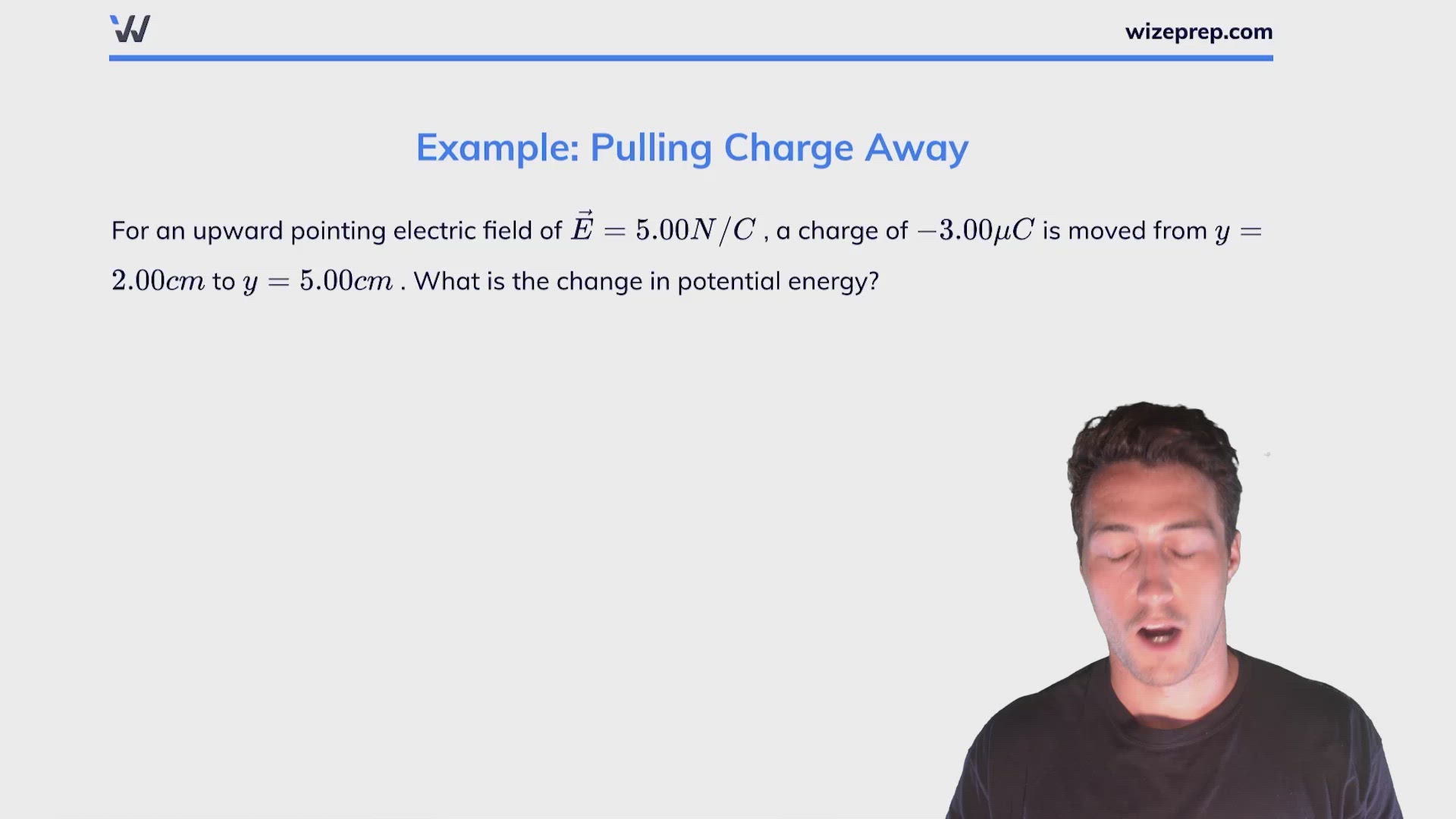
For an upward pointing electric field of , a charge of is moved from to . What is the change in potential energy?
The change in potential energy is related to the work done by the electric force
If the field is pointing upward, then we know that the force is downward for an electric charge.
Since the charge is moved upward , we expect the work done to be negative. The force points down, and the displacement points up. So the work is going to be .
So the change in potential energy is .
Let's just think about this problem. The force that the charge is feeling is pointing downward. We can almost think of it like gravitation. As we lift it upward, we are increasing the potential energy (just like increasing height in a gravitational field).
Practice: Electric Potential Energy of Multiple Charges
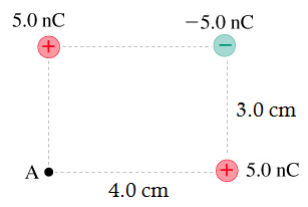
Three point charges are placed in a configuration as shown below. Find the electric potential energy of a 5.0µC charge placed at point A. This is not the same thing as asking for the total potential energy of the system! (Answer in Joules.)
Practice: Conservation of Energy
Two point charges are 20 cm apart and each carries 3 µc of positive charge. At a moment, they are released to move along the connecting line, repelling each other. What is the velocity of the charges when they are 60 cm apart? Consider the mass of the charges to be 0.3 grams.