Wize High School Grade 12 Physics Textbook > Magnetism
Magnetic Force on a Moving Charge

0:00 / 0:00
Magnetic Force on a Moving Charge
Magnetic forces only exist on charged particles while they are moving. This section explains the nature of this force.
- An electric charge moving in a magnetic field experiences a force proportional to the magnitude and velocity of the charge, as well as the magnetic field strength:
- The magnitude of the magnetic force can be calculated using the angle, 𝜃, between the velocity and magnetic field vectors:
- The direction of the magnetic force is found with the right-hand rule.

Watch Out!
If the charge is negative, then any results obtained with the right-hand rule need to be inverted.
More Properties of Magnetic Force
- If the velocity of the particle is parallel or anti-parallel to the magnetic field, then the magnetic force is zero.
- Uncharged particles do not feel a force produced by the magnetic field.
Wize Concept
Because the velocity and magnetic force directions are always perpendicular, the magnetic force never does work.
- If a charged particle is experiencing both an electric field and a magnetic field, then the total force is the vector sum of the two forces.
Wize Tip
This last equation is sometimes called the Lorentz force.

0:00 / 0:00
Example: Electron Moving Through Uniform Magnetic Field
An electron moves perpendicular to a uniform magnetic field which exerts a magnetic force on the electron shown in the figures below. In each case, find the direction of the magnetic field?
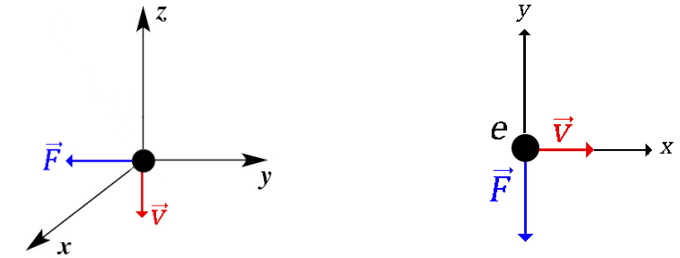
For the diagram on left side:
Right hand rule (RHR) for positive charge is
If the charge is negative, the final answer should be flipped.
Thus, if this was a positive charge, the F would have been along +Y axis. This mean, RHR indicated that B must be into the page or -X axis.
For the diagram on right side:
Right hand rule (RHR) for positive charge is
If the charge is negative, the final answer should be flipped.
Thus, if this was a positive charge, the F would have been along +Y axis. This mean, RHR indicated that B must be into the page or -Z axis.
Practice: Magnetic Force (Conceptual)
Which of the following statements is true for a charged particle moving in a constant magnetic field (perpendicular to the direction of motion)? Select all true statements.
0:00 / 0:00
Example: Magnetic Force Direction
Consider the following experiment. A charge enters a magnetic field and collides with a sensor as shown in the diagram. If the particle takes the trajectory shown, what is the sign of the charge?
Hint: The magnetic field is pointing into the page. We know this because of the X symbols. If the field was pointing out of the page, there would instead be dots instead.
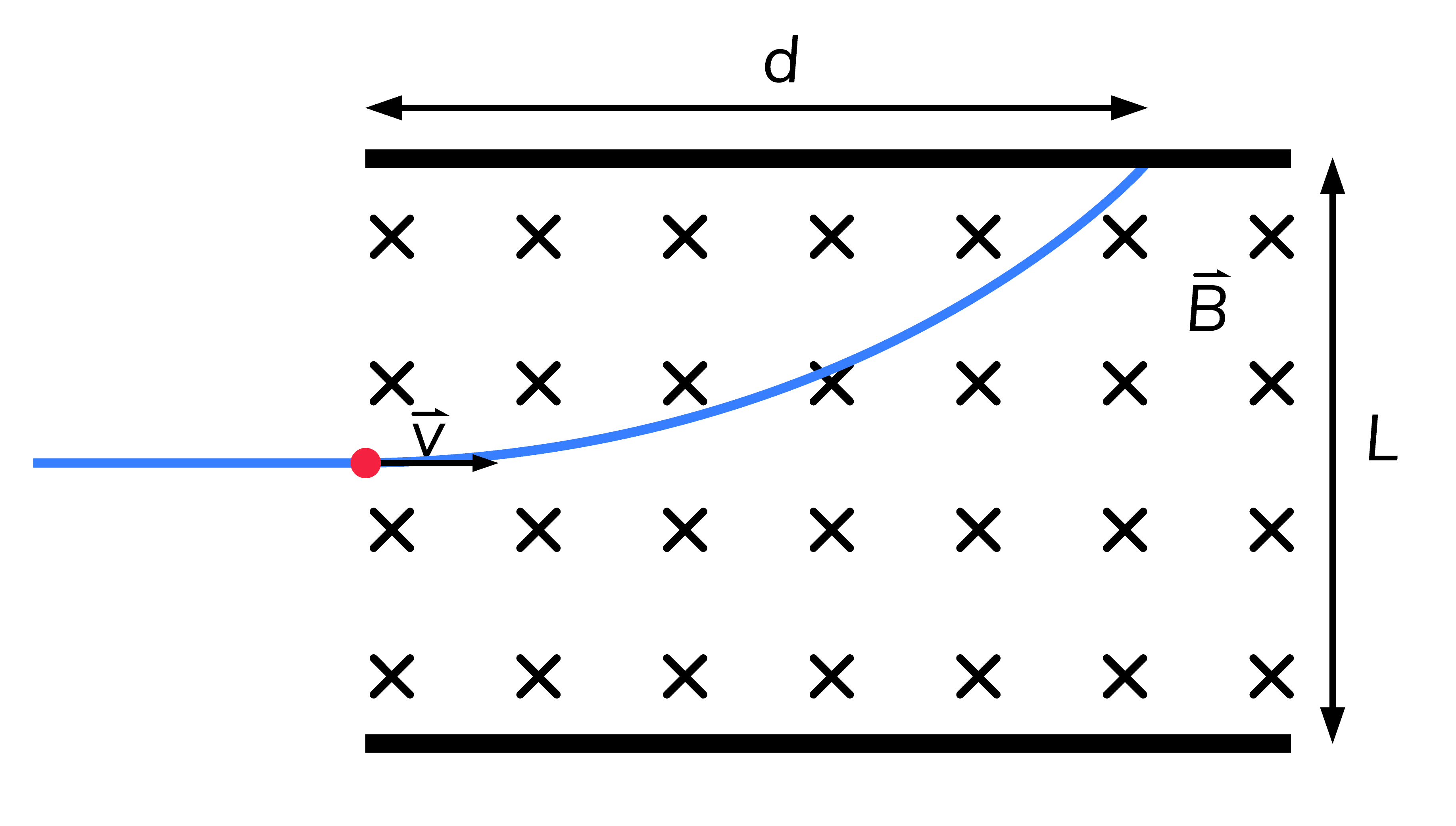
Use the right-hand rule with v and B as given, and your thumb will point upward. This means that if the charge is positive, then the force should point upward.
Since the trajectory shows acceleration in the upward direction, we know that the magnetic force on this particle is upward.
Since our right-hand rule and the drawn trajectory result in the same force, we know that the charge must be positive.
(If our right-hand rule had given the opposite result of the drawn trajectory, then the charge would have been negative.)
Practice: Moving Charge through Electric and Magnetic Field
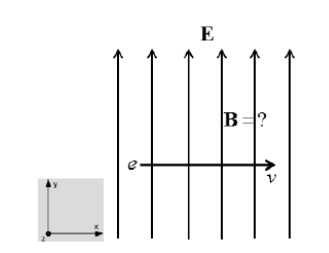
- In the figure, an electron is moving with velocity along +x-axis through uniform electric and magnetic fields. Find the direction of the magnetic field.
- The magnitudes of are given . Find the speed such that the electron remains traveling along the x direction.
Direction of magnetic field in left figure