Wize High School Grade 12 Physics Textbook > Magnetism
Charged Particle Motion in a Magnetic Field

0:00 / 0:00
Circular Motion in a Magnetic Field
When charged particles move in magnetic fields, they exhibit circular motion. As a result, we can use kinematics to gain a deeper understanding of magnetic fields.
- If the magnetic force is the only force acting on a charge, then the acceleration must be perpendicular to the field and the velocity.
- Because the acceleration and velocity are perpendicular, the direction of motion is constantly changing.
- The result is uniform circular motion with respect to the magnetic field direction. This is sometimes called cyclotron motion.

- We can use Newton's 2nd Law and the formula for centripetal acceleration to find the radius of the motion:
Watch Out!
In this equation, it's important to note that only the component of the velocity perpendicular to the magnetic field is used. It is possible for a charged particle to also have a parallel component, which results in helical motion.
- We can take this analysis a step further to find the period (T) of the circular motion, which is the time required for one full circle.
- The frequency (f) of the circular motion is the inverse of the period, and represents how many full circles are completed per second:
- The angular frequency can also be defined:
Wize Tip
Units for these three quantities:
- Period is measured in units of time (e.g. seconds)
- Frequency is measured in inverse time, with the standard unit of Hertz (Hz).
- Angular frequency is measured as radians per second.

0:00 / 0:00
Example: Circular Motion in a Magnetic Field
A positively charged particle of 2.01 x 10⁻⁵ C and mass 7.52 x 10⁻¹⁰ kg is travelling at a velocity of 2.0 x 10² m/s in the positive horizontal direction (to the right). It enters a uniform magnetic field of 1.50 T. The B field is due north (upwards).
a) What is the force on the particle as it enters the magnetic field?
b) Find the radius of the circular path traversed by the particle in the magnetic field.
Part a)
The formula for magnetic force is:
Because magnetic force is a vector, we need to determine both the magnitude and direction. We can determine the direction by using the right-hand rule. If you point your four fingers in the direction of the velocity (right) and curl your fingers in the direction of the magnetic field (up), your thumb points out of the page. Since the charge is positive, we can keep this result.
For the magnitude, we can substitute the values directly into the formula (the velocity and magnetic field vectors are perpendicular):
Part b)
For the radius of the path, we can use the equation (for extra practice, let's derive it from Newton's 2nd law again):
0:00 / 0:00
Example: Comparing Two Charged Particles
Two particles of the same charge, 𝑞−, are undergoing cyclotron motion within a uniform magnetic field that is pointing in the +𝑧-direction. The first particle has a mass of 𝑚 and travels at a speed of 𝑣 while the second particle has a mass of 1/2 𝑚 and is traveling at a speed of 3𝑣. What is the radius of motion of the second particle (𝑅2) in terms of the radius of motion of the first particle?
The radius of the first particle can be written in terms of the variables given in the question. We'll use the subscript 1 to indicate that it's for the first particle.
For the second particle, we'll substitute the mass and speed with the information given in the question.
In the last step, we substituted our result for particle 1 to get a direct comparison between the two radii to get the final answer. We see that the second particle has a larger radius of curvature by 1.5 times (or a factor of 3/2).
Practice: Circular Paths of Three Charged Particles
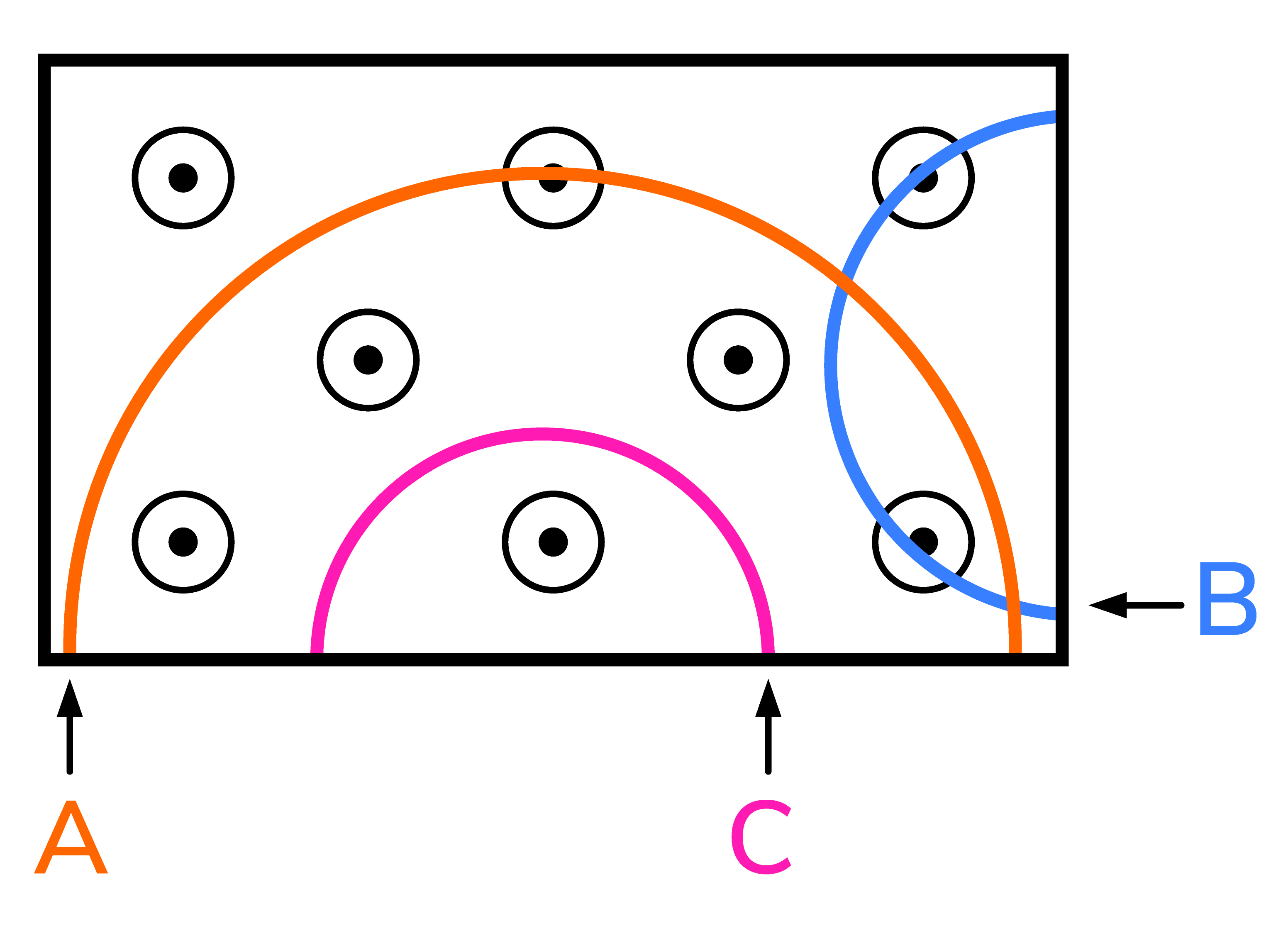
Consider three charges moving in the plane of the page through a magnetic field of constant strength that points out of the page. The paths are drawn below and have arrows showing where the motion begins, to indicate the direction of the motion (e.g. part A is clockwise).
- Charge 1 has charge +Q, speed V, and mass 2M.
- Charge 2 has charge +Q, speed 2V, and mass 2M.
- Charge 3 has charge –Q, mass M, and speed 2V.
Match each of the three paths with one of these descriptions.
A.
Path B
B.
Path A
C.
Path C
Charge 1
Charge 2
Charge 3
Practice: Circular Motion for Electrons and Protons
Consider an electron initially moving to the right at a speed of . The electron encounters a magnetic field pointing out of the page of strength .
a) What is the radius of the circular path of the electron? What is the direction of the motion?
b) Without doing any calculations, describe how the circular motion of a proton would be similar or different to the circular motion of the electron from part (a).
Part a) - radius
Practice: Circular Motion of Electron
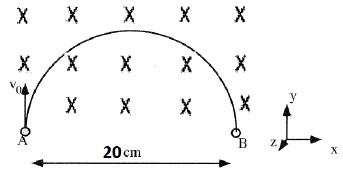
An electron moves in a constant magnetic field (B=0.114 mT) as shown below.
A) What is the speed of the electron?
B) How long does it take for the electron to leave the field?
C) If we assume that magnetic field covers everywhere, what would be the angular velocity of the rotation?
Practice: Electric and Magnetic Fields on Proton
A proton is travelling along straight line and enters a region where both electric and magnetic field co-exist. It is observed that proton does not change its line of motion and moves on straight line. If the velocity of the proton is 6.0×10⁶ m/s, and the magnitude of electric field 6000 N/C, what is the magnitude of the magnetic field?