Wize High School Grade 12 Physics Textbook > Work and Energy
Orbital Energies
0:00 / 0:00
Orbital Energies
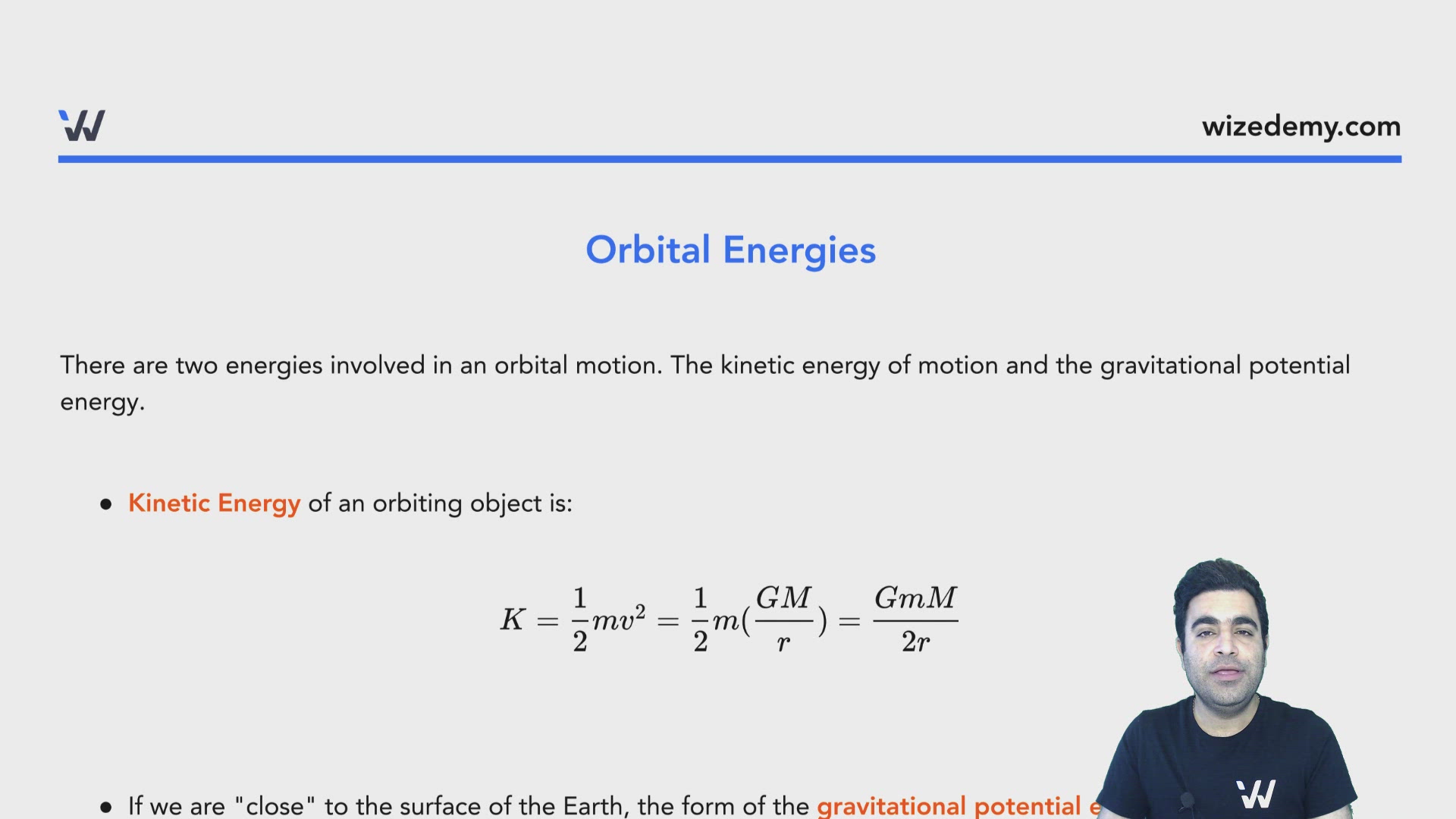
There are two energies involved in an orbital motion. The kinetic energy of motion and the gravitational potential energy.
- Kinetic Energy of an orbiting object is:
- If we are "close" to the surface of the Earth, the form of the gravitational potential energy is
where h is the height above the surface. For the general form, we would have to use the general form of .
- But if we are far away from Earth's surface, we have to use the general form of gravitational potential energy:
where "height" is now denoted as a radius (which is measured from the centre of the masses).
Some notes:
- Why is it negative!? In the mgh form, we used the Earth's surface as a "zero" reference point. But for the more general form, the reference point (zero point) is set where the force is totally gone, which is when . As the objects get closer and closer , we should have less and less energy (more negative), so our expression has a negative sign.
- As per Newton's law of universal gravity, this exists for every pair of massive object, and not just planets and stars!
- As a result, the total mechanical energy is:
The total mechanical energy determines the shape of the orbit:
- E < 0, then the orbit is closed, the object will be bound to the planet.
- E = 0, then the orbit is parabolic. The object will fly away.
- E > 0, then the orbit is hyperbolic. The object will fly away.
Wize Tip
The shape of the orbits comes from much more complicated maths, but you can interpret it like the balancing of kinetic/potential energy (the negative part comes from the potential energy).
At E < 0, the speed and the gravitational pull balances out, and the object will not fling off. At E = 0, this is just when the object is just fast enough to fling away, etc.
0:00 / 0:00
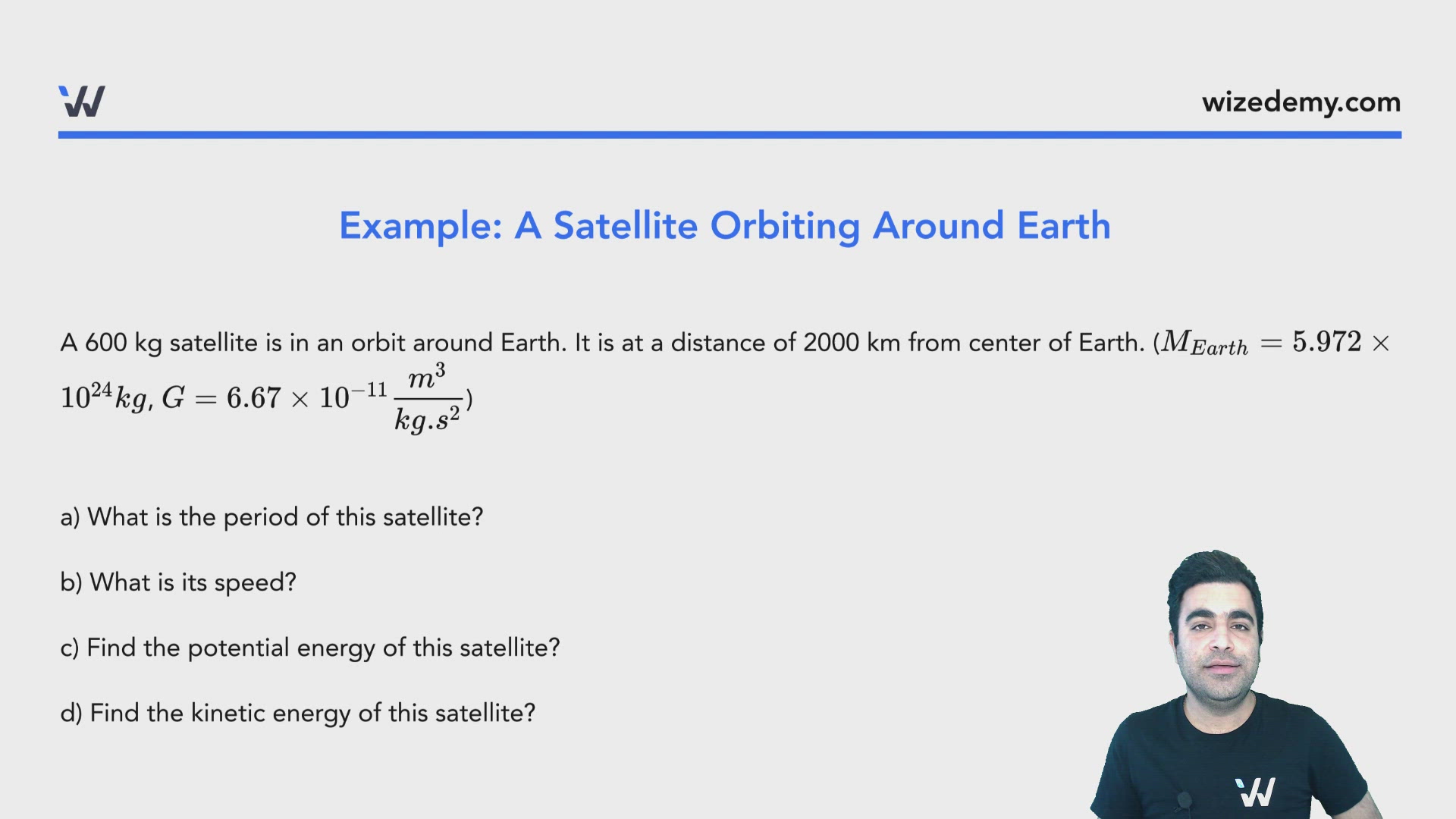
Example: A Satellite Orbiting Around Earth
A 600 kg satellite is in an orbit around Earth. It is at a distance of 2000 km from center of Earth. (, )
a) What is the period of this satellite?
b) What is its speed?
c) Find the potential energy of this satellite?
d) Find the kinetic energy of this satellite?
Solution:
This is the list of informations given to us:
Part a)
The circular motion of satellite is generated by gravitational force between Earth and satellite. So, the centripetal force is equal to . Furthermore, we can write down the speed of the satellite as where itself can be written in terms of period as: . So, we have:
From the first equation we can solve for speed of the satellite to be:
and from second equation:
By putting them equal to each other we have:
After some rearrangement we have:
From this equation we can solve for the period of the satellite to be:
Part b)
From above equations:
Part c)
Potential energy of an orbiting object is equal to:
After plugging numbers we get:
Part d)
Kinetic energy of a moving object is:
From the speed found in part b) we get: