Wize University Physics Textbook (Master) > Wave Optics
Single Slit Diffraction
Popular Courses
PHYSICS 1201A/B
Western University
Intro to Physics
University Study Guides
Grade 12 Physics
Ontario High School
Physics
General Course
High School Physics
US High School
Grade 12 Physics
Canada High School
PHYSICS 1A03
McMaster University
PHYS 130
University of Alberta
PHYS 101
McGill University
PHYS 131
University of British Columbia
Intro to Physics
University Study Guides
Physics 30
Alberta High School
PHYS 124
University of Alberta
PHY 1122
University of Ottawa
PHYS 142
McGill University
ENGG 212
University of Calgary
PHYS 102B
University of Victoria
PHYS 111
University of Victoria
PHYS 1050
University of Manitoba
PHYS 101
Simon Fraser University
Diffraction as the Spreading of Light
Diffraction is the spreading out of light as it passes through a small opening.
But why does this happen? Why does light "spread" in the first place?
According to Huygen's Principle, waves can be modeled as a bunch of little wavelets. That is, every point on a wave front can be considered a point source, generating secondary waves spreading away from it. As a wave spreads out, each wavelet is spreading out and interfering with all the others.
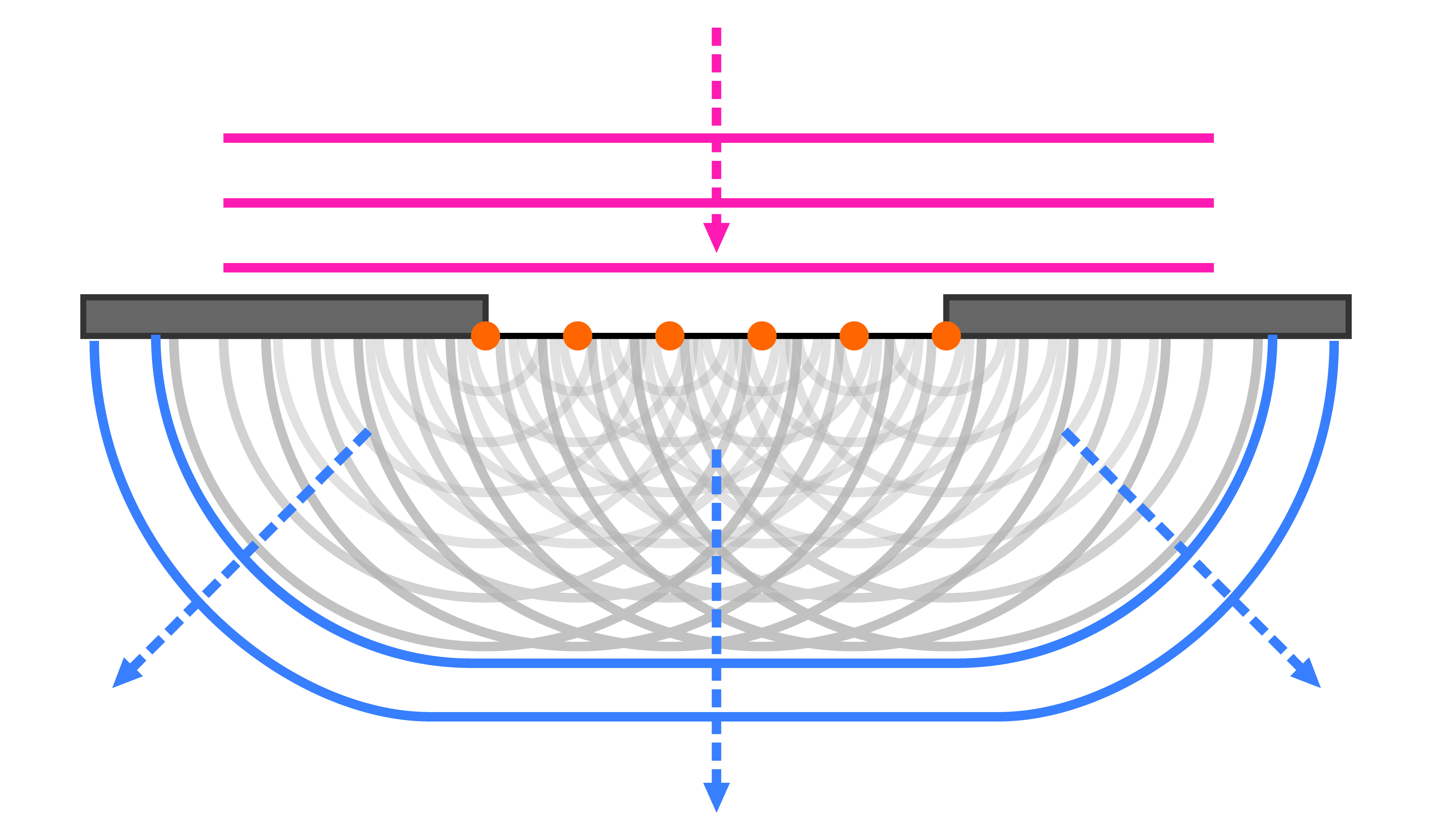
Actually, light can be described as either waves, or as particles called photons.
The fact that light can be accurately described either way is why we talk about the wave-particle duality.
Wize Concept
It turns out that this duality is true for all matter as well. Electrons behave like waves, and fundamentally, everything else does, too!
Single Slit Diffraction
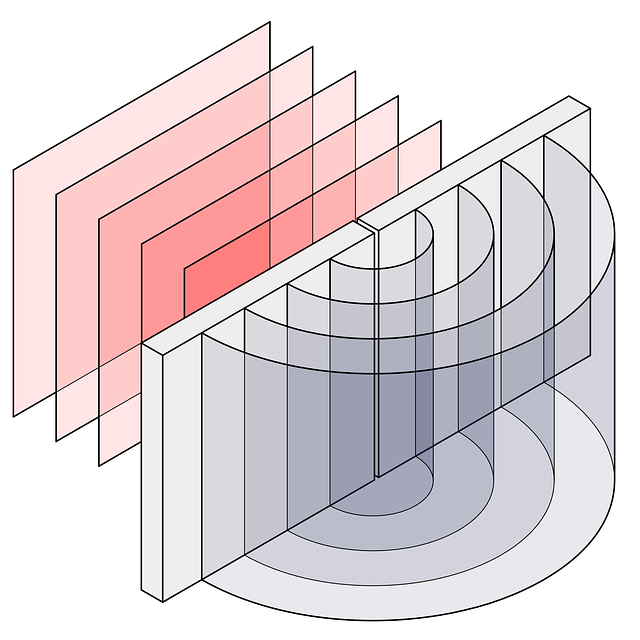
Light passing through a single slit can be viewed as an infinite number of point sources.
The resulting pattern shows a wide central maximum, followed by smaller bright fringes on either side.

Dark fringes on the screen correspond to destructive interference. The path difference is given by:
where is the width of the slit.
Exam Tip
- This formula is exactly the same as for the double slit, except that here is the width of the slit instead of the distance between the two slits .
- Also, here labels the dark spots, not the bright spots as the double slit.
Watch Out!
Because labels the dark spots on either side, and we have a bright spot at the center, cannot be zero.
Bright fringes on the screen correspond to constructive interference. The path difference is given by:
Exam Tip
To find the width of the central maximum, you need to find double the distance corresponding to the first dark fringe, which has .
Small Angle Approximation:
For we can use the small angle approximation, which gives us:
Therefore we have the angle and position on the screen for dark fringes:
and
for
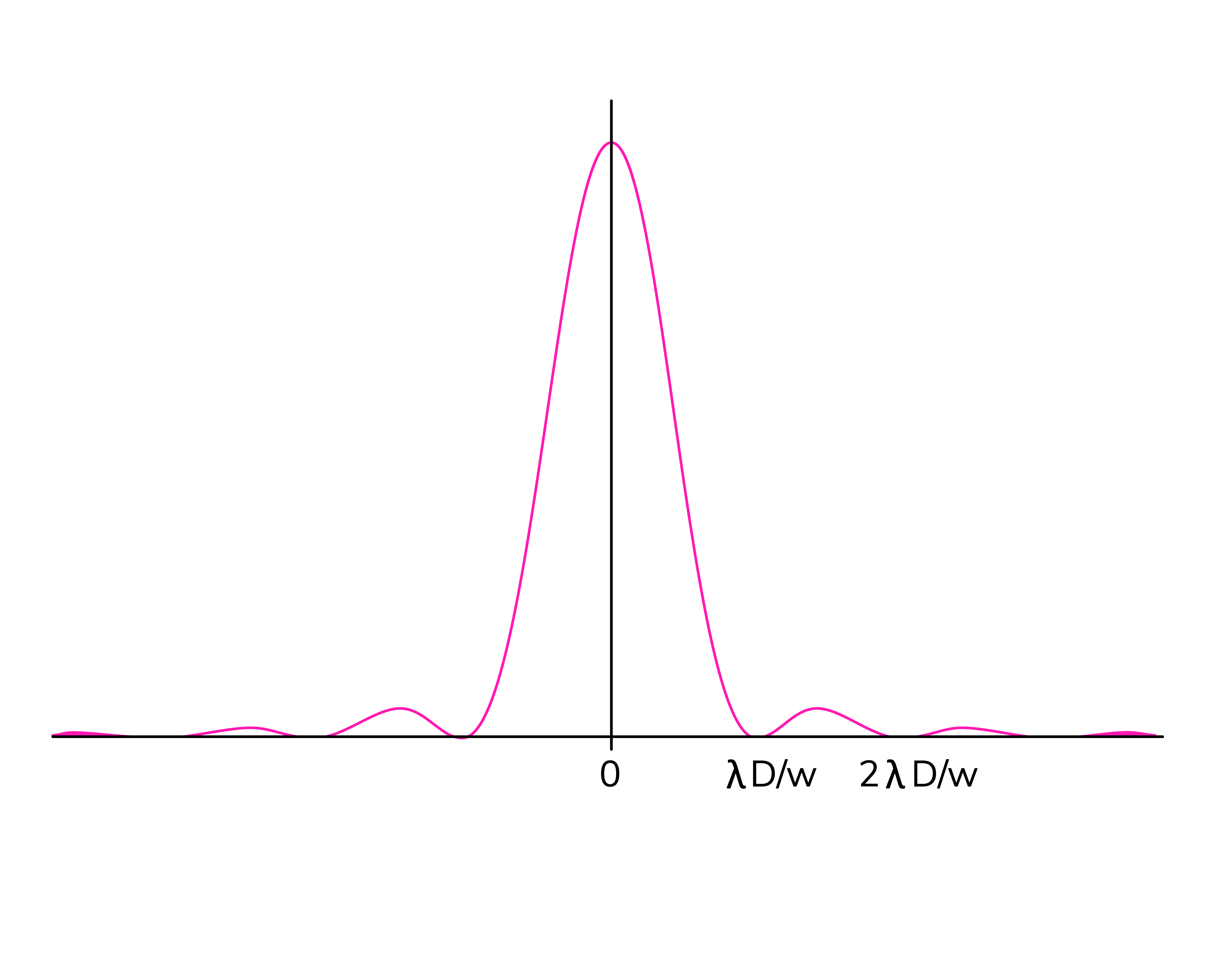
Wize Concept
As the width of the slit gets smaller (the slit gets narrower), the patter gets wider.
Example: Single vs. Double Slit
A two-slit apparatus with slits a distance of mm apart is illuminated by an Argon laser (wavelengthnm). Then, in a separate experiment a single slit of width mm is illuminated. The two intensity patterns are shown below. Which one is the single-slit?
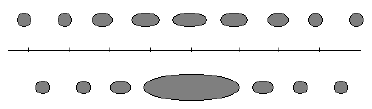
The lower one is the single slit because it has a much wider central max.
Practice: Single Slit
You shine light of nm upon a single slit located m away from a screen. On the screen, you measure the distance to the dark spot to be m.
a) What is the width of the slit?
b) What is the width of the central bright spot?