
0:00 / 0:00
Review of Previous Atomic Models
The History of Atomic Models followed the following order:
- Dalton's "Billiard Ball" Theory
- Thomson's "Plum Pudding" Theory
- Rutherford's "Planetary" Theory
- Bohr's Theory --> "Quantum" Theory
Watch Out!
Before we explain Bohr's Theory we need to understand the basics of Emission and Absorption Spectra
0:00 / 0:00
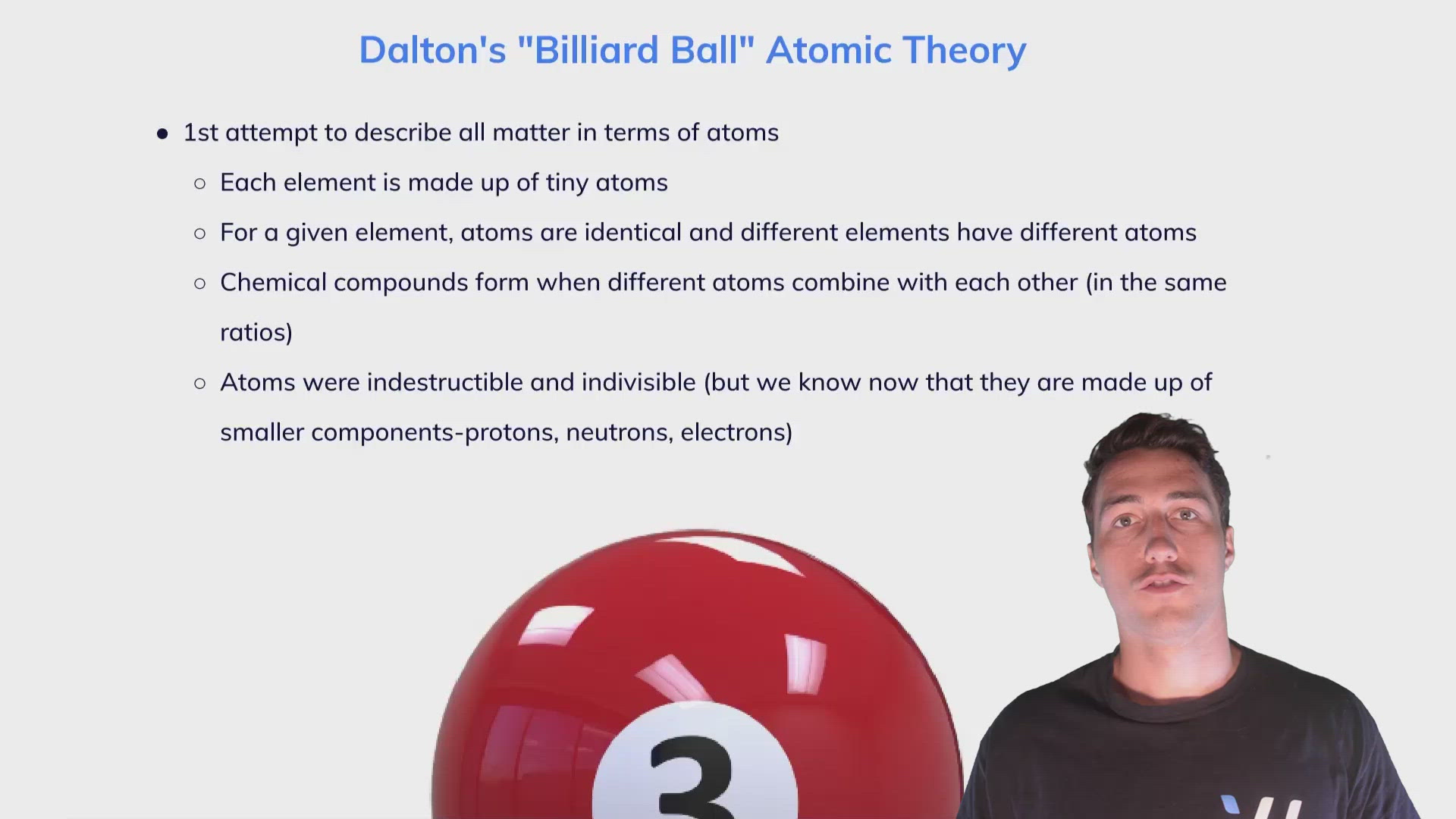
Dalton's "Billiard Ball" Atomic Theory
- 1st attempt to describe all matter in terms of atoms
- Each element is made up of tiny atoms
- For a given element, atoms are identical and different elements have different atoms
- Chemical compounds form when different atoms combine with each other (in the same ratios)
- Atoms were indestructible and indivisible (but we know now that they are made up of smaller components-protons, neutrons, electrons)


0:00 / 0:00
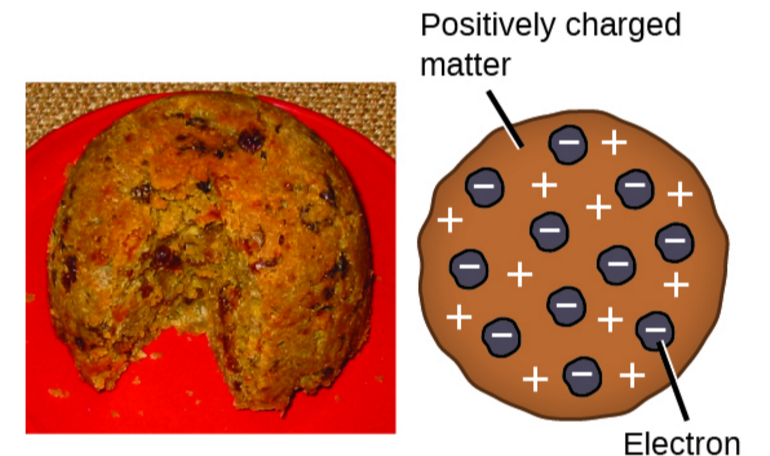
Thomson's "Plum Pudding" Atomic Theory
Discovery of the Electron: JJ Thomson's Experiment
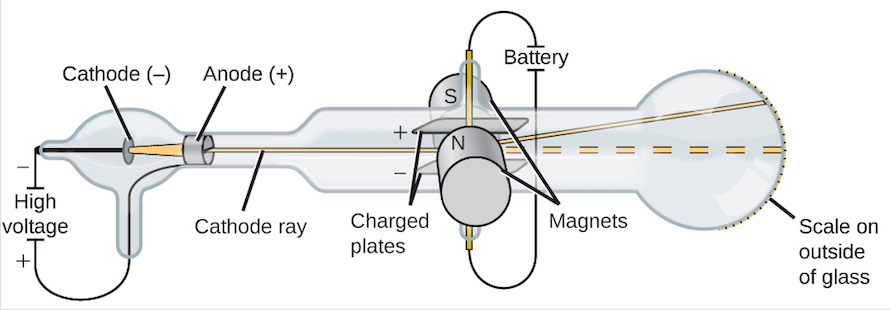
- There are 2 main components here:
- (+) and (-) charged plates
- magnets producing a magnetic field
- The cathode ray (with the electric plates) is deflected away from the negatively-charged electric plate, and towards the positively-charged electric plate. That means the charge of the particles in the ray is negative
- The cathode ray (with the magnets) is deflected as well further showing that the ray is negative
- These particles are electrons
- Since we knew at this point that all matter is made up of atoms and that a cathode ray is negative there is clearly some smaller part of an atom that is negatively charged
- This lead Thomson to define the Plum Pudding Model:
- Since electrons were negatively charged, and atoms were neutral he proposed that electrons were embedded in a positively charged atom

0:00 / 0:00
Millikan's Oil Drop Experiment
Millikan's Oil Drop Experiment was used to determine the elementary charge of an electron

- By this term, we knew (thanks to JJ Thomson) that there were electrons but we didn't know how negative these electrons were!
- Millikan used an atomizer (similar to a perfume dispenser) that sprayed tiny droplets of oil
- The droplets of oil were ionized so that they had an electric charge
- Some of these droplets passed through an opening and into an electric field created by parallel plates
- In the absence of the electric field, these droplets would fall due to the force of gravity
- With an electric field, Millikan could adjust the voltage so that these droplets were suspended in mid-air
- He balanced the gravitational force the droplet was experiencing with the electric force
- Millikan found that using the electric force and the gravitational force that the elementary charge for an electron was

0:00 / 0:00
Rutherford's Atomic Model
Discovery of the Nucleus: Rutherford's Gold Foil Experiment
- Rutherford wanted to learn more about the contents of an atom so he conducted the following experiment:


Why was this so shocking?!
- Currently, the Thomson model, had positive space (we didn't know there were protons!) with electrons scattered throughout
- If an alpha particle was to be shot into this space even if it hit an electron it would travel straight through as the mass of an alpha particle is much greater than the mass of an electron
- But that did not happen!
- Conclusions from the Rutherford gold experiment:
- The positive charge must be localized over a very small volume of the atom, which also contains most of the atom's mass. This was the nucleus!
- This explained how a very small fraction of the alpha particles were deflected drastically (due to the rare collision with a heavy and dense gold nucleus)
- Since most of the alpha particles passed straight through the gold foil, the atom must be made up of mostly empty space!
- When trying to figure out the mass of the nucleus, Rutherford was finding that the mass was too high compared to the mass of protons, which later led to the discovery of neutrons in the nucleus
- The discovery of the nucleus led to Rutherford creating a new atomic model which is referred to as the "planetary model" of the atom since it resembles planets orbiting the sun (with electrons being the planets, and the central body being the nucleus)

- The problem with this theory was that if electrons were orbiting a stationary nucleus they would eventually collide into the nucleus and cease to orbit (that would happen even if everything was of neutral charge!)
- Another problem with this theory was that electrons in motion around a central body (the nucleus) were thought to continuously give off radiation and lose energy
- If this was the case, the radius of the electron's orbit should get smaller and smaller until the electrons spiral into the nucleus and destroys it-this does not happen!

0:00 / 0:00
The Basics of Absorption and Emission Spectra
Each atom has a unique absorption and emission spectrum.

Absorption Spectra
- We get an absorption spectrum by transmitting electromagnetic radiation (light) through a substance.
- The dark bands in the spectra represent all of the specific wavelengths of photons absorbed by the atom's electrons

Emission Spectra
- We get an emission spectrum by measuring the electromagnetic radiation (light) that is emitted from a substance
- The background is black and the coloured bands represent the wavelengths of photons that were emitted from this atom's electrons

0:00 / 0:00
Bohr's Atomic Model
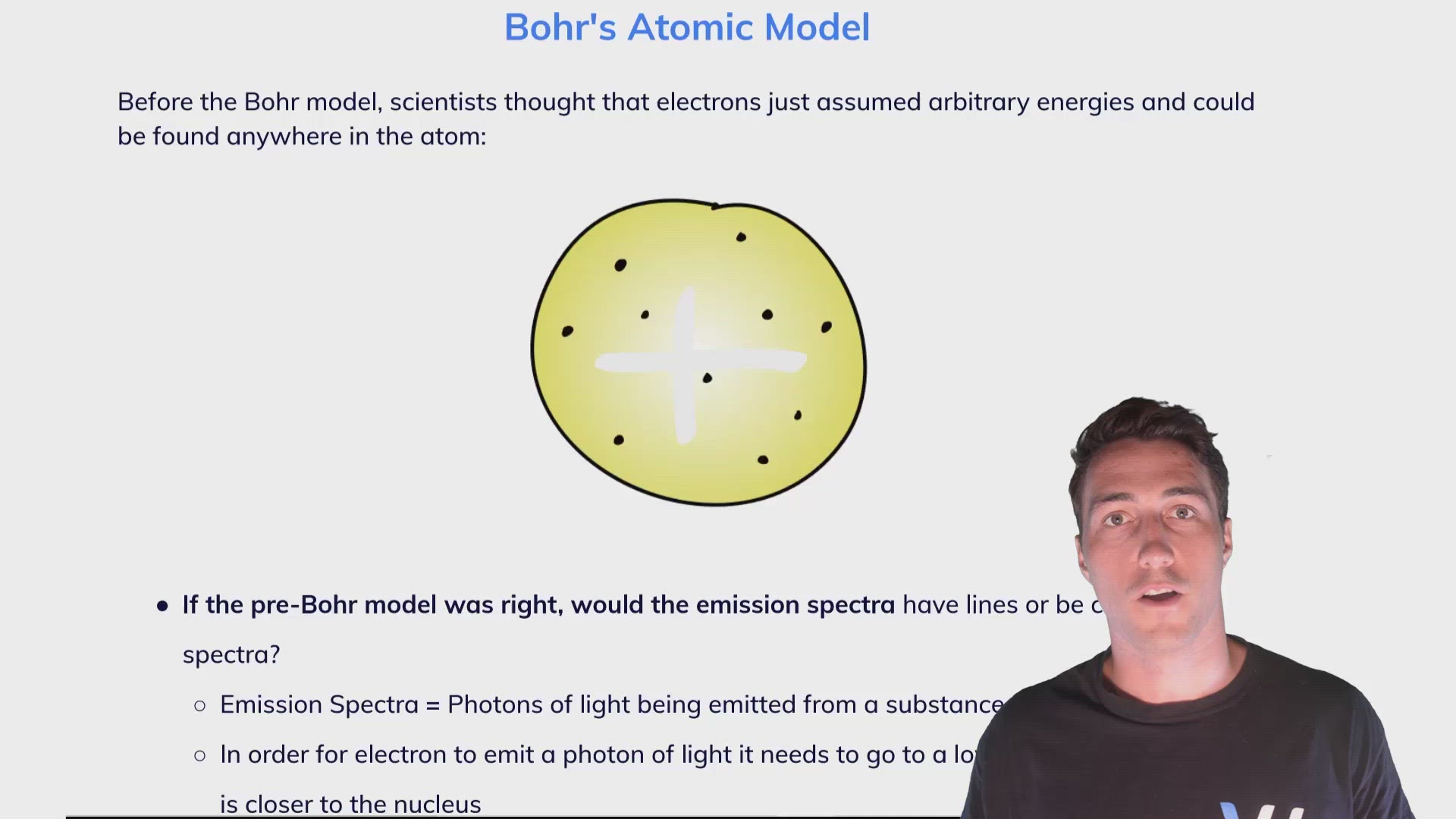
Before the Bohr model, scientists thought that electrons just assumed arbitrary energies and could be found anywhere in the atom:
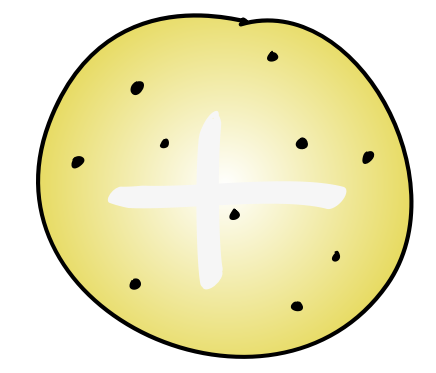
- If the pre-Bohr model was right, would the emission spectra have lines or be continuous spectra?
- Emission Spectra = Photons of light being emitted from a substance
- In order for electron to emit a photon of light it needs to go to a lower energy state which is closer to the nucleus
- Since electrons could be going to any point surrounding the nucleus the emission spectra would be continuous
- Niels Bohr realized that the existing atomic model was inconsistent with emission spectra data. Why did each element have a unique emission spectra with photons of light being emitted with specific energies and wavelengths?
- Bohr realized that the electrons must have discrete energies in order to explain the emission spectra with photons with specific amounts of energy being released.
Bohr's Atomic Model
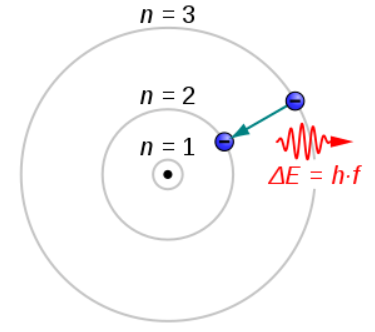
- Electrons orbit nucleus at fixed distances and in circular paths (like how planets orbit the sun!)
- Energy electrons have are quantized (only specific energies are allowed)
- When an electron emits a photon that photon will have the exact same energy as the energy the electron lost to go closer to the nucleus
- Shell's distance from nucleus determines energy (n=1, 2, 3, etc, higher n=higher energy shell)
- Gap between levels shrinks as n grows
- Bohr model is only accurate for atoms with 1 electron ("Bohr atoms")
- The Bohr model explains why only photons with certain energies are observed in the emission spectra!
Analogy: Staircase vs Ramp

- Ramp->if you're walking up a ramp, you could be 12cm, 17cm, or 20cm above the ground. (Pre-Bohr Model)
- Staircase-> if each step is 17cm high, you can never be standing 12 cm or 20cm above the ground (Bohr Model)
- The stairs are discrete units just like shells in an atom are discrete units.
- And just like how we can only be certain heights above the ground when we take the stairs, electrons can only be in certain shells with certain energies (can't be between two shells)
Watch Out!
Bohr's Model only worked for the Hydrogen atom as it only has 1 electron - it didn't work for the other elements. That's when the Quantum Theory of the atom took over!
0:00 / 0:00
Quantum Atomic Theory
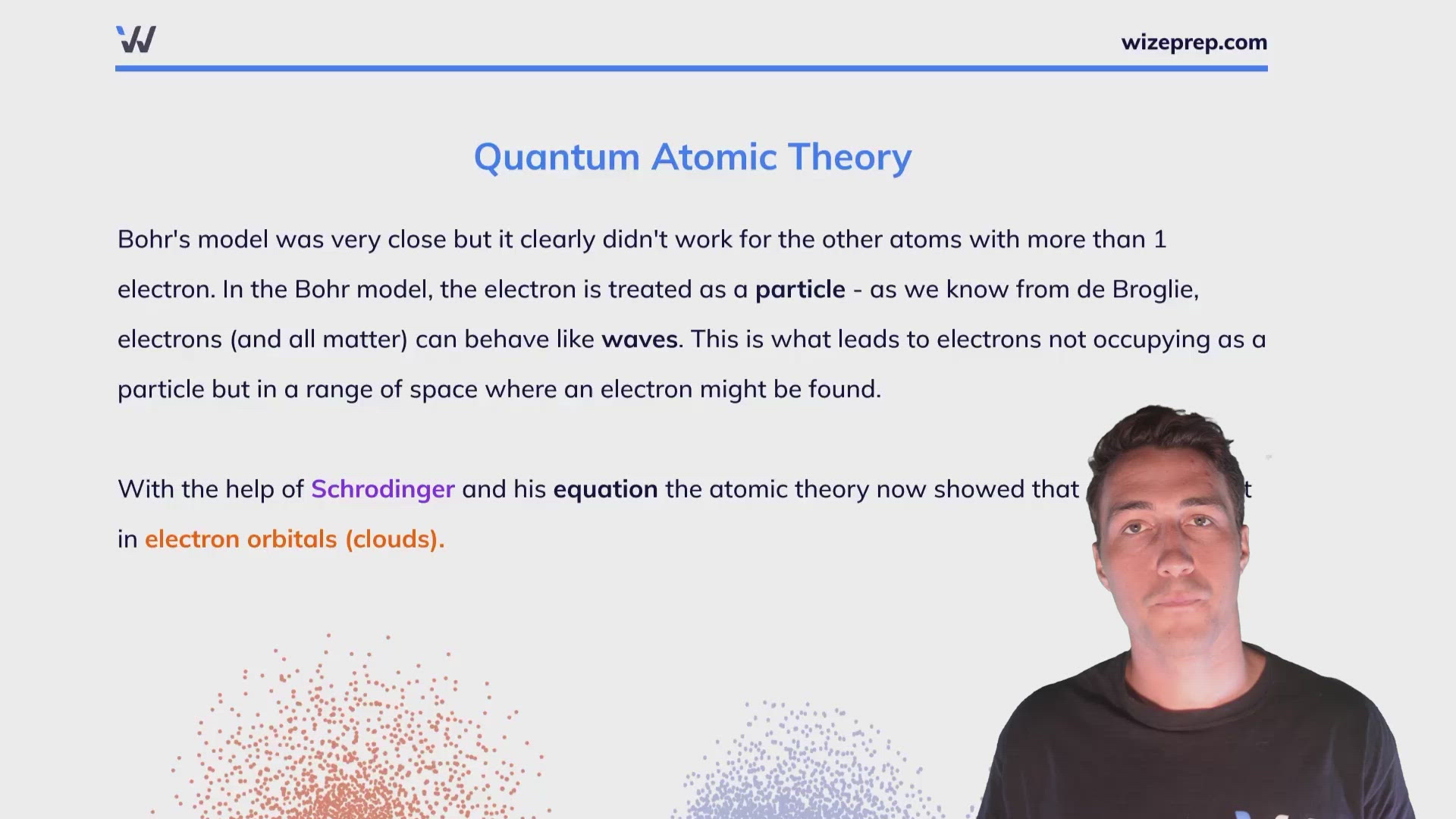
Bohr's model was very close but it clearly didn't work for the other atoms with more than 1 electron. In the Bohr model, the electron is treated as a particle - as we know from de Broglie, electrons (and all matter) can behave like waves. This is what leads to electrons not occupying as a particle but in a range of space where an electron might be found.
With the help of Schrodinger and his equation the atomic theory now showed that electrons exist in electron orbitals (clouds).

Watch Out!
This is where Physics starts turning more into Chemistry so we won't go too in-depth here as we just need to understand the basics of the currently accepted model of an atom