Wize High School Grade 12 Physics Textbook > Atomic Physics
Elementary Particles
0:00 / 0:00
Fermions and Bosons
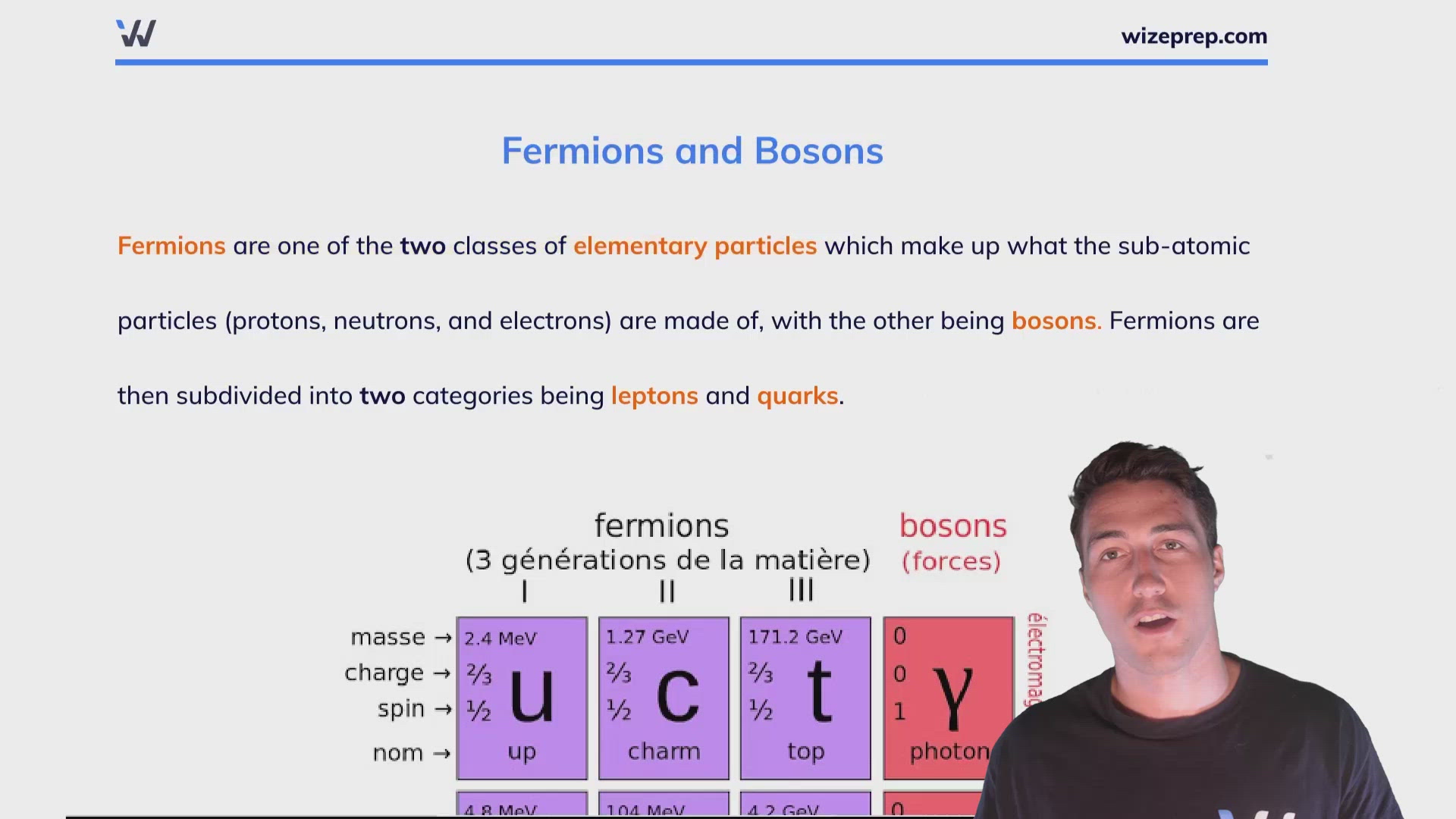
Fermions are one of the two classes of elementary particles which make up what the sub-atomic particles (protons, neutrons, and electrons) are made of, with the other being bosons. Fermions are then subdivided into two categories being leptons and quarks.

Hadrons
- A hadron is a subatomic composite particle made up of two or more quarks that are held together by the strong nuclear force (these are protons and neutrons!)
Quarks
- A proton is comprised of 2 up quarks and 1 down quark. The up quark has a charge of and a down quark has a charge of summing these up we get a value of or +1.
- A neutron is comprised of 1 up quark and 2 down quarks. Summing these up we get a value of 0
- Quarks are never found by themselves they are either in pairs or in triplets
- They have various intrinsic properties which include charge, spin, mass, and even colour
- These quarks were discovered by high energy particle accelerators that smash together protons, neutrons, electrons, and positrons
- These experiments are known as deep inelastic scattering which is an extension of Rutherford's scattering experiment except at much higher energies
- These experiments showed the existence of quarks that were only mathematically hypothesized due to the need to fulfill the conservation of mass, energy, momentum,
- They were discovered due to the requirement of the laws of physics, namely the conservation of momentum, charge, mass (and energy), among others