Popular Courses
COMM 217
Concordia University
ACCT 2301
The University of Texas at Dallas
Intro to Financial Accounting
General Course
COMM 293
University of British Columbia
Intro to Financial Accounting
University Study Guides
MGCR 211
McGill University
ACCT*1220
University of Guelph
Intro to Financial Accounting
University Study Guides
ACCT 217
University of Calgary
AP/ADMS 2500 3.00
York University
COMMERCE 1AA3
McMaster University
COMM 111
Queen's University
ADM 1340
University of Ottawa
BU127
Wilfrid Laurier University
ACCT 2301
Houston
ACCT 2301
Houston
COMM 1101
Dalhousie University
AFM 101
University of Waterloo
BUS 251
Simon Fraser University
AFA 100
Toronto Metropolitan University
0:00 / 0:00
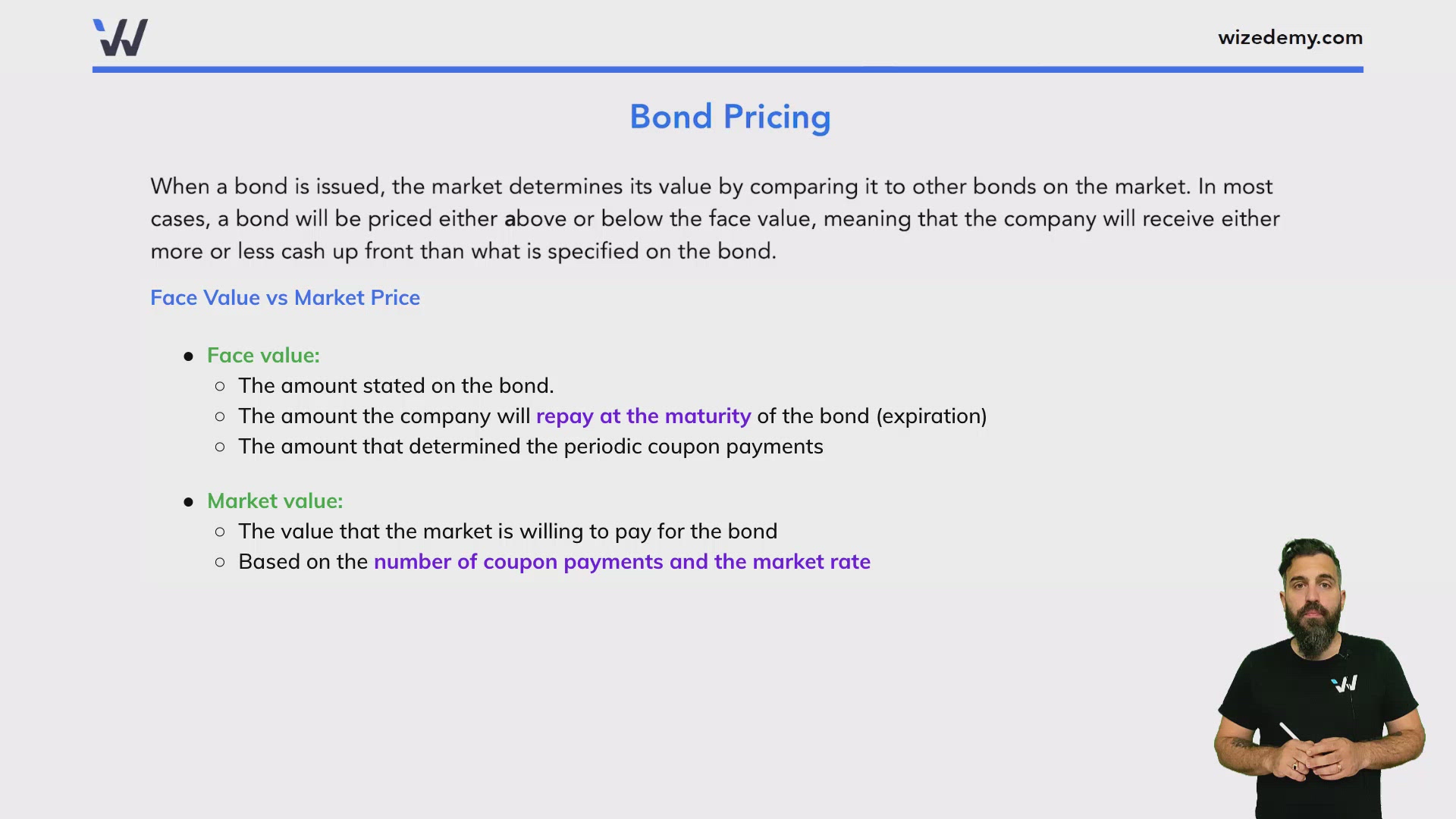
Bond Pricing
When a bond is issued, the market determines its value by comparing it to other bonds on the market. In most cases, a bond will be priced either above or below the face value, meaning that the company will receive either more or less cash up front than what is specified on the bond.
Face Value vs Market Price
- Face value:
- The amount stated on the bond.
- The amount the company will repay at the maturity of the bond (expiration)
- The amount that determined the periodic coupon payments
- Market value:
- The value that the market is willing to pay for the bond
- Based on the number of coupon payments and the market rate
The Market Rate
- Also called the yield or yield to maturity.
- The rate that determines the value of new bonds.
- The rate of return that investors expect to earn on a bond investment.
Comparing the Rates
- Coupon rate > Market rate:Premiumbond
- Market value of the bond is greater than the face value.
- More cash is received when the bond is sold (premium received).
- Coupon rate < Market rate:Discountbond
- Market value of the bond is lower than the face value.
- Less cash is received when the bond is sold (discount given).
- Coupon rate = Market rate:Parbond
- Market value of the bond is equal to the face value.
- The face value is received in cash when the bond is sold.
Calculating Market Value and Issue Price
- Market value is thepresent valueof all future payments.
- Future payments: Coupon payments and face value
- Use the present value factor tables.
- Rate: Periodic market rate
- Periods: Number of payments


Watch Out!
When calculating the present value , ALWAYS use the market rate, NOT the coupon rate.

0:00 / 0:00
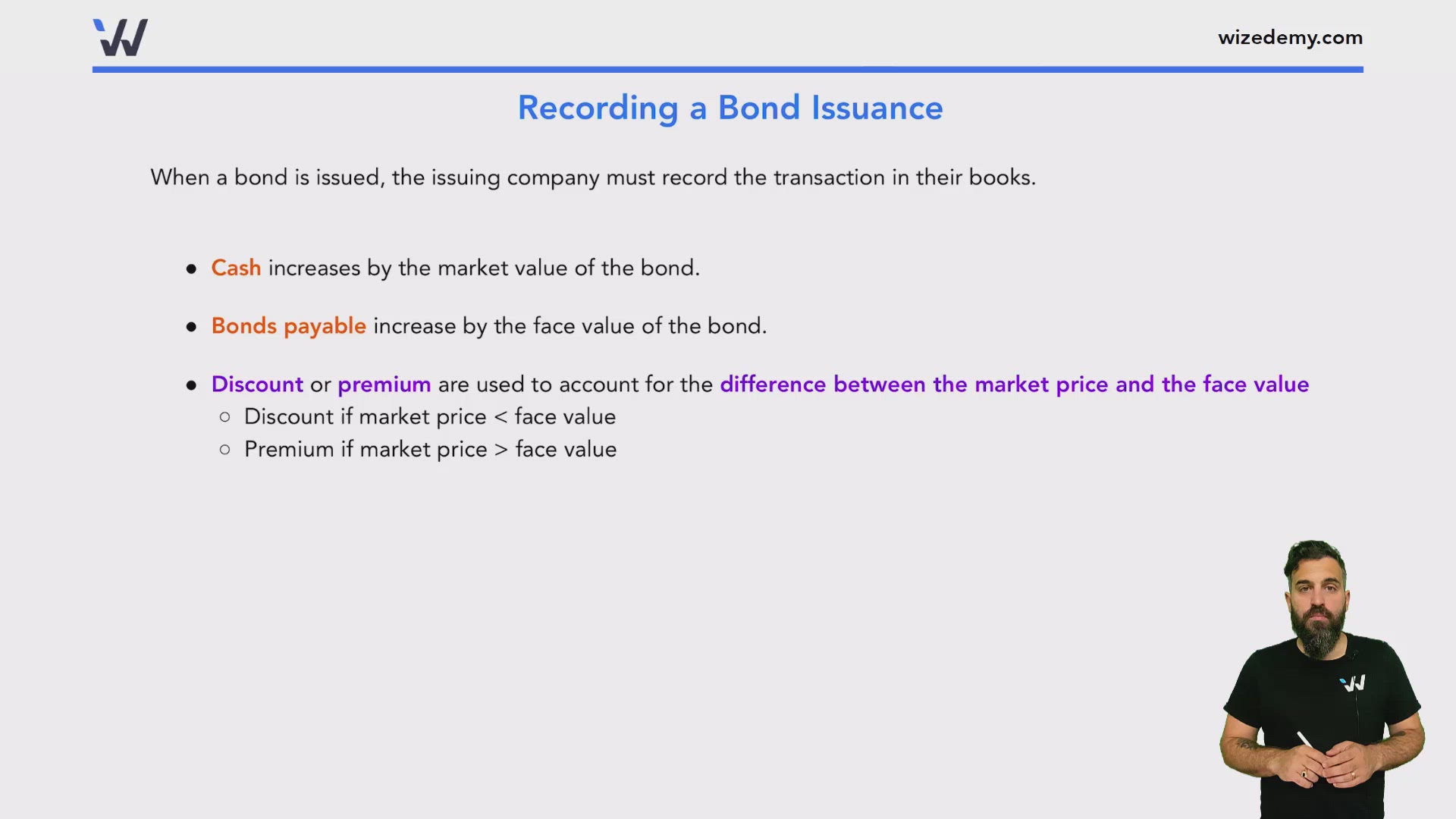
Recording a Bond Issuance
When a bond is issued, the issuing company must record the transaction in their books.
- Cash increases by the market value of the bond.
- Bonds payable increase by the face value of the bond.
- Discount or premium are used to account for the difference between the market price and the face value
- Discount if market price < face value
- Account name: Discount on bonds payable
- Contra-liability: Decreases the bond's carrying value
- Natural debit: Increases on the debit side and decreases on the credit side
- Premium if market price > face value
- Account name: Premium on bonds payable
- Liability: Increases the bond's carrying value
- Natural credit: Increases on the credit side and decreases on the debit side
Premium Bond

Discount Bond

Par Bond

0:00 / 0:00
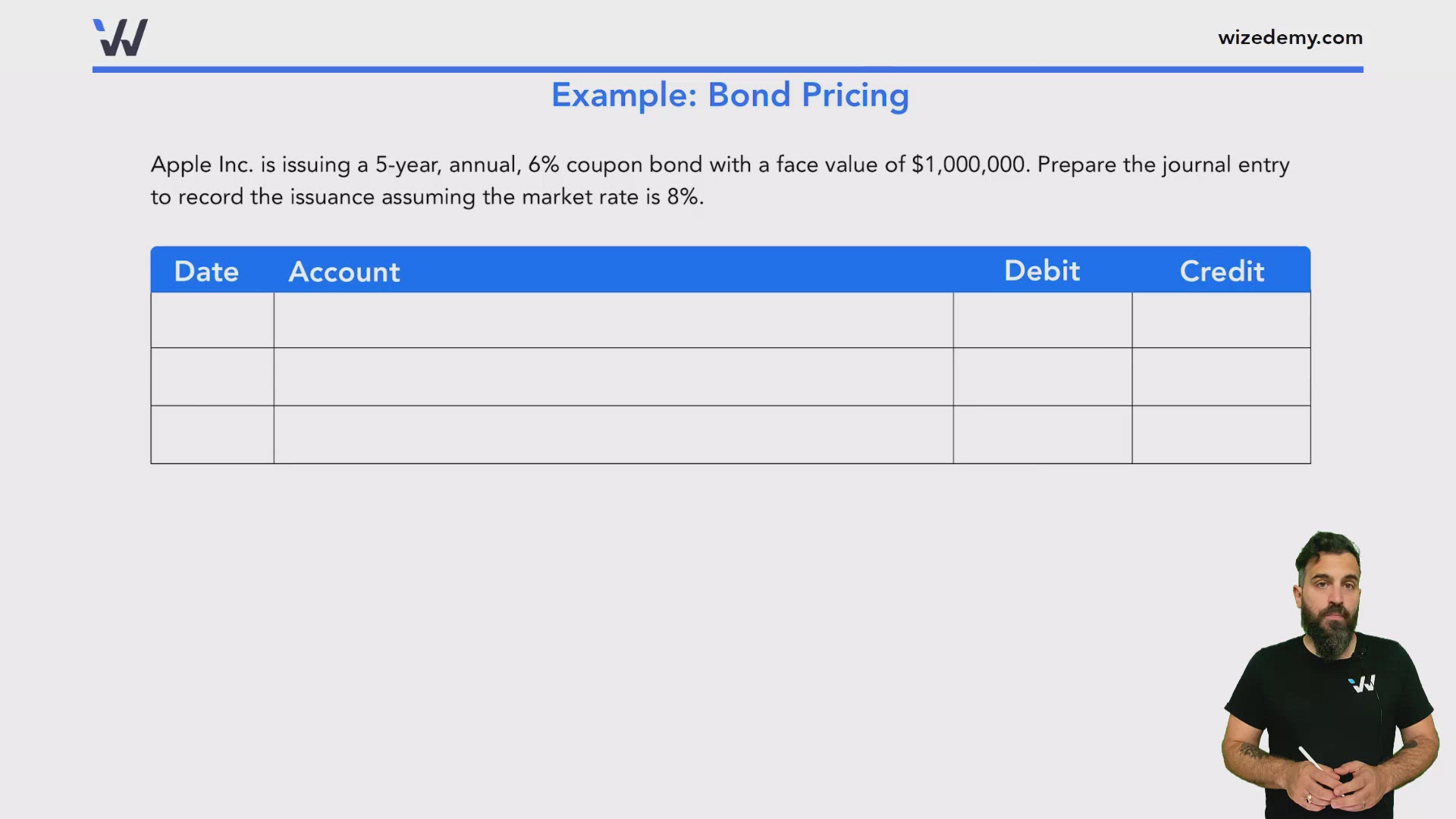
Example: Bond Pricing
Apple Inc. is issuing a 5-year, annual, 6% coupon bond with a face value of $1,000,000. Prepare the journal entry to record the issuance assuming the market rate is 8%.
Round present value factors to 4 decimal places and round answers to the nearest dollar.

0:00 / 0:00
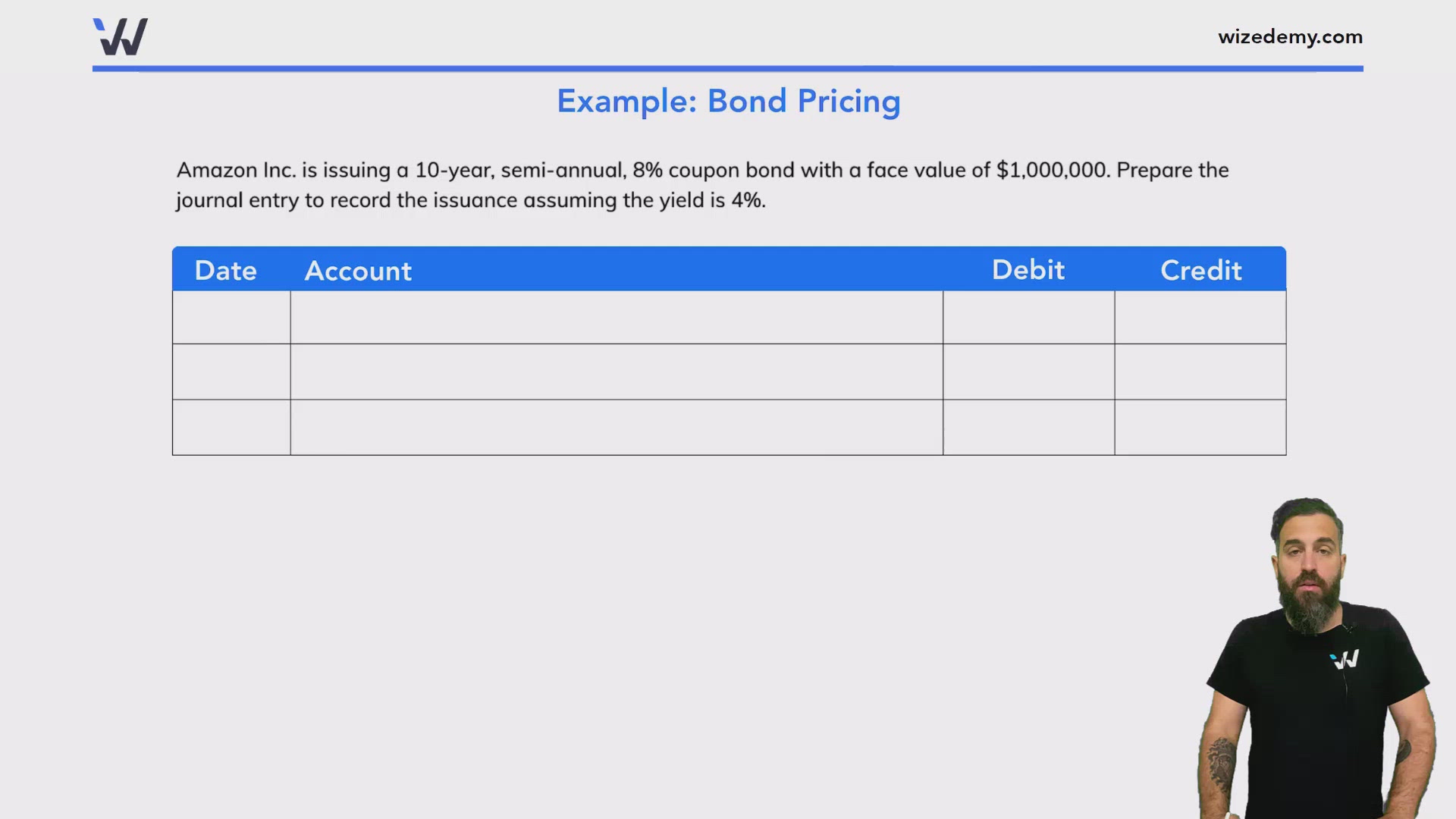
Example: Bond Pricing
Amazon Inc. is issuing a 10-year, semi-annual, 8% coupon bond with a face value of $1,000,000. Prepare the journal entry to record the issuance assuming the yield is 4%.
Round present value factors to 4 decimal places and round answers to the nearest dollar.

0:00 / 0:00
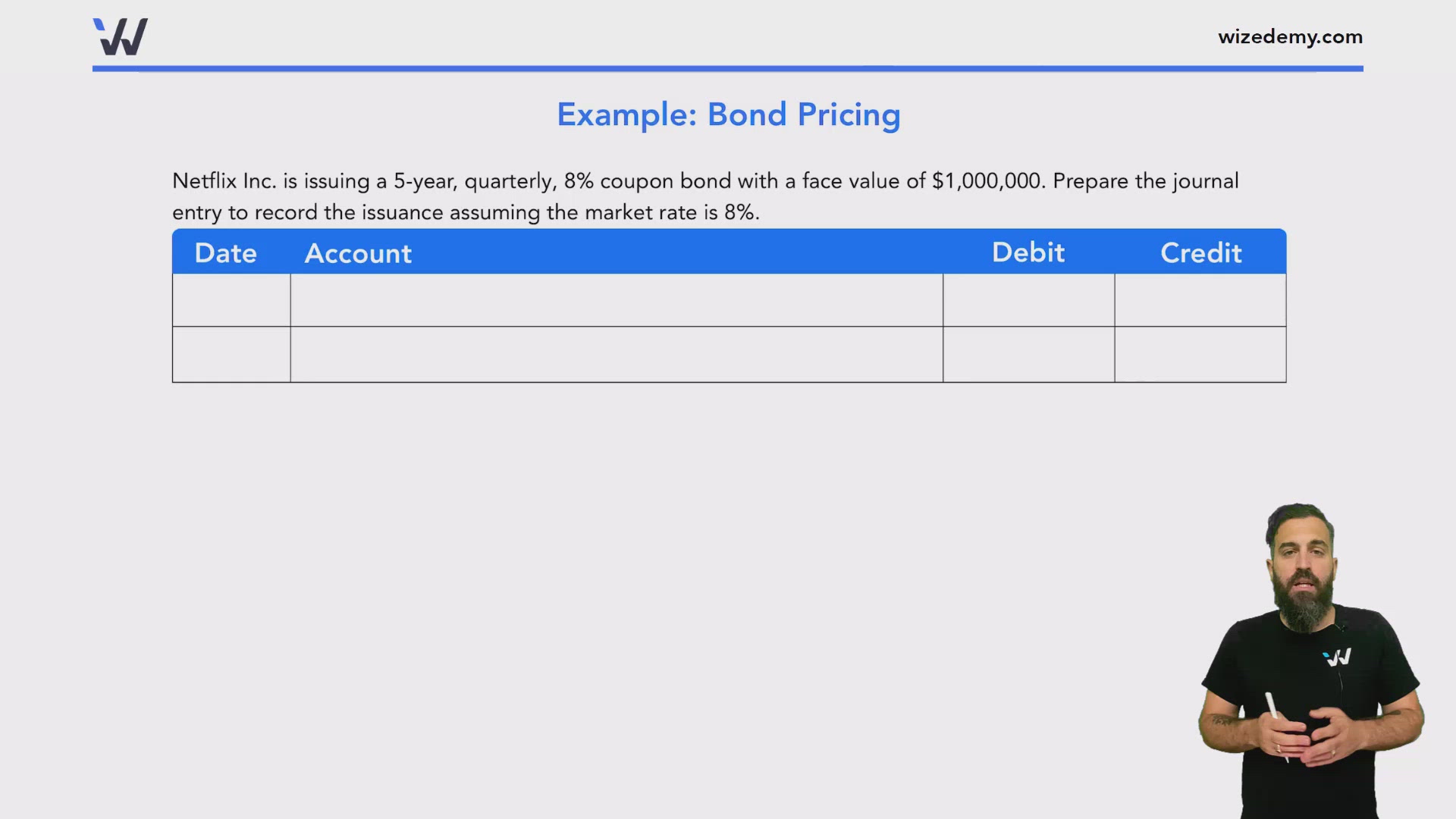
Example: Bond Pricing
Netflix Inc. is issuing a 5-year, quarterly, 8% coupon bond with a face value of $1,000,000. Prepare the journal entry to record the issuance assuming the market rate is 8%.
Round present value factors to 4 decimal places and round answers to the nearest dollar.

Practice: Bond Pricing
Determine the price of each of the following bonds and prepare the journal entries to record the issuance.
Bond #1
Face value: $500,000
Coupon rate: 7%
Payments: Semi-annual
Market rate: 6%
Maturity: 4 years
Round present value factors to 4 decimal places and round answers to the nearest dollar.
Present Value Factor Table
Table 1: Present Value of $1
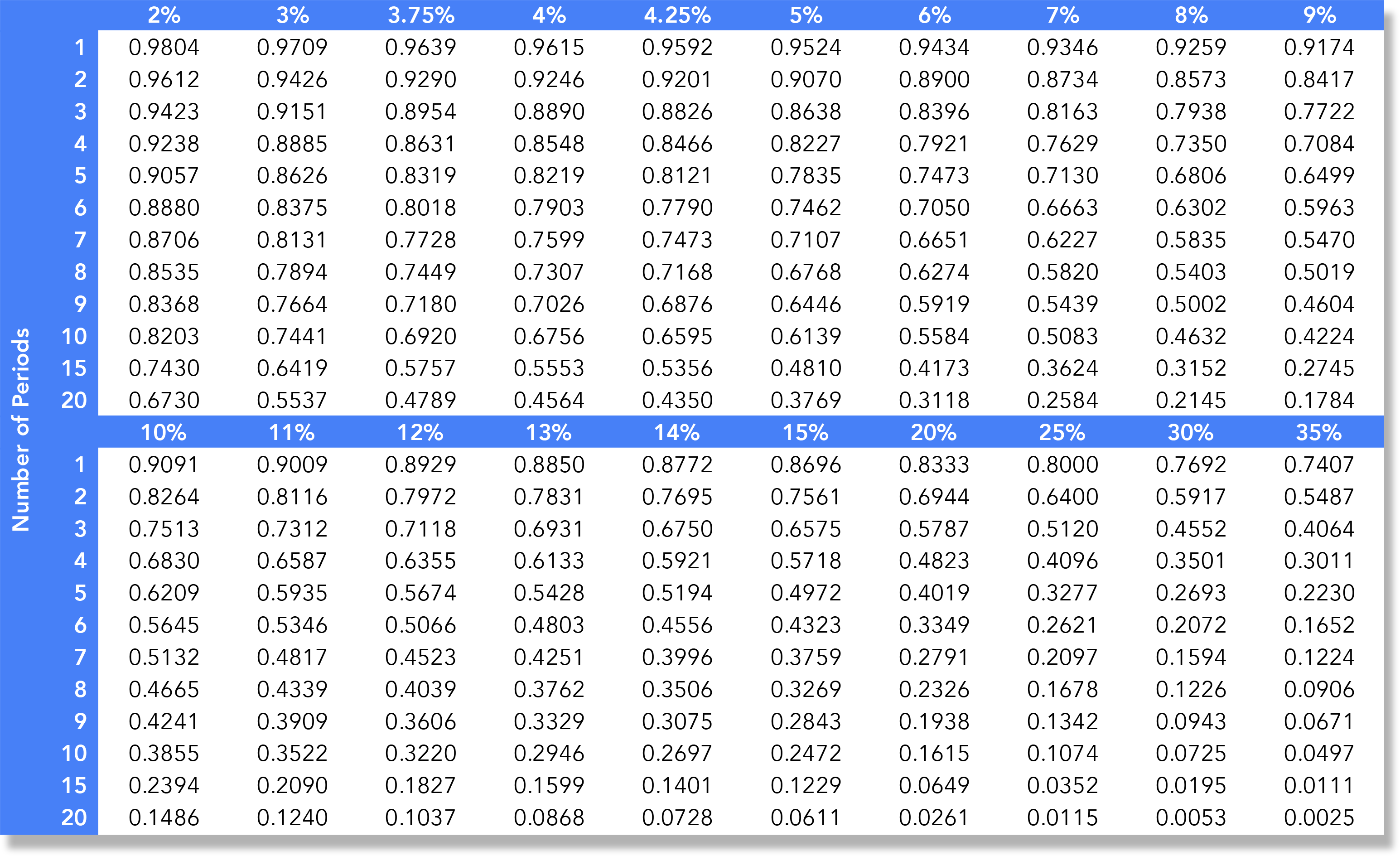
Table 2: Present Value of an Annuity of $1
