Wize University Introduction to Financial Accounting Textbook > Current Liabilities
Payroll Liabilities (US)
Popular Courses
ACCT 2301
The University of Texas at Dallas
Intro to Financial Accounting
General Course
Intro to Financial Accounting
University Study Guides
ACCT*1220
University of Guelph
Intro to Financial Accounting
University Study Guides
AP/ADMS 2500 3.00
York University
BU127
Wilfrid Laurier University
ACCT 2301
Houston
ACCT 2301
Houston
AFM 101
University of Waterloo
BUS 251
Simon Fraser University
AFA 100
Toronto Metropolitan University
BUSINESS 3321K
Western University
ACCT-1510
University of Windsor
ADMN 1221H
Trent University
ACC 110
Toronto Metropolitan University
ACC 1100
University of Manitoba
ACCT 1201
Northeastern University
SB/ACTG 2011 3.00
York University
ACC 221
Miami University - Ohio
0:00 / 0:00
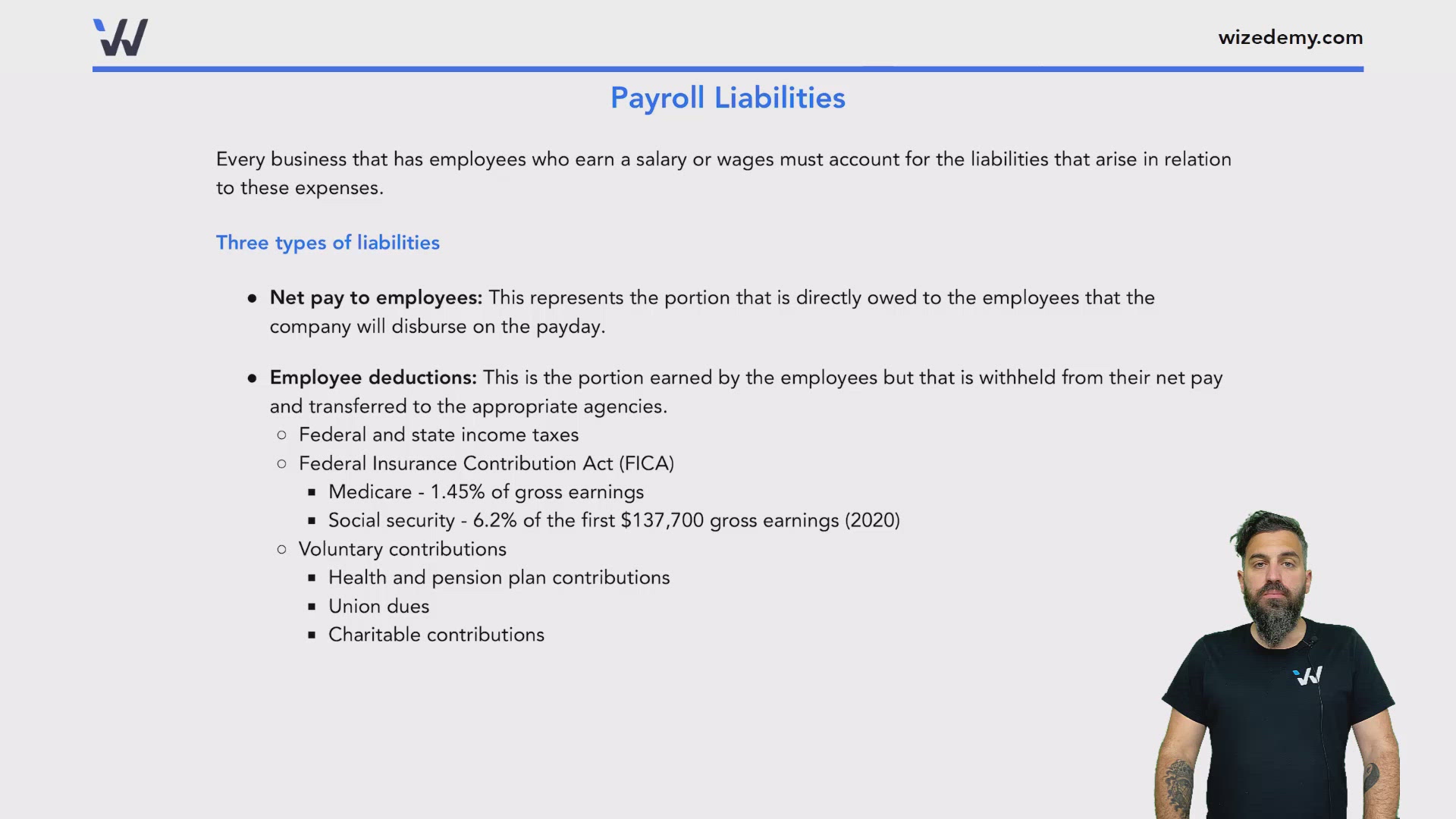
Payroll Liabilities
Every business that has employees who earn a salary or wages must account for the liabilities that arise in relation to these expenses.
Three types of liabilities
- Net pay to employees: This represents the portion that is directly owed to the employees that the company will disburse on the payday.
- Employee deductions: This is the portion earned by the employees but that is withheld from their net pay and transferred to the appropriate agencies.
- Federal and state income taxes
- Federal Insurance Contribution Act (FICA)
- Medicare - 1.45% of gross earnings
- Social security - 6.2% of the first $137,700 gross earnings (2020)
- Voluntary contributions
- Health and pension plan contributions
- Union dues
- Charitable contributions
- Additional payroll obligations: These are the additional obligations that are imposed on businesses by the government and other agencies.
- Federal and state unemployment taxes
- Federal Insurance Contribution Act (FICA)
- Medicare - 1.45% of employees' gross earnings
- Social security - 6.2% of the first $137,700 gross earnings by each employee (2020)
- Voluntary contributions
Wize Tip
Employee deductions are part of the Salaries and Wages Expense and additional payroll obligations are debited to Employee Benefit Expense.

0:00 / 0:00
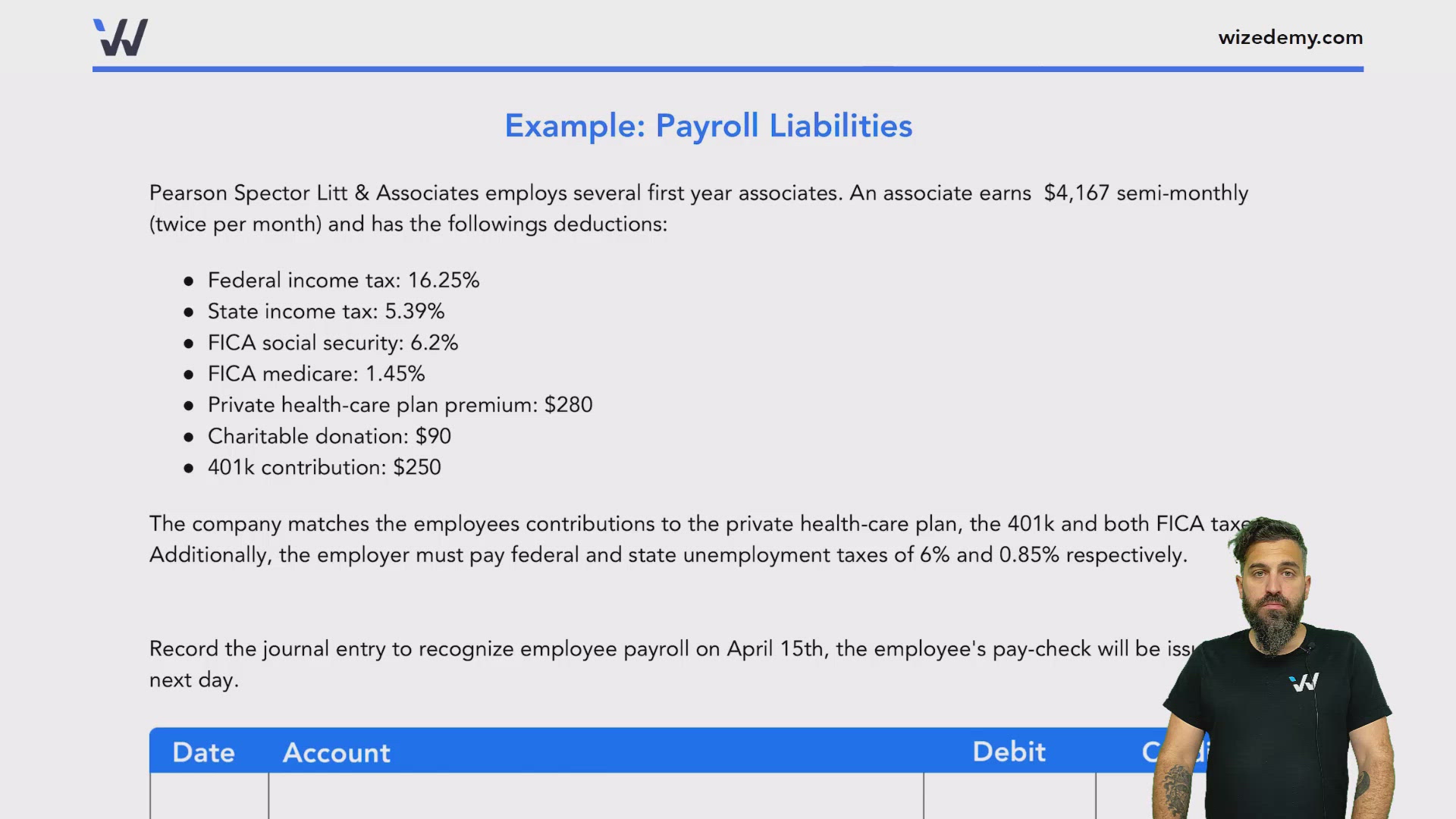
Example: Payroll Liabilities
Pearson Spector Litt & Associates employs several first year associates. An associate earns $4,167 semi-monthly (twice per month) and has the followings deductions:
- Federal income tax: 16.25%
- State income tax: 5.39%
- FICA social security: 6.2%
- FICA medicare: 1.45%
- Private health-care plan premium: $280
- Charitable donation: $90
- 401k contribution: $250
The company matches the employees contributions to the private health-care plan, the 401k and both FICA taxes. Additionally, the employer must pay federal and state unemployment taxes of 6% and 0.85% respectively.
Record the journal entry to recognize employee payroll on April 15th, the employee's pay-check will be issued the next day.

Record the journal entry to recognize the employer's additional payroll related expenses on April 15th.

Record the journal entry to recognize the issuance of the employee's pay in cash on April 16th.

Prepare the journal entry to recognize the remittance of all the payroll related liabilities to the appropriate agencies on April 16th.

Practice: Payroll Liabilities
Wize Corporation has only one employee, Mary. This employee earns $40 per hour and works 38 hours per week. The following payroll information is available:
- FICA social security 6.2% of gross pay
- FICA medicare 1.45% of gross pay
- Federal income tax 5% of gross pay
- State income tax 3.75% of gross pay
- Health-insurance premium $300 per pay-check
- Union dues $60 per pay-check
- Charitable contributions $70 per pay-check
The company matches the employee's charitable contributions and is responsible for 75% of the health-insurance premium.
If the employee receives a pay-check every 2 weeks, what is the net amount that she will receive in cash?