Wize University Introduction to Financial Accounting Textbook > Transaction Analysis
The Accounting Equation
Popular Courses
COMM 217
Concordia University
ACCT 2301
The University of Texas at Dallas
Intro to Financial Accounting
General Course
COMM 293
University of British Columbia
Intro to Financial Accounting
University Study Guides
MGCR 211
McGill University
ACCT*1220
University of Guelph
Intro to Financial Accounting
University Study Guides
ACCT 217
University of Calgary
AP/ADMS 2500 3.00
York University
ACCTG 211
University of Alberta
COMMERCE 1AA3
McMaster University
ACC 100
Toronto Metropolitan University
COMM 111
Queen's University
ADM 1340
University of Ottawa
BU127
Wilfrid Laurier University
ACCT 2301
Houston
ACCT 2301
Houston
RSM219H1
University of Toronto
COMM 1101
Dalhousie University
0:00 / 0:00
The Accounting Equation
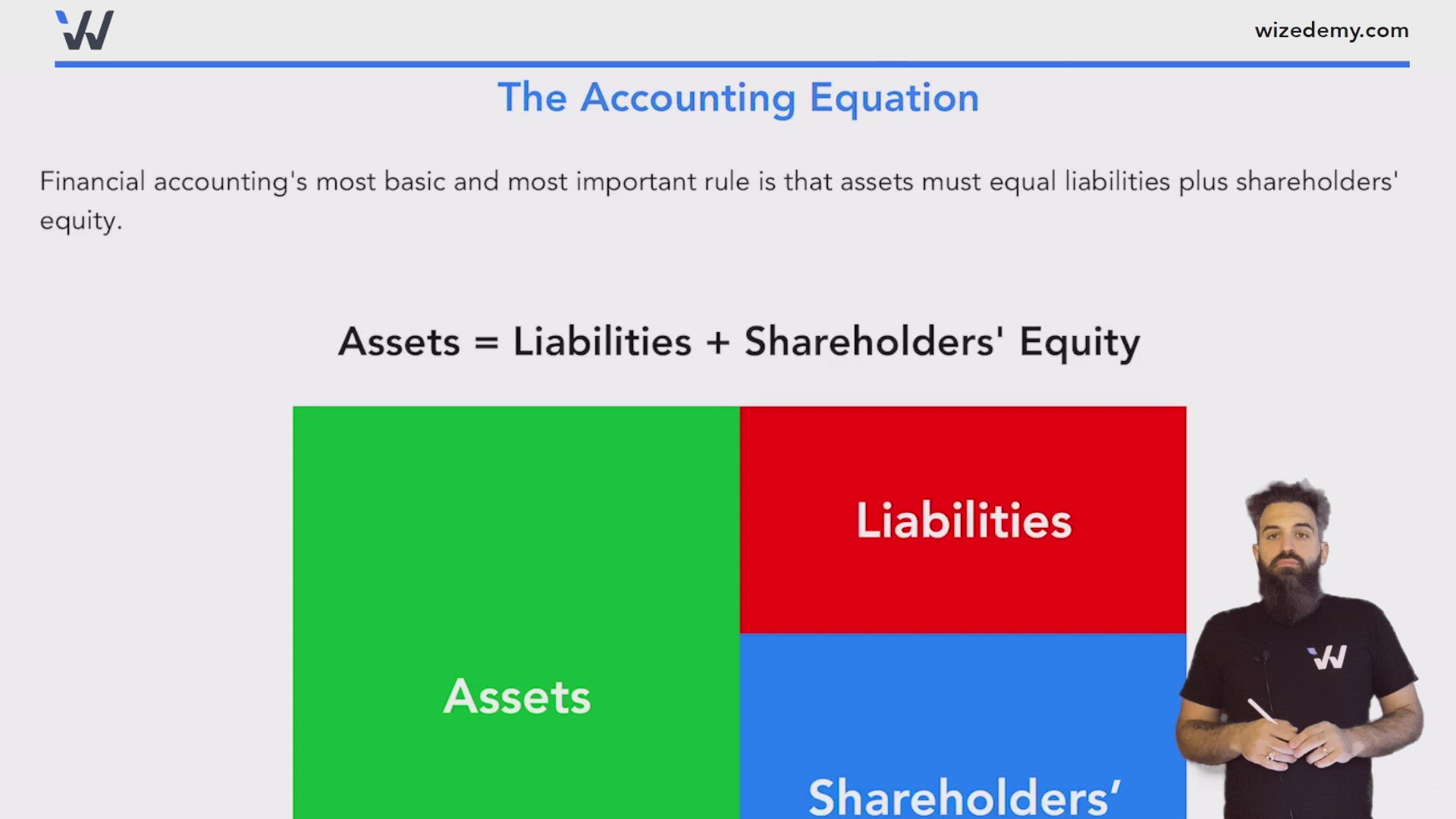
Financial accounting's most basic and most important rule is that assets must equal liabilities plus shareholders' equity.
Assets = Liabilities + Shareholders' Equity

- Describes who has rights to the company's assets
- Assets can be divided between credits (liabilities) and owners (equity)
- Describes how assets are purchased
- Can be purchased using debt (liabilities) or purchased by owners (equity).
Double-Entry Accounting System
- Based on the accounting equation
- Every transaction must affect at least two accounts.
- Accounting equation should always remain balanced.

0:00 / 0:00
The Expanded Accounting Equation
The purpose of the expanded accounting equation is to show you how revenues, expenses and dividends are related to the overall accounting equation.
- Revenues increase retained earnings and shareholders' equity
- Expenses decrease retained earnings and shareholders' equity
- Dividends decrease retained earnings and shareholders' equity

Practice: The Accounting Equation
Select the correct answer for each of the following questions
If a transactions increases an asset by $10,000, then which of the following would keep the accounting equation in balance?
Select all that apply.