Wize University Introduction to Financial Accounting Textbook > Shareholders' Equity
Retiring No-Par Value Shares
Popular Courses
COMM 217
Concordia University
ACCT 2301
The University of Texas at Dallas
Intro to Financial Accounting
General Course
COMM 293
University of British Columbia
Intro to Financial Accounting
University Study Guides
MGCR 211
McGill University
ACCT*1220
University of Guelph
Intro to Financial Accounting
University Study Guides
AP/ADMS 2500 3.00
York University
COMMERCE 1AA3
McMaster University
COMM 111
Queen's University
ADM 1340
University of Ottawa
BU127
Wilfrid Laurier University
ACCT 2301
Houston
ACCT 2301
Houston
COMM 1101
Dalhousie University
AFM 101
University of Waterloo
BUS 251
Simon Fraser University
AFA 100
Toronto Metropolitan University
BUSINESS 3321K
Western University
0:00 / 0:00
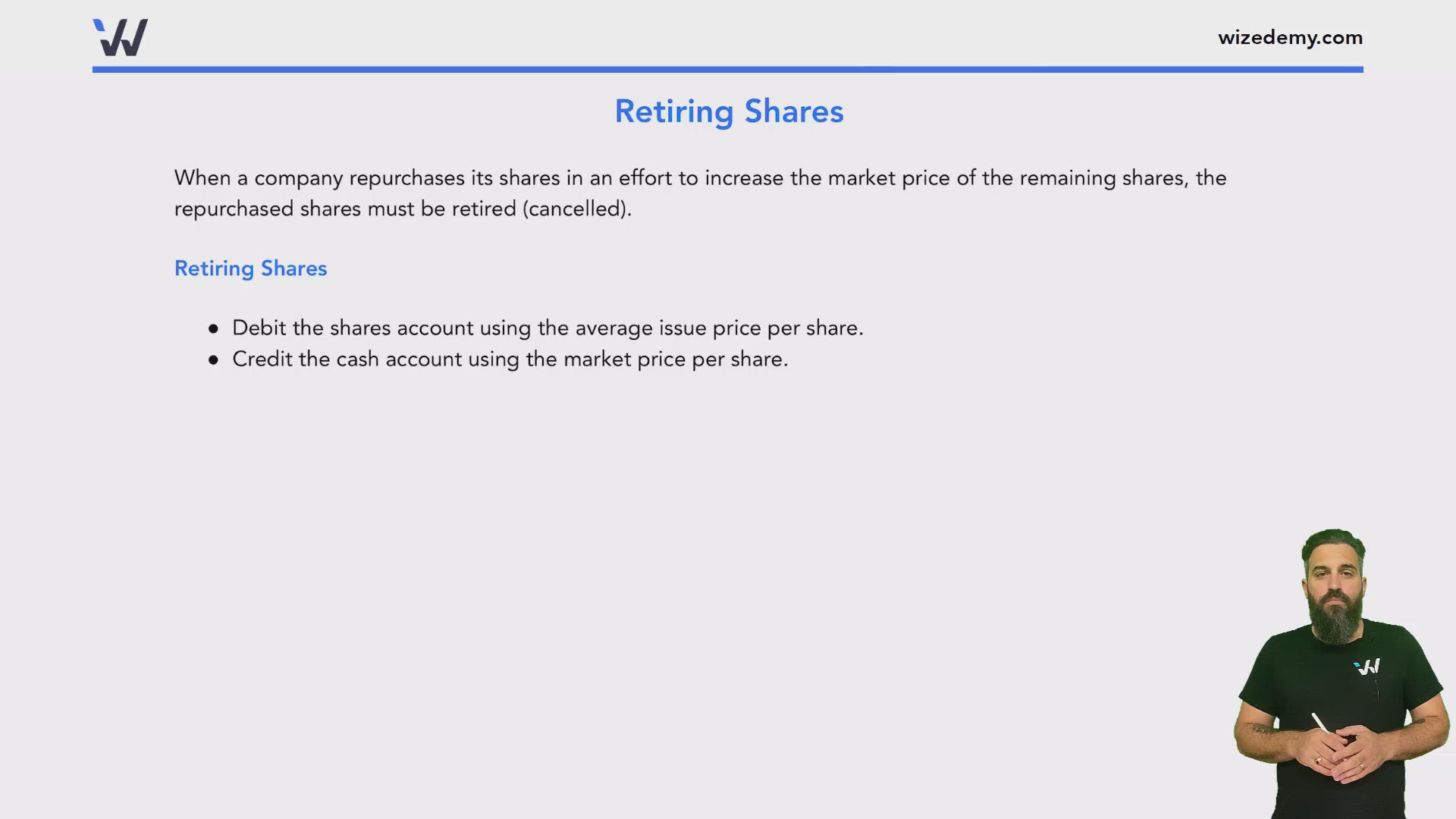
Retiring Shares
When a company repurchases its shares in an effort to increase the market price of the remaining shares, the repurchased shares must be retired (cancelled).
Retiring Shares
- Debit the shares account using the average issue price per share.
- Credit the cash account using the market price per share.
Repurchasing Shares above Average Issue Price
- Loss for the company
- Decreases contributed surplus and then retained earnings.
Wize Concept
Repurchasing shares above the average issue price only decreases retained earnings when the company has no contributed surplus.
Repurchasing Shares below Average Issue Price
- Gain for the company
- Increases contributed surplus
0:00 / 0:00
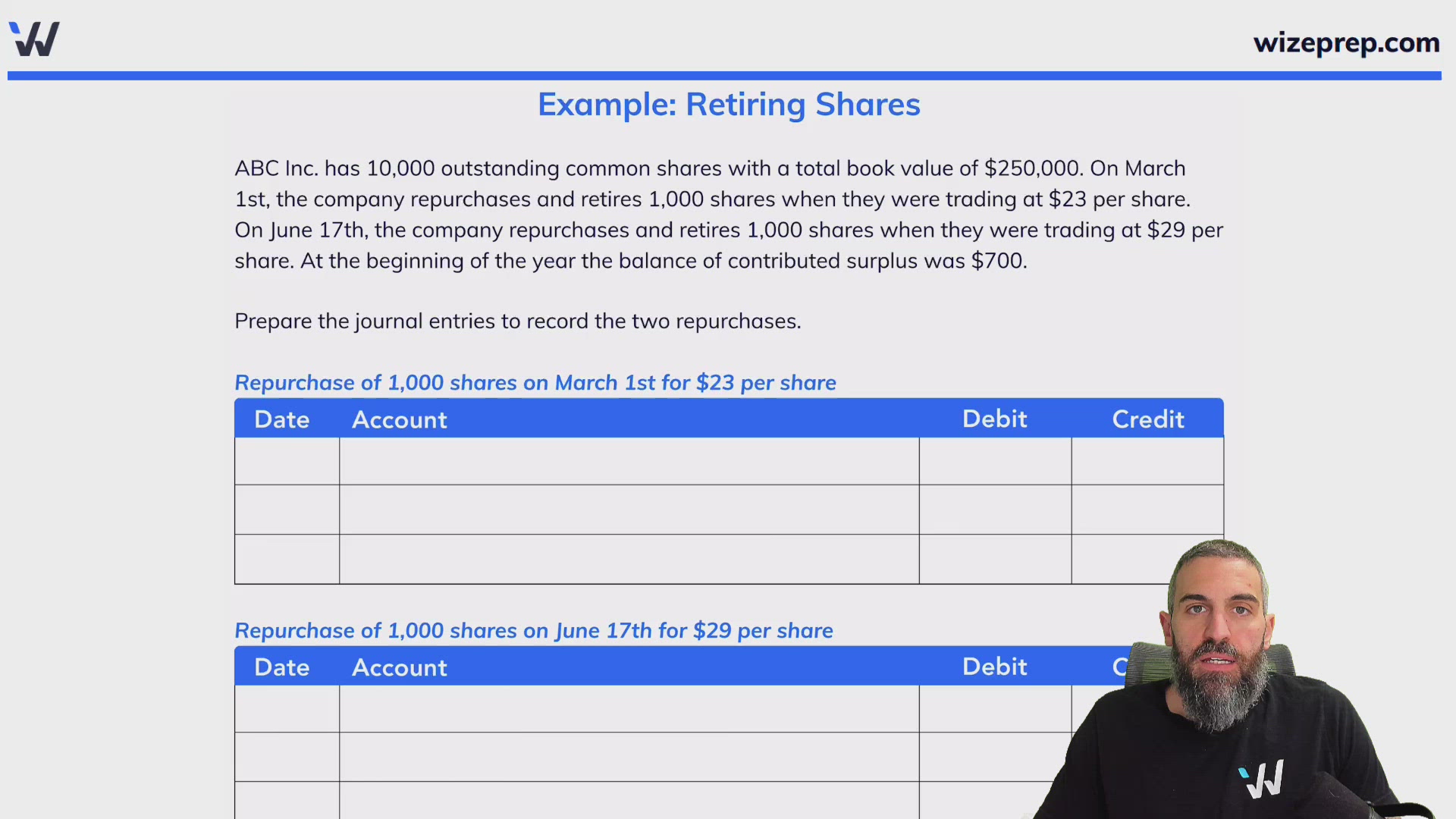
Example: Retiring Shares
ABC Inc. has 10,000 outstanding common shares with a total book value of $250,000. On March 1st, the company repurchases and retires 1,000 shares when they were trading at $23 per share. On June 17th, the company repurchases and retires 1,000 shares when they were trading at $29 per share. At the beginning of the year the balance of contributed surplus was $700.
Prepare the journal entries to record the two repurchases.
Repurchase of 1,000 shares on March 1st for $23 per share

Repurchase of 1,000 shares on June 17th for $29 per share

Practice: Retiring Shares
The following is an excerpt of Brownstein Inc.'s statement of financial position at December 31st, 2022:

On April 12th, 2020 the company's shares were trading at $55 per share. The company repurchases 3,000 shares and retires them.
Transactions:
| Account | Debit | Credit |
|---|---|---|