
Variable vs Fixed vs Mixed Costs
Variable Costs
- Costs that increase proportionally with output on a total basis.
- Remain constant on a per-unit basis.
- Examples: direct materials, direct labor, sales commissions
Fixed Costs
- Costs that remain constant on a total basis.
- Decrease proportionally to output increase on a per-unit basis.
- Examples: rent, insurance, supervisor salaries, equipment depreciation
Mixed Costs
- Costs that have a variable and fixed component
- Examples: electricity bill, telephone bill, vehicle rentals
Relevant Range
- Range of activity that the company typically operates in
- Variable and fixed costs rules apply only within the relevant range
- Periods outside of the relevant range should never be used in an analysis
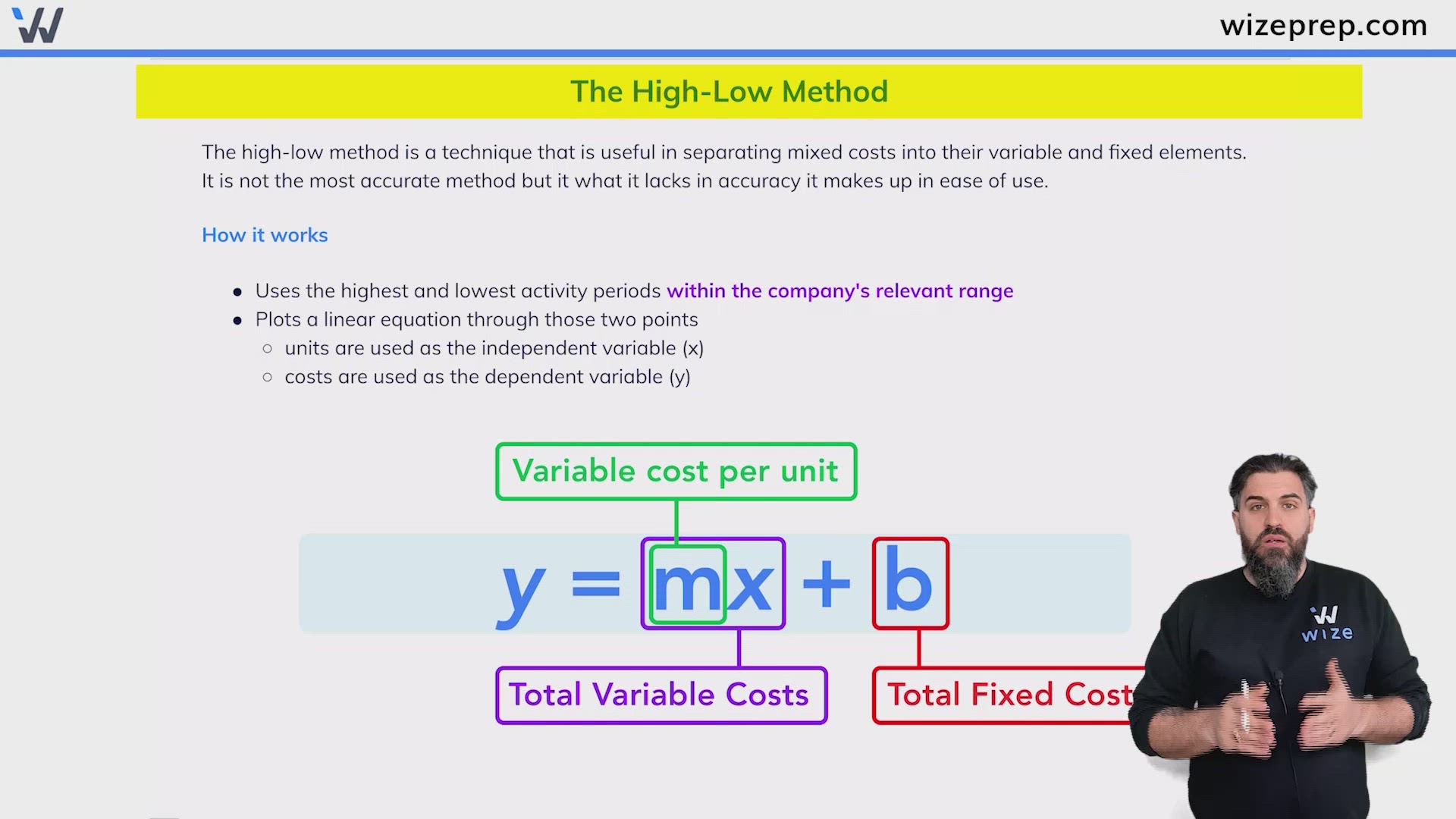
The High-Low Method
The high-low method is a technique that is useful in separating mixed costs into their variable and fixed elements. It is not the most accurate method but it what it lacks in accuracy it makes up in ease of use.
How it works
- Uses the highest and lowest activity periods within the company's relevant range
- Plots a linear equation through those two points
- units are used as the independent variable (x)
- costs are used as the dependent variable (y)

Example: High-Low Method
ABC Inc. usually produces between 5,000 and 8,000 units per month. In months it produces 5,000 units the electricity bill is approximately $2,500. In months it produces 8,000 units the electricity bill is approximately $3,900.
Using the high-low method determine the following:
1. Total fixed cost of electricity
2. Variable electricity cost per unit