Wize University Biology Textbook > Chemistry of Life
Types of Bonds and Intermolecular Forces
Popular Courses
MCAT
General Course
AP Biology Exam Prep Course
AP Exam Prep
Biology
General Course
General Biology
University Study Guides
BIOL 102
Queen's University
BIOL 112
University of British Columbia
Grade 12 Biology
Canada High School
DAT
General Course
High School Biology
US High School
General Biology
University Study Guides
BIOL 130
University of Waterloo
BLG 143
Toronto Metropolitan University
BIOL 112
McGill University
BIOL 186
University of Victoria
BIOL 1201
Western University
BISC 101
Simon Fraser University
BIOL 1P91
Brock University
BIOLOGY 2601A/B
Western University
BS 161
Michigan State University
BIOL 1020
University of Manitoba
0:00 / 0:00
Types of Chemical Bonds
Elements (atoms) can bond to other elements of the periodic table to form molecules by donating, accepting or sharing electrons. This helps the individual elements to become more stable. Different types of bonds are found in this lesson.
What determines bond type?
- Elements all have inherent properties; one important property is electronegativity.
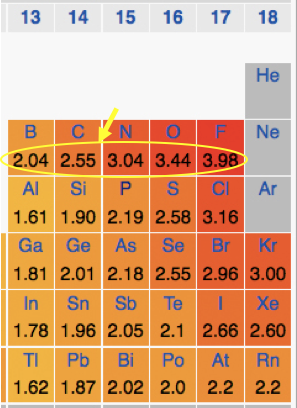
- Electronegativity can be thought of as "how much an element wants to hold on to electrons."
- Values for electronegativity can be found in the period table.
- When two elements combine to form a molecule, whether one atom steals the electron from the other, or whether the electrons are shared (almost) equally, depends on the electronegativity of each element.
Covalent Bonds
- Electrons are shared between two atoms with similar electronegativities. Example: Water (H2O) results from the covalent bonding of 2 hydrogen (H) atoms to one oxygen (O) atom.
- They are more common and stronger than ionic bonds.

Ionic Bonds
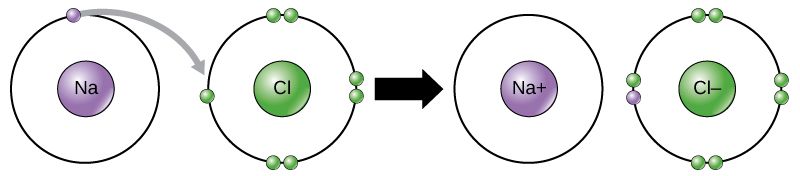
- One element gains an electron and the other loses an electron to the other.
- Each element becomes an ion (charged). Example: Sodium chloride (table salt!) is made from the ionic bonding of sodium (Na) to chlorine (Cl). Because Cl is much more electronegative than Na, it steals one of its electrons. This causes both of the atoms to become ions (Na+ and Cl-), where the positive (+) charge indicates that Na has one less electron than it normally has, and the negative (-) charge indicates that Cl has one more electron than it normally has.
Practice: Ionic Bonding
Ionic Bonding occurs:
Practice: Types of Intramolecular Bonds
What type of bonding would be expected in the following compounds?
Table salt (NaCl)