Wize University Biology Textbook > Chemistry of Life
From Monomers to Polymers
Popular Courses
MCAT
General Course
AP Biology Exam Prep Course
AP Exam Prep
Biology
General Course
General Biology
University Study Guides
BIOL 107
University of Alberta
BIOL 102
Queen's University
BIOL 112
University of British Columbia
Grade 12 Biology
Canada High School
DAT
General Course
High School Biology
US High School
BIOL 200
McGill University
General Biology
University Study Guides
BIOL 130
University of Waterloo
SC/BIOL 1000 3.00
York University
BIOL 200
University of British Columbia
BLG 143
Toronto Metropolitan University
BIOL 112
McGill University
BIOL 186
University of Victoria
BIOL 1010
Dalhousie University
BIOL 1201
Western University

0:00 / 0:00
From Monomers to Polymers
There are four types of major macromolecules in a cell:
- Proteins
- Nucleic Acids
- Polysaccharides
- Lipids
Macromolecules are made out of smaller units:
- Macromolecules are polymers, which are molecules made out of two or more repeating building blocks called monomers.

How are monomers joined together to form polymers?
- Monomers are linked together by a type of reaction called a dehydration or condensation reaction.
- In this type of reaction, a water molecule is lost and a bond is formed between the two monomers.
- The type of bond that forms between the monomers is different depending on the types of molecules involved, but the type of reaction that forms the bond is always a dehydration / condensation reaction.

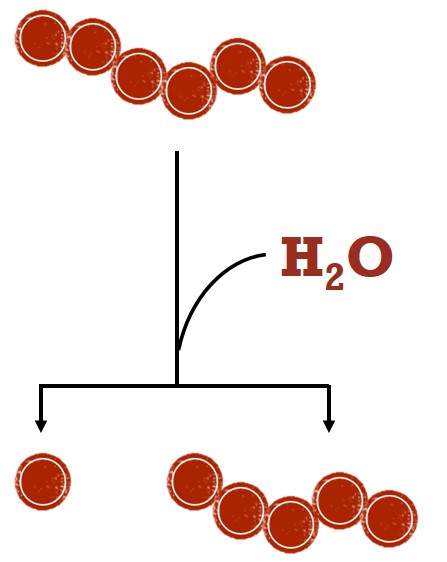
How are polymers broken apart?
- Polymers are broken back down into their monomers by the opposite type of reaction, called a hydrolysis reaction.
- A hydrolysis reaction involves adding a water molecule in order to break the bond between the monomers.
- The monomers can then be recycled to form new polymers.
Practice: Polymer Breakdown
What type of reaction breaks down polymers?
Practice: Water Molecules
Water molecules:
i. Are large ionic molecules
ii. Are small polar molecules
iii. Are polar and therefore have difficulty entering a cell
iv. Are removed during the synthesis of polymers
v. Are able to enter the cell using aquaporin channels
Practice: Protein Formation
Proteins are formed in the cells of our body through what reaction?