Wize University Biology Textbook > The Plasma Membrane
Thermodynamics of Membrane Formation
Popular Courses
MCAT
General Course
Biology
General Course
General Biology
University Study Guides
BIOLOGY 1002B
Western University
BIOL 211
University of Calgary
BIOL 211
University of Calgary
BIOL 107
University of Alberta
BIOL 112
University of British Columbia
DAT
General Course
High School Biology
US High School
General Biology
University Study Guides
BIOL 130
University of Waterloo
SC/BIOL 1000 3.00
York University
BIOL 200
University of British Columbia
BIOL 112
McGill University
BIOL 186
University of Victoria
BIOL-1101
University of Windsor
BIO230H1
University of Toronto
BIOL 1201
Western University
BISC 101
Simon Fraser University
0:00 / 0:00
Thermodynamics of Membrane Formation
The bilayer formation is stabilized by the hydrophobic effect. By preventing the interaction of non-polar groups with water (which is unfavorable) the entropy of water is increased.
- Enthalpic (ΔH) and Entropic (TΔS) stability contribute to membrane formation.
- Enthalpy refers to bonds that are formed (the more negative, the greater the stability) and entropy refers to molecular motion (the more positive, the greater the stability).
- Gibbs Free Energy (ΔG) can be determined by the formula can be thought of as a measure of instability: all systems tend to minimize ΔG. It is given by the following formula:
ΔG = ΔH + (−TΔS)
- Bilayer formation is spontaneous when ΔG is negative.
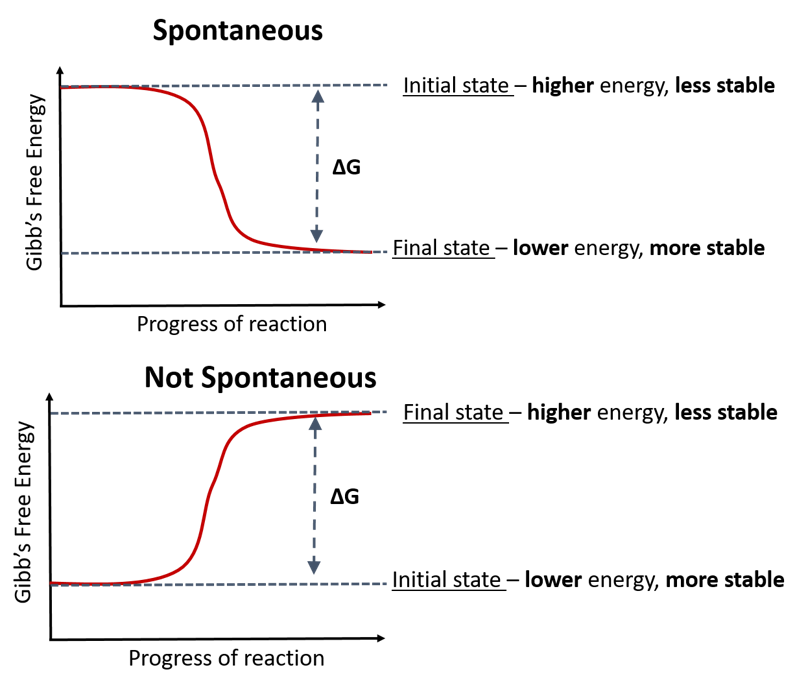
Favorability of Bilayer Formation
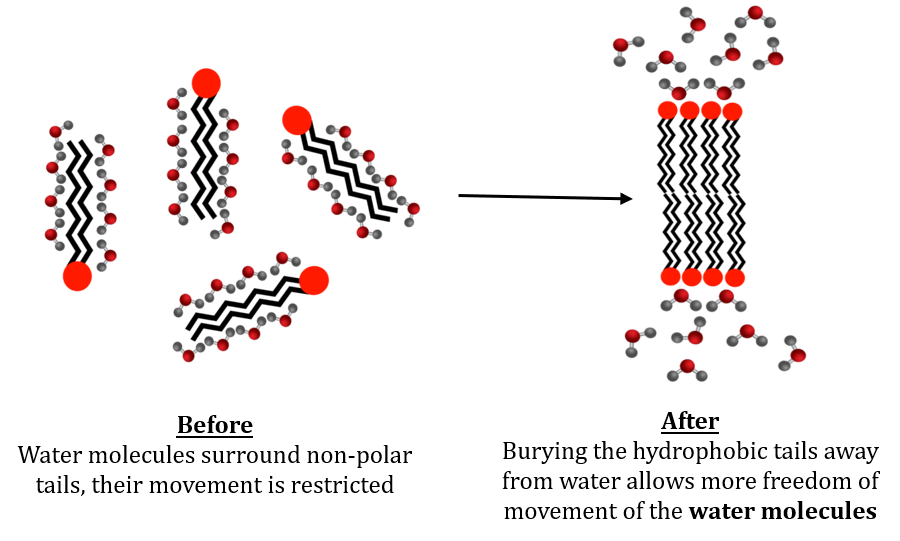
ΔG = ΔH + (-TΔS)
More freedom of movement = more entropy = bigger TΔS = more negative
ΔG = thermodynamically favorable
- Why is bilayer formation thermodynamically favorable in terms of ΔH?
- Lower energy interactions between lipid tails than water with lipid tails (lower enthalpy).
- Why is there a large ΔS when bilayers form?
- The lipid tails have more freedom to move (higher entropy).
Which enthalpic and entropic combinations will result in a spontaneous bilayer formation?
| Spontaneous (yes/no/depends) | ∆H | T∆S |
| <0 | >0 | |
| <0 | <0 | |
| >0 | >0 | |
| >0 | <0 |