Wize University Biology Textbook > Cellular Respiration
Energy of Glucose Metabolism
Popular Courses
MCAT
General Course
AP Biology Exam Prep Course
AP Exam Prep
Biology
General Course
General Biology
University Study Guides
BIOLOGY 1002B
Western University
BIOL 211
University of Calgary
BIOL 107
University of Alberta
BIOL 102
Queen's University
BIOL 112
University of British Columbia
Grade 12 Biology
Canada High School
DAT
General Course
High School Biology
US High School
General Biology
University Study Guides
BIOL 130
University of Waterloo
SC/BIOL 1000 3.00
York University
BIOL 111
McGill University
BIO 1141
University of Ottawa
BLG 143
Toronto Metropolitan University
BIOL 112
McGill University
BIOL 186
University of Victoria

0:00 / 0:00
Energy of Glucose Metabolism
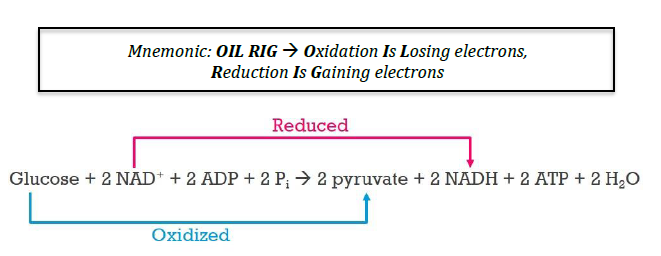
Glucose is metabolized via several connected and coupled reactions. The potential energy in glucose bonds are converted into potential energy in the bonds of ATP and electron carriers.
- Glycolysis has an overall negative ΔG, and the energy is transferred to energy-storing molecules ATP, NADH, and FADH2.
- ATP produced in glycolysis is called Substrate Level Phosphorylation and occurs in the cytoplasm.

Wize Tip
Reminder: Oxidized atoms are losing electrons (or losing bonds with hydrogen atoms) and reduced atoms can be seen as gaining electrons (or gaining bonds to hydrogen atoms).
Practice: Glycolysis Electron Carriers
This/These electron carriers are produced during glycolysis (select all that apply)