Wize University Chemistry Textbook > Early Atomic Theory to Quantum Theory
Understanding the Bohr Model
Popular Courses
MCAT
General Course
General Chemistry
University Study Guides
CHEM 101
University of Alberta
CHEM 112
Queen's University
CHEM 121
University of British Columbia
DAT
General Course
CHM 1311
University of Ottawa
Chemistry
General Course
CHEM 103
University of Alberta
General Chemistry
University Study Guides
CHEM 110
McGill University
CHEM 1E03
McMaster University
CHM135H1
University of Toronto
CHEM 154
University of British Columbia
CHEM 101
University of Victoria
CHEM 120
University of Waterloo
CHEM 205
Concordia University
CHEM 121
Simon Fraser University
SC/CHEM 1000 3.00
York University
APSC 131
Queen's University

0:00 / 0:00
The Basics of Absorption and Emission Spectra
Each atom has a unique absorption and emission spectrum.

Absorption Spectra
- We get an absorption spectrum by transmitting electromagnetic radiation (light) through a substance.
- The dark bands in the spectra represent all of the specific wavelengths of photons absorbed by the atom's electrons

Emission Spectra
- We get an emission spectrum by measuring the electromagnetic radiation (light) that is emitted from a substance
- The background is black and the coloured bands represent the wavelengths of photons that were emitted from this atom's electrons

0:00 / 0:00
Bohr's Atomic Model
Before the Bohr model, scientists thought that electrons just assumed arbitrary energies and could be found anywhere in the atom.
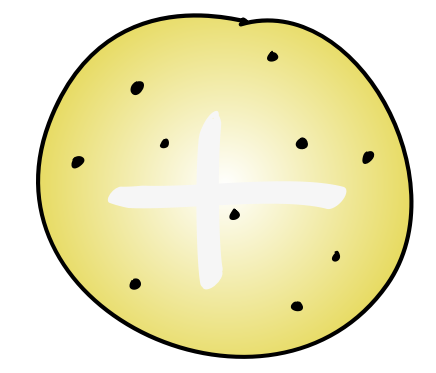
If the pre-Bohr model was right, what would the emission spectra look like? Would they have lines or would they be continuous spectra?
Continuous spectra
Niels Bohr realized that the existing model at the time was inconsistent with emission spectra data... if electrons could be anywhere and have any energy, why did each element have a unique emission spectra with photons of light being emitted with specific energies and wavelengths?
Bohr realized that the electrons must have discrete energies in order to explain the emission spectra with photons with specific amounts of energy being released.
Bohr's Atomic Model Details
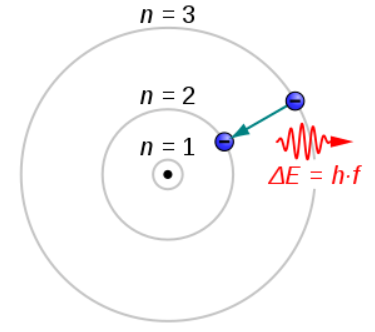
- Electrons orbit nucleus at fixed distances and in circular paths (like how planets orbit the sun!)
- Energy electrons have are quantized (only specific energies are allowed)
- Shell's distance from nucleus determines energy (n=1, 2, 3, etc, higher n=higher energy shell)
- Gap between levels shrinks as n grows
- Bohr model is only accurate for atoms with 1 electron ("Bohr atoms")
- The Bohr model explains why only photons with certain energies are observed in the emission spectra!
Analogy: Staircase vs Ramp

- Ramp->if you're walking up a ramp, you could be 12cm, 17cm, or 20cm above the ground. (Pre-Bohr Model)
- Staircase-> if each step is 17cm high, you can never be standing 12 cm or 20cm above the ground (Bohr Model)
- The stairs are discrete units just like shells in an atom are discrete units.
- And just like how we can only be certain heights above the ground when we take the stairs, electrons can only be in certain shells with certain energies (can't be between two shells)
0:00 / 0:00
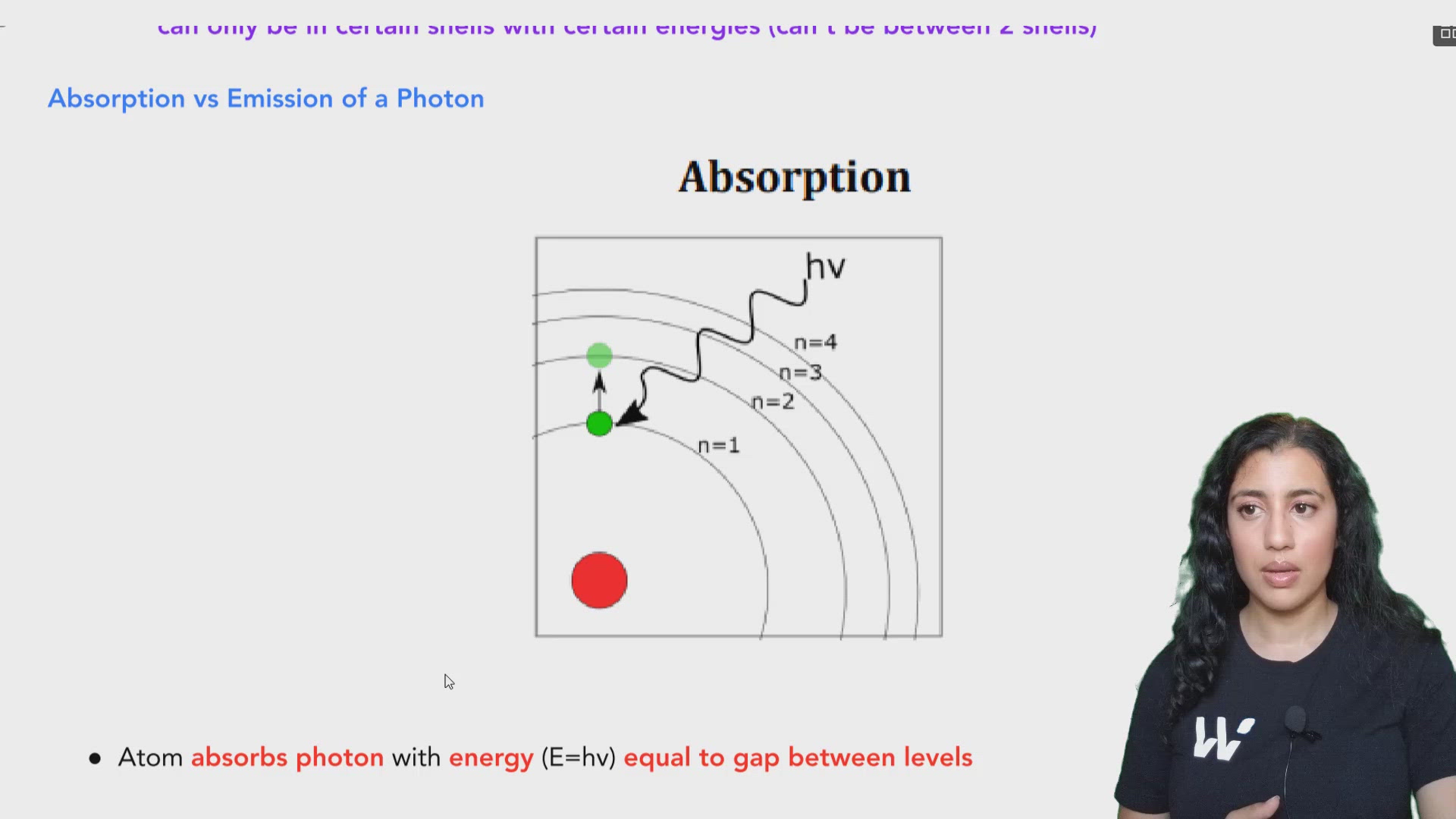
Absorption vs Emission of a Photon
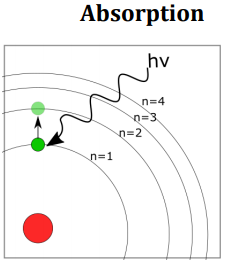
- Atom absorbs photon with energy (E=hv) equal to gap between levels
- Electron is promoted to higher energy level (ex: n = 1 → n = 2)
- Greater Δn = higher energy
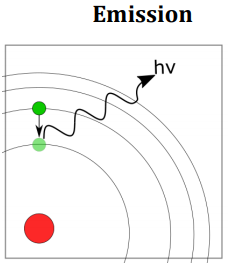
- Atom emits photon with energy equal to gap between levels
- Electron relaxes to lower energy level (ex: n = 4 → n = 2)
0:00 / 0:00
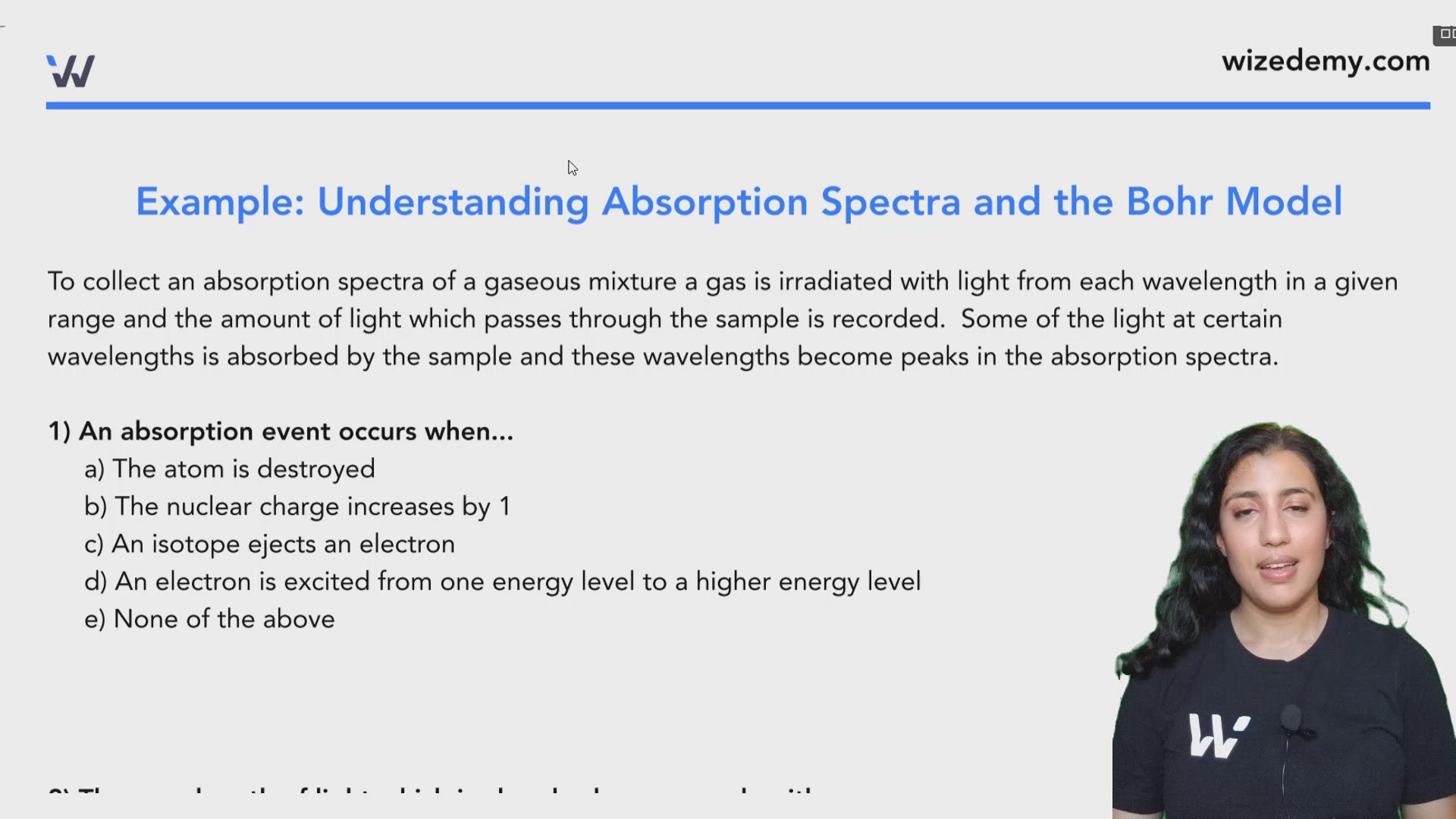
Example: Understanding Absorption Spectra and the Bohr Model
To collect an absorption spectra of a gaseous mixture a gas is irradiated with light from each wavelength in a given range and the amount of light which passes through the sample is recorded. Some of the light at certain wavelengths is absorbed by the sample and these wavelengths become peaks in the absorption spectra.
1) An absorption event occurs when...
a) The atom is destroyed
b) The nuclear charge increases by 1
c) An isotope ejects an electron
d) An electron is excited from one energy level to a higher energy level
e) None of the above
D
2) The wavelength of light which is absorbed corresponds with ...
a) The difference in energy between the energy levels which the electrons occupy
b) The energy level of the orbit the electron was initially in
c) The energy level of the orbit the electron ends up in
d) The distance between the two orbits the electron moves between
e) None of the above
A
0:00 / 0:00
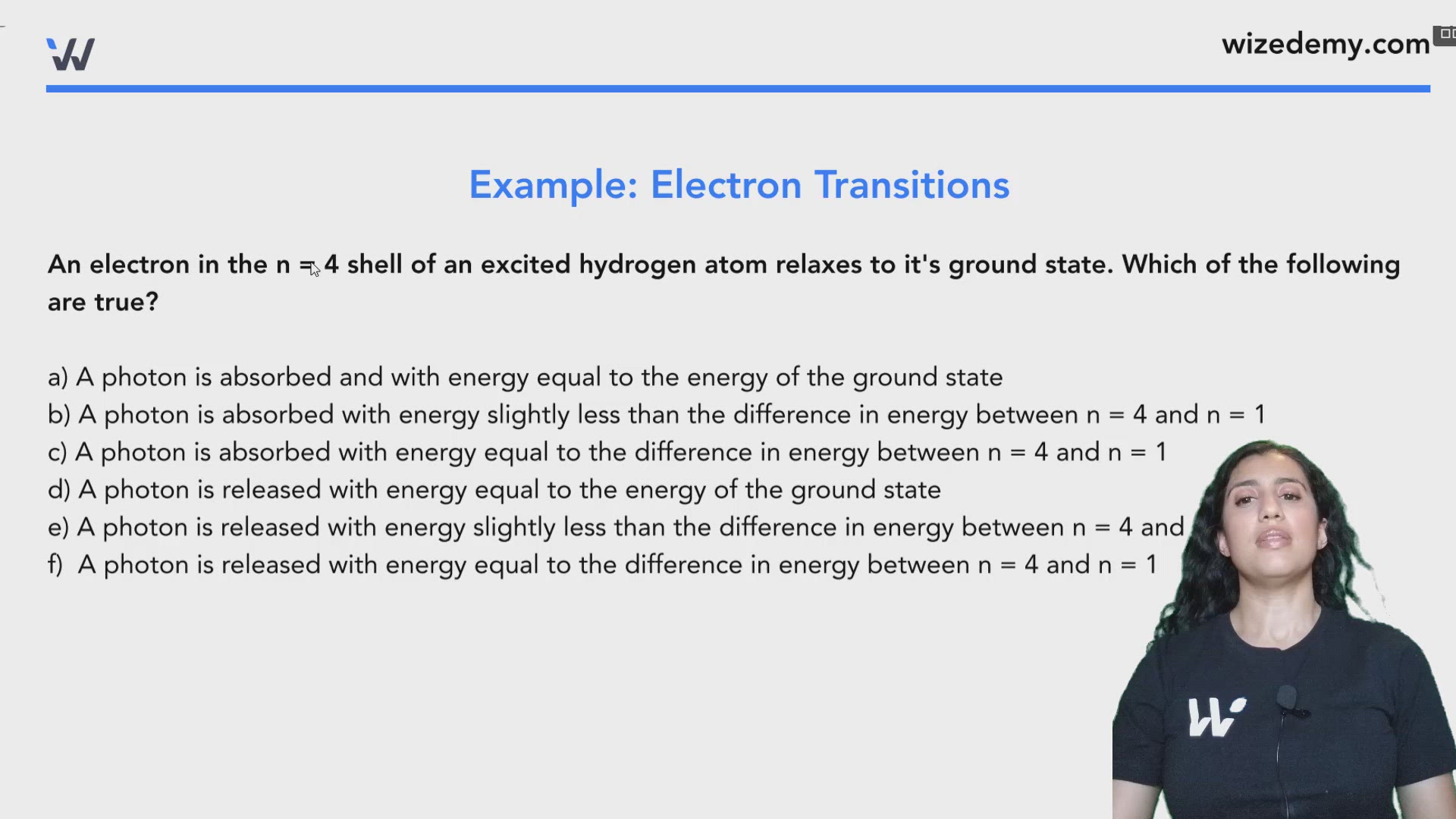
Example: Electron Transitions
An electron in the n = 4 shell of an excited hydrogen atom relaxes to it's ground state. Which of the following is true?
a) A photon is absorbed and with energy equal to the energy of the ground state
b) A photon is absorbed with energy slightly less than the difference in energy between n = 4 and n = 1
c) A photon is absorbed with energy equal to the difference in energy between n = 4 and n = 1
d) A photon is released with energy equal to the energy of the ground state
e) A photon is released with energy slightly less than the difference in energy between n = 4 and n = 1
f) A photon is released with energy equal to the difference in energy between n = 4 and n = 1
f