Wize University Chemistry Textbook > Early Atomic Theory to Quantum Theory
The Photoelectric Effect
Popular Courses
MCAT
General Course
General Chemistry
University Study Guides
AP Chemistry Exam Prep Course
AP Exam Prep
CHEM 101
University of Alberta
CHEM 112
Queen's University
CHEM 121
University of British Columbia
DAT
General Course
Chemistry
General Course
CHEM 103
University of Alberta
General Chemistry
University Study Guides
CHEM 110
McGill University
CHEM 1E03
McMaster University
CHM135H1
University of Toronto
CHEM 101
University of Victoria
CHEM 120
University of Waterloo
CHEM 205
Concordia University
CHEM 121
Simon Fraser University
APSC 131
Queen's University
CHEM 1100
University of Manitoba
CHEM 1481
Texas A & M University

0:00 / 0:00
The Photoelectric Effect
In 1905, Einstein conducted his photoelectric effect experiment.

- The apparatus is made of a metal grid in which light of different intensities and frequencies was shown onto it.
- The ammeter (A) measures current (the number of electrons emitted).
- The voltmeter (V) measures the stopping potential (the energy of the electrons emitted).

Experimental Findings
1) 1 photon with sufficient energy to eject an electron:

2) 1 photon with insufficient energy to eject an electron
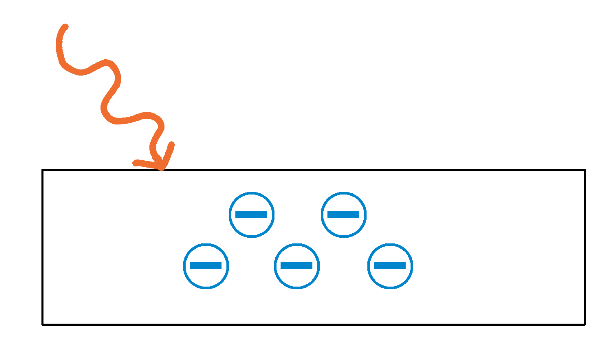
3) Multiple photons hitting the metal, individually they have insufficient energy to eject an electron but if you add up the their energy they have more energy than required to eject an electron
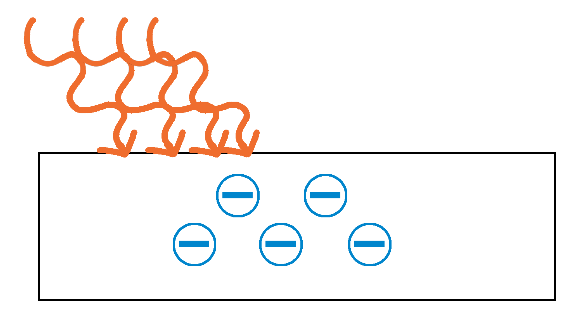
4) Multiple photons, each with sufficient energy needed to eject an electron hitting the metal
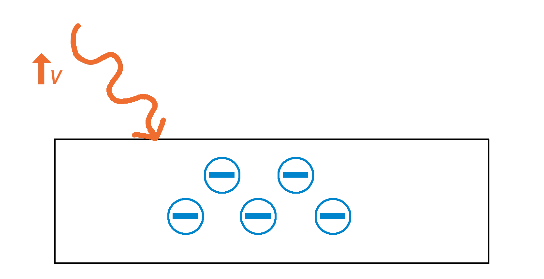
5) A photon with an increased frequency than the photons with minimum sufficient energy to eject an electron
Summary of the Findings:
- Electrons must be ejected by 1:1, photon : electron collisions
- Increased intensity of the light (more photons for a given part of the light beam), increased the number of electrons emitted (if each of the photons had sufficient energy to eject electrons)
- Increased frequency of the light, increased the energy of the electrons emitted
Before this experiment, people thought of light only as WAVES, but Einstein showed that light could also be thought of as particles (photons).
- When particle A hits particle B, particle A transfers its momentum to particle B. This is not the case for waves!
- The photoelectric effect showed that light can behave like particles since photons of light can hit a solid substance and cause electrons to be emitted
0:00 / 0:00
Photoelectric Effect Equation
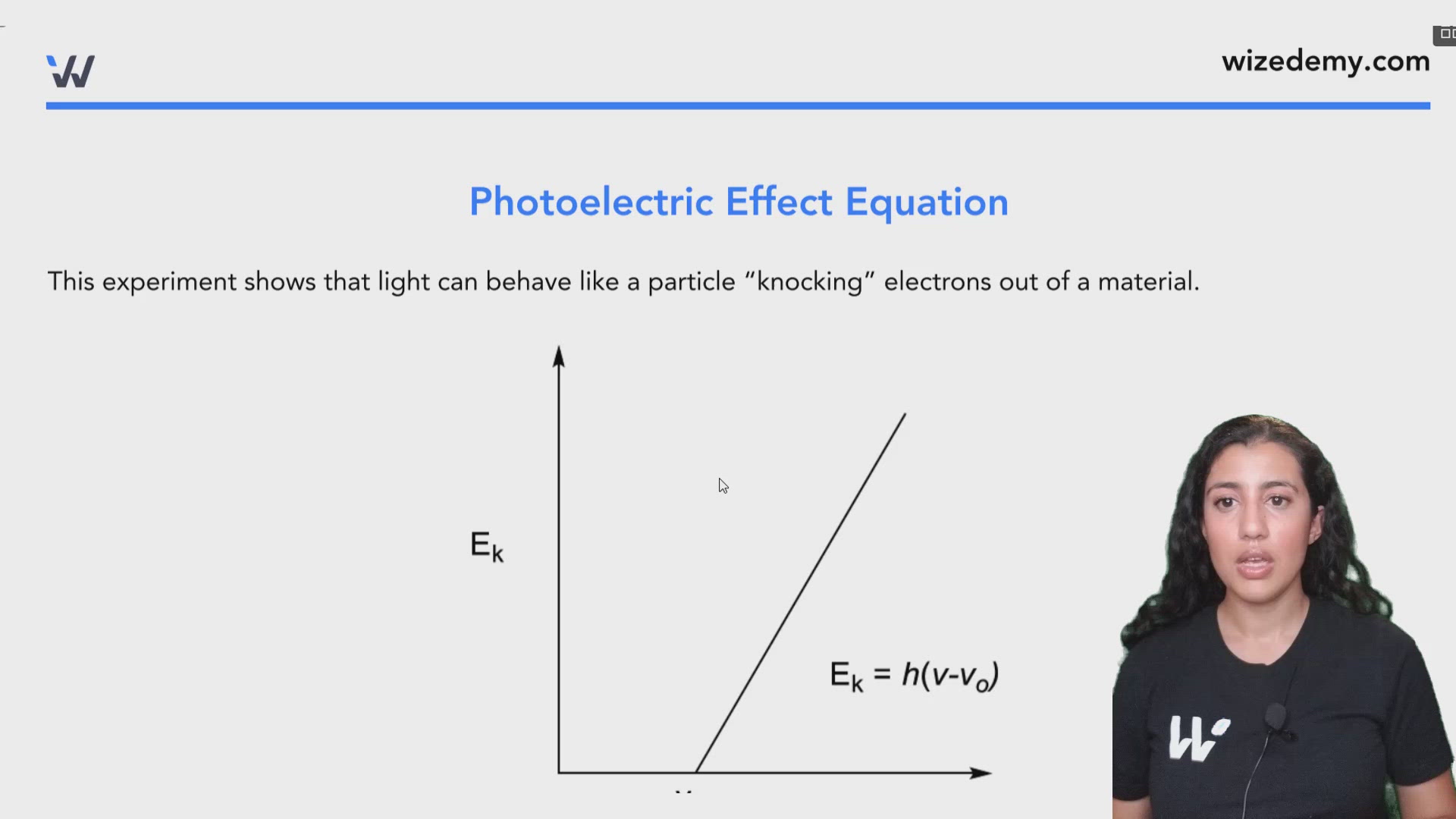
This experiment shows that light can behave like a particle “knocking” electrons out of a material.

- The y-axis shows the kinetic energy (Ek) of the emitted electron
- The x-axis shows the frequency of the photon that is hitting the metal's surface
- When the frequency is too low, the energy of the photon is too low and an electron is not emitted
- When the frequency reaches the threshold frequency, there is enough energy to emit an electron
- At even higher frequencies, the kinetic energy (Ek) of the electron is increased further!
The energy corresponding to vo is called the ‘binding energy’ and represents the amount of energy required to remove the electron, EBinding
and Ebinding=minimum amount of energy needed to eject an electron
Wize Tip
The binding energy for each metal is unique.
Example: The binding energy of iron and gold are different.
The binding energy for a specific metal is constant so if you are given the binding energy for iron in a question, you can use that for part a) b) c) for example.
Does an electron get displaced when Ephoton > or < than Ebinding?
Ephoton> Ebinding means that the electron will have KE and it will get displaced!
0:00 / 0:00
Example: Ejecting an Electron
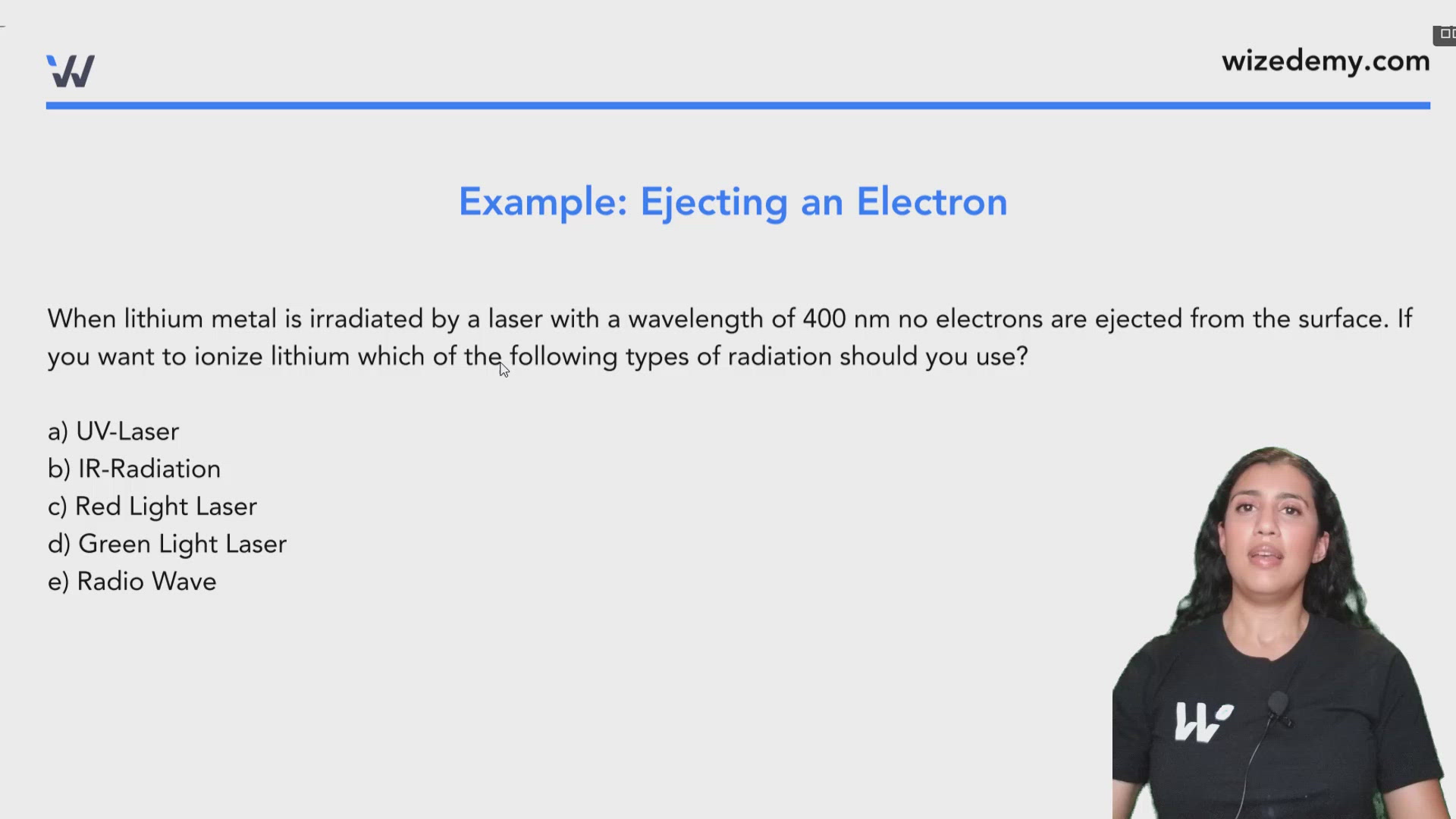
When lithium metal is irradiated by a laser with a wavelength of 400 nm no electrons are ejected from the surface. If you want to ionize lithium which of the following types of radiation should you use?
a) UV-Laser
b) IR-Radiation
c) Red Light Laser
d) Green Light Laser
e) Radio Wave
If the 400 nm light (purple light) does not eject photons then the energy of the photon must be less than the work function (binding energy). Therefore we need a higher energy (shorter wavelength) photon.
Of the options listed only the UV-Laser will be higher energy than 400 nm laser. Answer is A
Wize Tip
When you see a question that mentions electrons being ejected from the surface of a metal, you know the question is going to have something to do with the photoelectric effect!
Practice: No Electrons are Ejected
A metal surface is irradiated by light from a laser with a wavelength of 492 nm. No electrons are measured leaving the surface. What is the most likely explanation?
Practice: Calculate the Binding Energy
An element is bombarded with a beam of X-rays of wavelength 0.75664nm. Upon irradiation, electrons are ejected with a velocity of 2.35 × 10⁷ m/s. The mass of an electron is 9.11 × 10⁻³¹ kg.
What is the binding energy for the element?
h = 6.626 × 10⁻³⁴ Js