Wize University Chemistry Textbook > Early Atomic Theory to Quantum Theory
Blackbody Radiation
Popular Courses
General Chemistry
University Study Guides
CHEM 101
University of Alberta
CHEM 112
Queen's University
CHEM 121
University of British Columbia
Chemistry
General Course
DAT
General Course
CHEM 103
University of Alberta
General Chemistry
University Study Guides
CHEM 110
McGill University
CHEM 120
University of Waterloo
CHEM 121
Simon Fraser University
APSC 131
Queen's University
CHEM 1100
University of Manitoba
CHEM 1481
Texas A & M University
CEM 141
Michigan State University
CHMA10H3
University of Toronto
SC/CHEM 1100 4.00
York University
CHEM 1035
Virginia Tech
CHM 2045
University of Florida
CHEM 1001
Carleton University
0:00 / 0:00
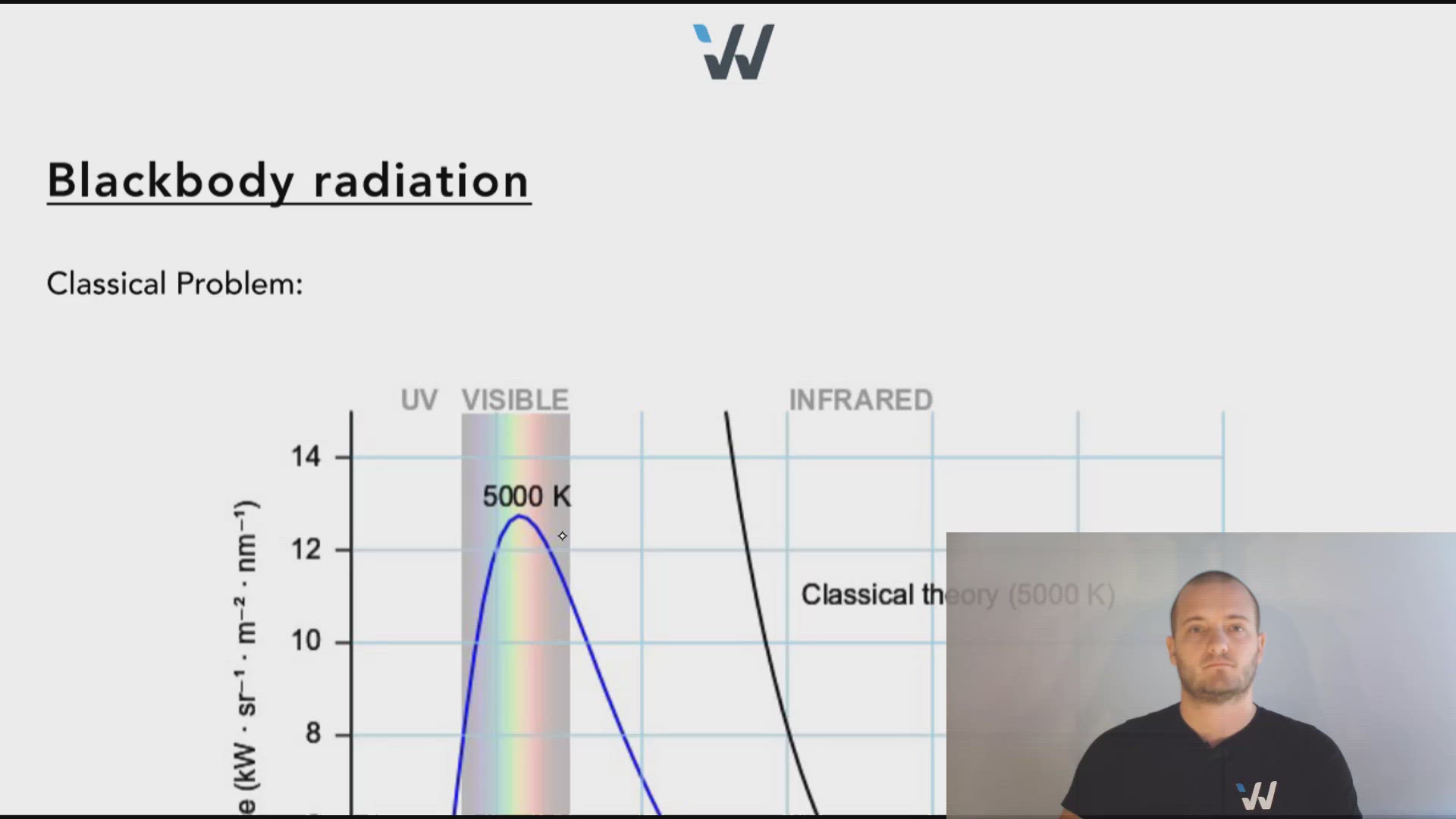
Blackbody radiation
Classical Problem:
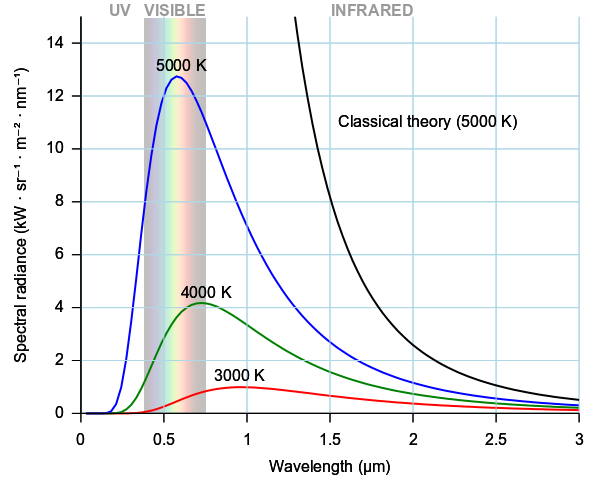
Issues:
- Classical Theory does not do a good job predict the emission of bodies in the infrared region, especially for cooler bodies.
- Near the UV-range classical theory predicts an infinite increase in radiance which means an infinite amount of light being emitted. This is a clear contradiction of energy conservation, a BIG ISSUE! Known as the UV-Catastrophe
Solution:
- Max Plank discovered that if the restricted energy that can be released or absorbed by atoms into discrete energy packets he could successfully predict the experimental observations.
Results:
- The smallest quantity of energy that can be emitted or absorbed as electromagnetic radiation, is called a quanta
The energy of a single quantum is:

Wize Tip
You should memorize the value for the speed of light (c) = 3.0x10⁸m/s as that value is not always provided on exams.
Wize Concept
Where will I see this on an exam?
Questions on this topic tend to arise in the form of a calculation. You will be asked to determine the energy or wavelength of a given ray of light.