Wize University Chemistry Textbook > Early Atomic Theory to Quantum Theory
Electromagnetic Radiation
Popular Courses
MCAT
General Course
CHEM 1301A/B
Western University
General Chemistry
University Study Guides
AP Chemistry Exam Prep Course
AP Exam Prep
CHEM 1A03
McMaster University
CHEM 101
University of Alberta
CHEM 112
Queen's University
CHEM 121
University of British Columbia
DAT
General Course
CHM 1311
University of Ottawa
Chemistry
General Course
CHEM 103
University of Alberta
General Chemistry
University Study Guides
CHEM 110
McGill University
CHEM 1E03
McMaster University
CHM135H1
University of Toronto
CHEM 120
University of Waterloo
CHEM 205
Concordia University
CHEM 121
Simon Fraser University
SC/CHEM 1000 3.00
York University
0:00 / 0:00
Electromagnetic Spectrum
Up until this point in history, scientists were unsure if light shared the properties of waves or particles...there was some evidence for both!
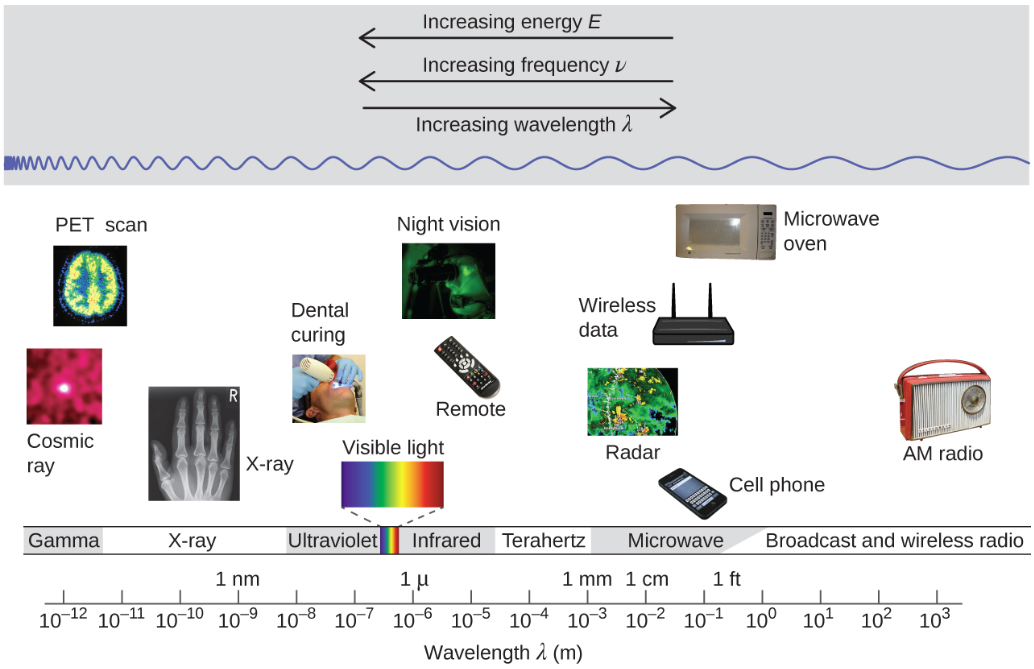
The discovery of the electromagnetic spectrum showed the different wavelengths and frequencies that electromagnetic radiation could exist at. Since the different types of radiation in this spectrum behave as waves, and visible light is a part of this spectrum, it became clear to scientists that light acts as waves!
Types of Electromagnetic Radiation
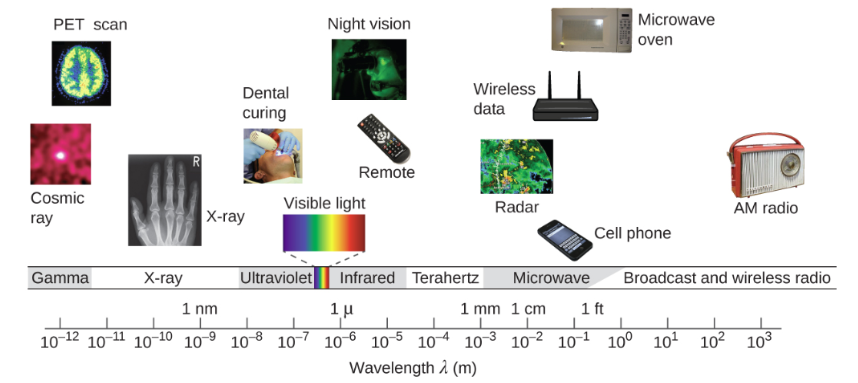
- In the diagram above, the electromagnetic radiation is organized from the types of radiation that are highest in energy (gamma rays) to the types of radiation that are lowest in energy (radiowaves)
- You might recognize a lot of common household objects on the side of the spectrum with lower amounts of energy!
0:00 / 0:00
Photon Equations
Electromagnetic Radiation Waves
- Light (or electromagnetic radiation) behaves as a wave
- A wave is a self-propagating transverse oscillation of electric and magnetic fields
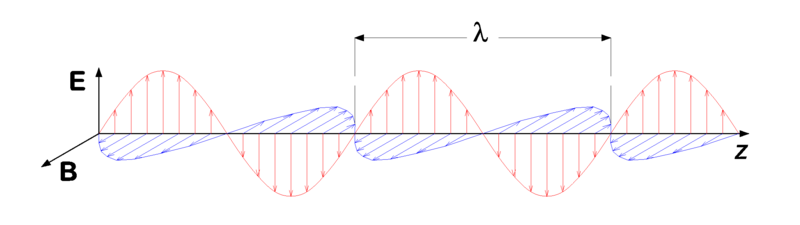
where E is the electric field and B is the magnetic field
- To describe waves, we can use the following terms:
- Amplitude (A): the height of a wave crest or depth of a trough
- Wavelength (λ): The distance a wave travels in one cycle (m)
- Frequency (v): cycles per second (s-1 or units Hz)
- Energy (E): units are Joules (J)
Energy of a Photon Equations
where h is Planck's constant: 6.626x10⁻³⁴ Js
and c is the speed of light: 3.0 x10⁸ m/s

Wize Tip
You should memorize the value for the speed of light (c) = 3.0x10⁸m/s as that value is not always provided on exams.
Wize Concept
Where will I see this on an exam?
Questions on this topic tend to arise in the form of a calculation. You will be asked to determine the energy or wavelength of a given ray of light.
0:00 / 0:00
Photon Equations (Cntd.)
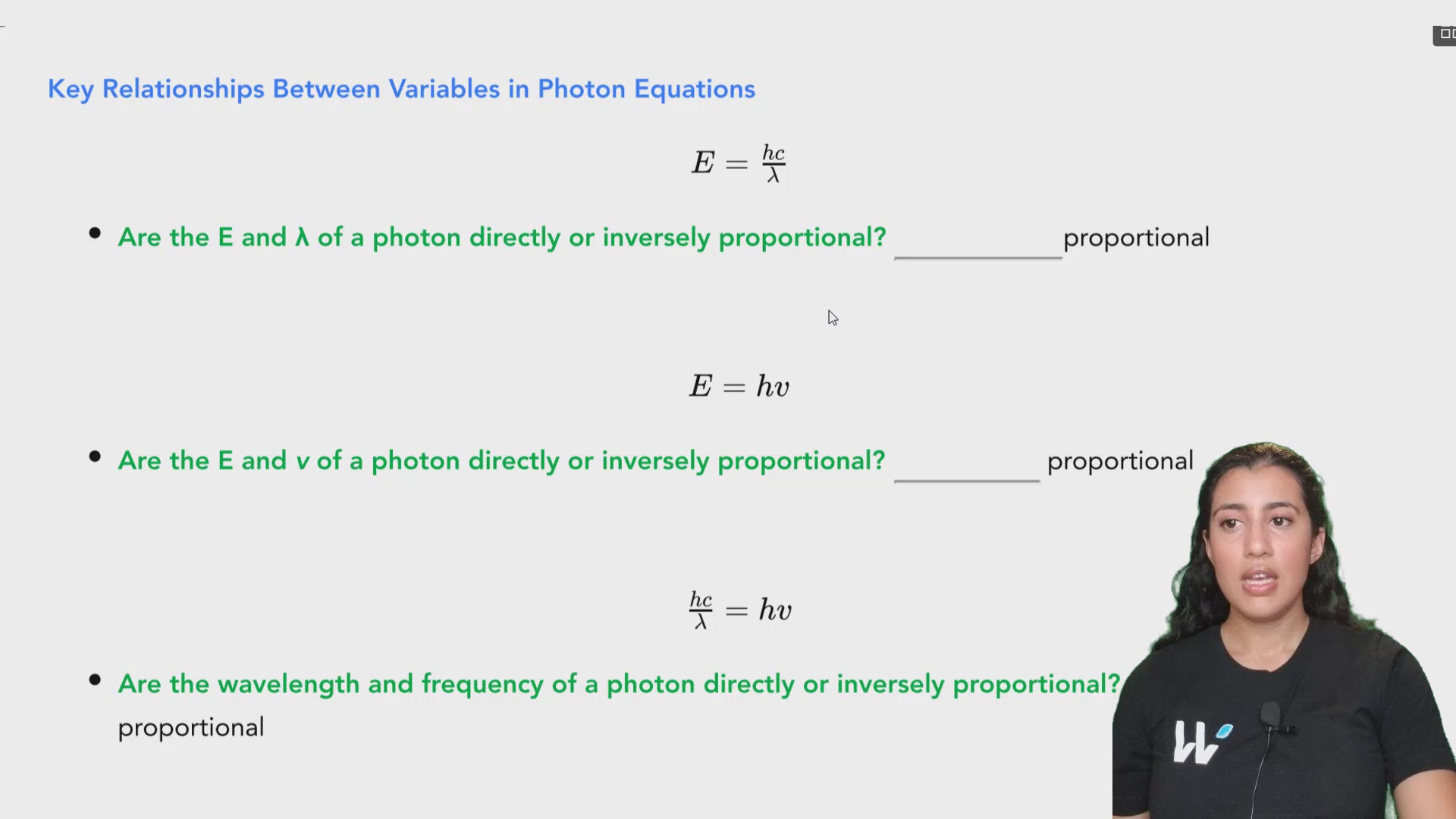
Key Relationships Between Variables in Photon Equations
- Are the E and λ of a photon directly or inversely proportional?inverselyproportional
- Are the E and v of a photon directly or inversely proportional?directlyproportional
- Are the wavelength and frequency of a photon directly or inversely proportional?inverselyproportional
Summary

0:00 / 0:00
Example: Calculating Energy of a Photon Given Wavelength
A photon of light was found to emit light at 723 nm. How much energy is associated with this light?
h=6.626x10⁻³⁴ Js
Wavelength and energy are related through this equation:
We have Planck's constant (h) and know that the speed of light is 3x10⁸m/s
The wavelength (λ) =723 nm
First, we must convert 723 nm to m.
723 nm x= 7.23 x10⁻⁷ m
We can now plug in our values and solve for E:
E =
E = 2.75 x 10⁻¹⁹ J
Watch Out!
Don't forget that for the photon equations E must in joules (J) and λ (wavelength) must be in m (meters) not nm (nanometers)!
- If you are given a wavelength value in nm, you would have to convert it to m before plugging it into an equation.
Remember: 1nm=1x10⁻⁹m
0:00 / 0:00
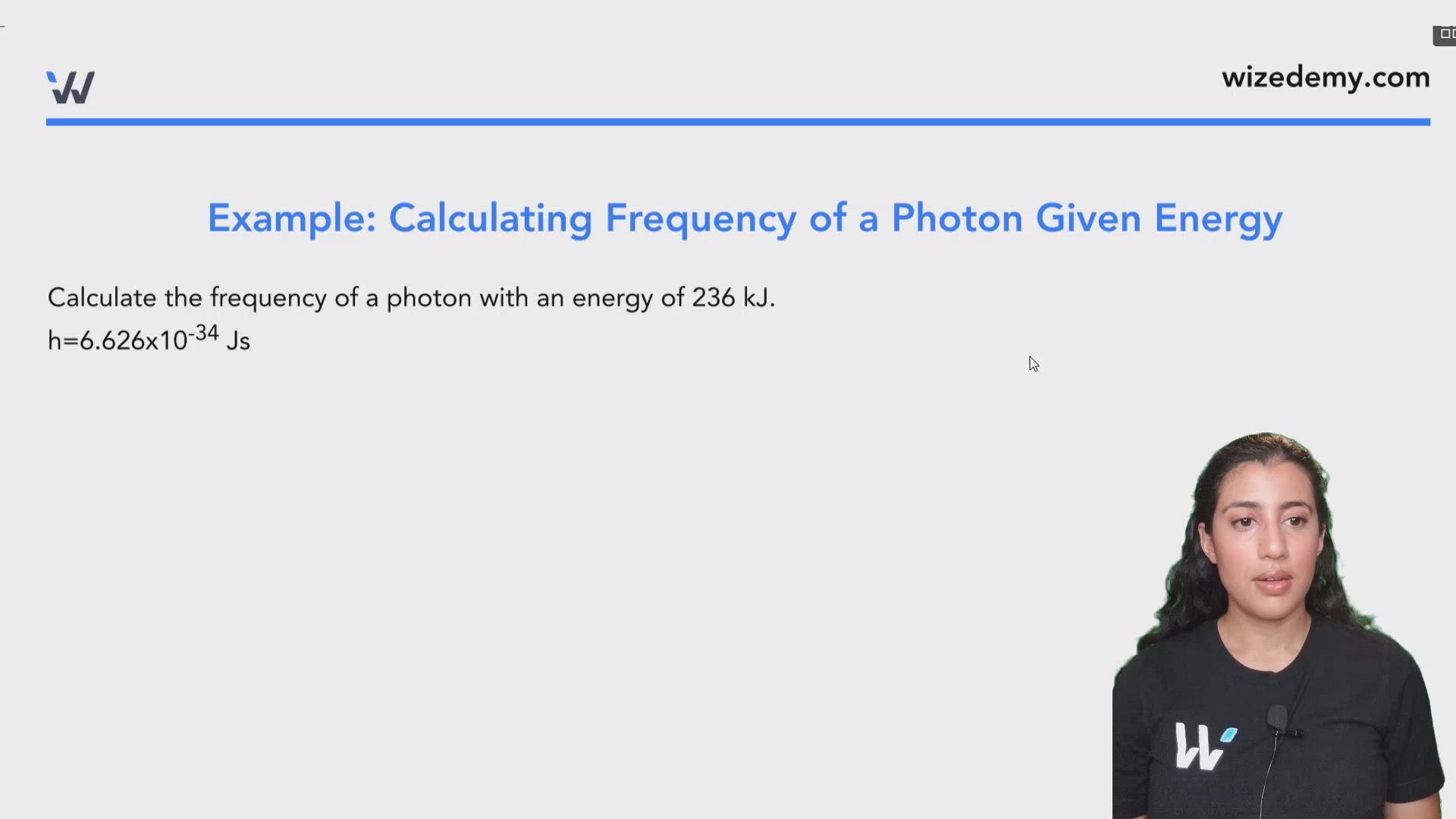
Example: Calculating Frequency of a Photon Given Energy
Calculate the frequency of a photon with an energy of 236 kJ.
h=6.626x10⁻³⁴ Js
The following equation has both E and frequency (v) in it. Rearrange to solve for v:
E must be in joules. Right now it is in kJ, so we must convert kJ to J:
Now we can plug in all values and solve for v:
Practice: Different Types of Electromagnetic Radiation
Rank the following types of electromagnetic radiation from lowest to highest energy.
Radio Waves, Infrared Radiation, X-rays, Microwaves, Visible Light, UV Radiation
Practice: Calculating Frequency of a Photon Given Wavelength
A photon of light has a wavelength of 700 nm. What is its frequency?