Wize University Chemistry Textbook > Early Atomic Theory to Quantum Theory
Early Atomic Theory
Popular Courses
MCAT
General Course
General Chemistry
University Study Guides
CHEM 101
University of Alberta
CHEM 121
University of British Columbia
DAT
General Course
Chemistry
General Course
CHEM 103
University of Alberta
General Chemistry
University Study Guides
CHEM 110
McGill University
CHM135H1
University of Toronto
CHEM 120
University of Waterloo
CHEM 205
Concordia University
CHEM 121
Simon Fraser University
SC/CHEM 1000 3.00
York University
CHEM 1100
University of Manitoba
CHEM 1481
Texas A & M University
CH110
Wilfrid Laurier University
CEM 141
Michigan State University
CHMA10H3
University of Toronto
SC/CHEM 1100 4.00
York University

0:00 / 0:00
Review of Previous Atomic Models
Dalton's Atomic Theory
- first attempt to describe all matter in terms of atoms
- each element is made up of tiny atoms
- for a given element, atoms are identical and different elements have different atoms
- chemical compounds form when different atoms combine with each other (in the same ratios)
- said that atoms were indestructible and indivisible (but we know now that they are made up of smaller components-protons, neutrons, electrons)

Discovery of the Electron: JJ Thomson's Experiment
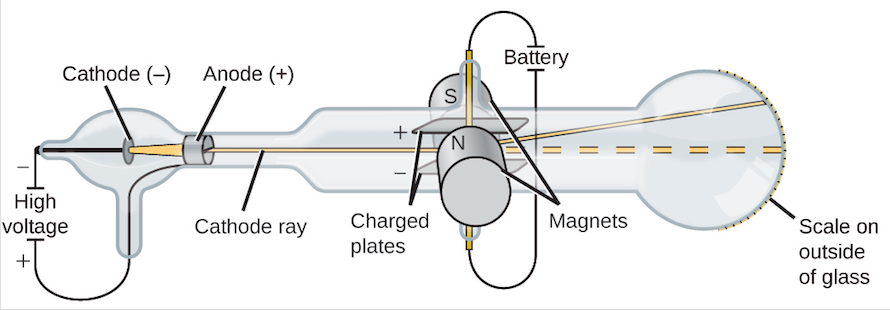
- There are 2 main components here:
- (+) and (-) charged plates
- magnets producing a magnetic field
- The cathode ray is deflected away from the negatively-charged electric plate, and towards the positively-charged electric plate. That means the charge of the particle in the ray isnegative!
- These particles are:electrons!
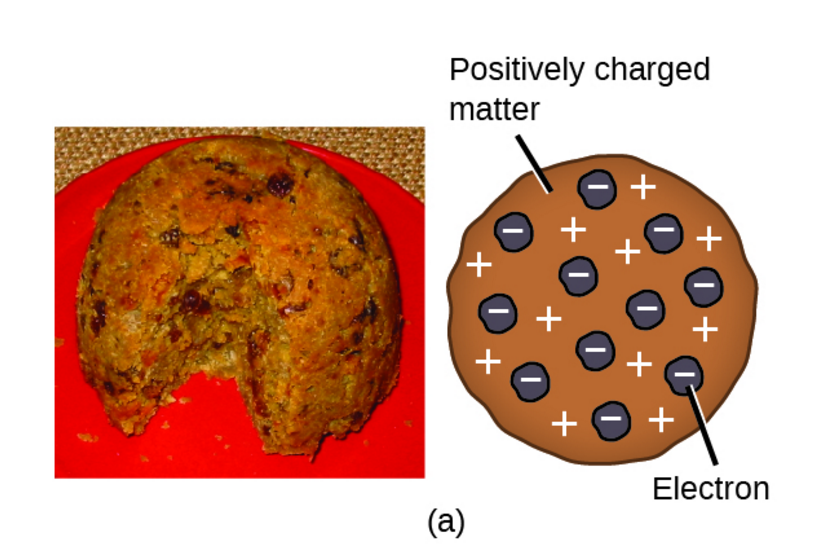
- Thomson also came up with the Plum Pudding Model:
- Since electrons were negatively charged, and atoms were neutral he proposed that electrons were embedded in a positively charged atom
Discovery of the Nucleus
- Rutherford wanted to learn more about the contents of an atom so he conducted the following experiment:

Why was this so shocking?!
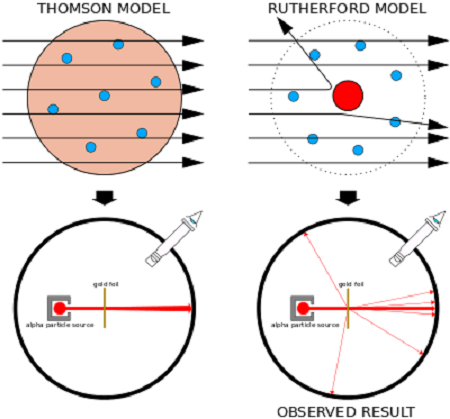
- According to the thomson/plum pudding model, since electrons were thought to be floating around in a positive space, the positive alpha particles were just expected to go right through because the positive space was thought to be too weak to affect the path of the fast moving alpha particles
- But that did not happen!
- Conclusions from the Rutherford gold experiment:
- The positive charge must be localized over a very small volume of the atom, which also contains most of the atom's mass. This was the nucleus!
- This explained how a very small fraction of the alpha particles were deflected drastically (due to the rare collision with a heavy and dense gold nucleus.)
- Since most of the alpha particles passed straight through the gold foil, the atom must be made up of mostly empty space!
- when trying to figure out the mass of the nucleus, Rutherford was finding that the mass was too high compared to the mass of protons, which later led to the discovery of neutrons in the nucleus
- The discovery of the nucleus led to Rutherford creating a new atomic model which is referred to as the "planetary model" of the atom since it resembles plantets orbiting the sun (with electrons being the planets, and the central body being the nucleus)
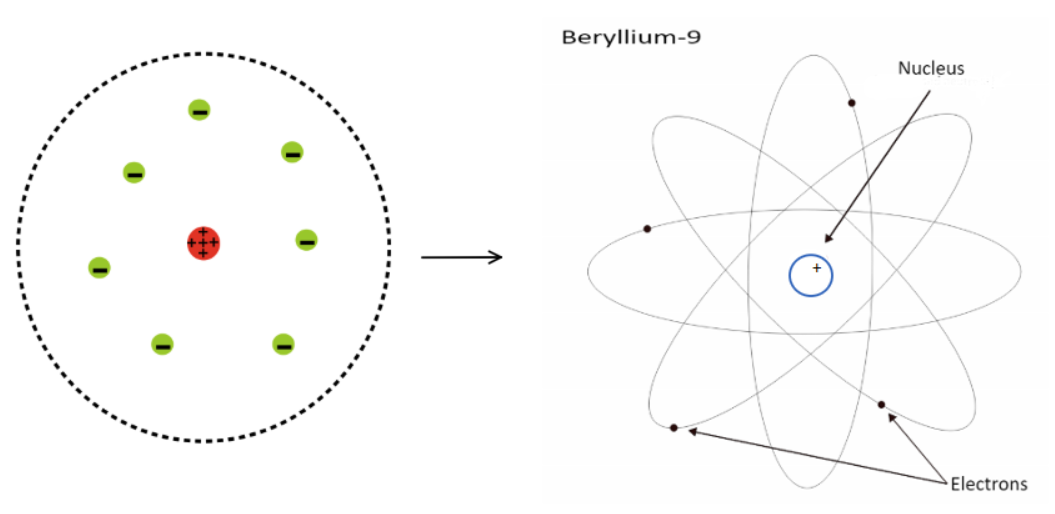
- Another problem with this theory was that electrons in motion around a central body (the nucleus) were thought to continuously give off radiation and lose energy
- If this was the case, the radius of the electron's orbit should get smaller and smaller until the electrons spiral into the nucleus and destroys it-this does not happen!