Wize University Chemistry Textbook > Stoichiometry
Combustion Reactions + Empirical and Molecular Formulae
Popular Courses
CHEM 1301A/B
Western University
General Chemistry
University Study Guides
CHEM 101
University of Alberta
DAT
General Course
Chemistry
General Course
CHEM 103
University of Alberta
General Chemistry
University Study Guides
CHEM 120
University of Waterloo
CHEM 120
McGill University
CHEM 130
University of British Columbia
CHEM 1100
University of Manitoba
CHEM 1481
Texas A & M University
CEM 141
Michigan State University
CHMA10H3
University of Toronto
SC/CHEM 1100 4.00
York University
CHM 2045
University of Florida
CHEM 1035
Virginia Tech
CHEM 1001
Carleton University
CHEM 111
University of British Columbia
CHEM 112
University of Saskatchewan
0:00 / 0:00
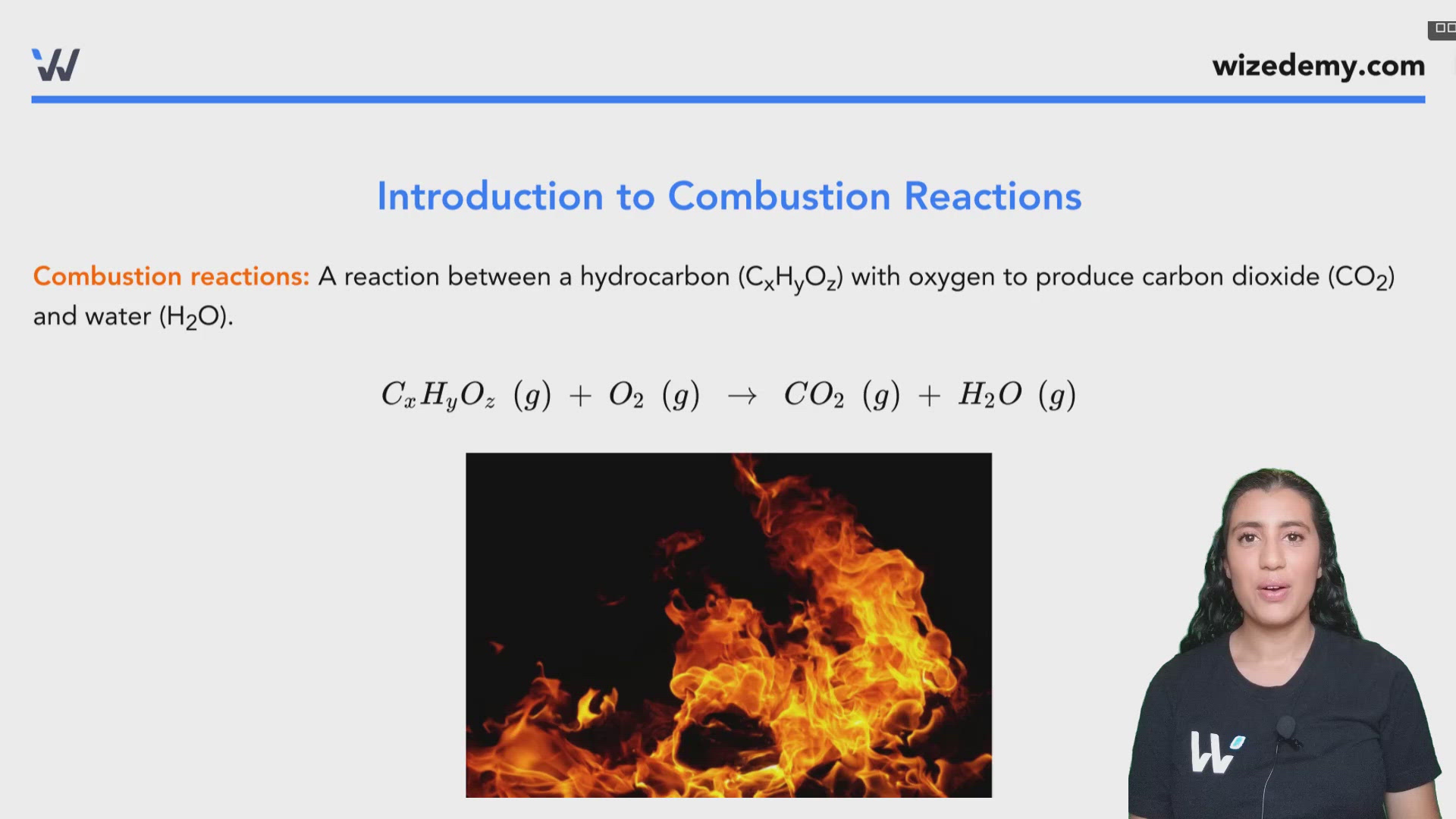
Introduction to Combustion Reactions
Combustion reactions: A reaction between a hydrocarbon (CxHyOz) with oxygen to produce carbon dioxide (CO2) and water (H2O).
Combustion reactions are commonly used in elemental analysis to determine the empirical formula of a compound.
Steps to Balance a combustion reaction:
- Balance the carbons
- Balance the hydrogens
- Balance the oxygens using ONLY the coefficient of elemental oxygen (O2)
- If the equation has any fractions (often times the coefficient in front of O2 is a fraction), multiply the ENTIRE equation by 2
Example: Balancing the Following Reaction
0:00 / 0:00
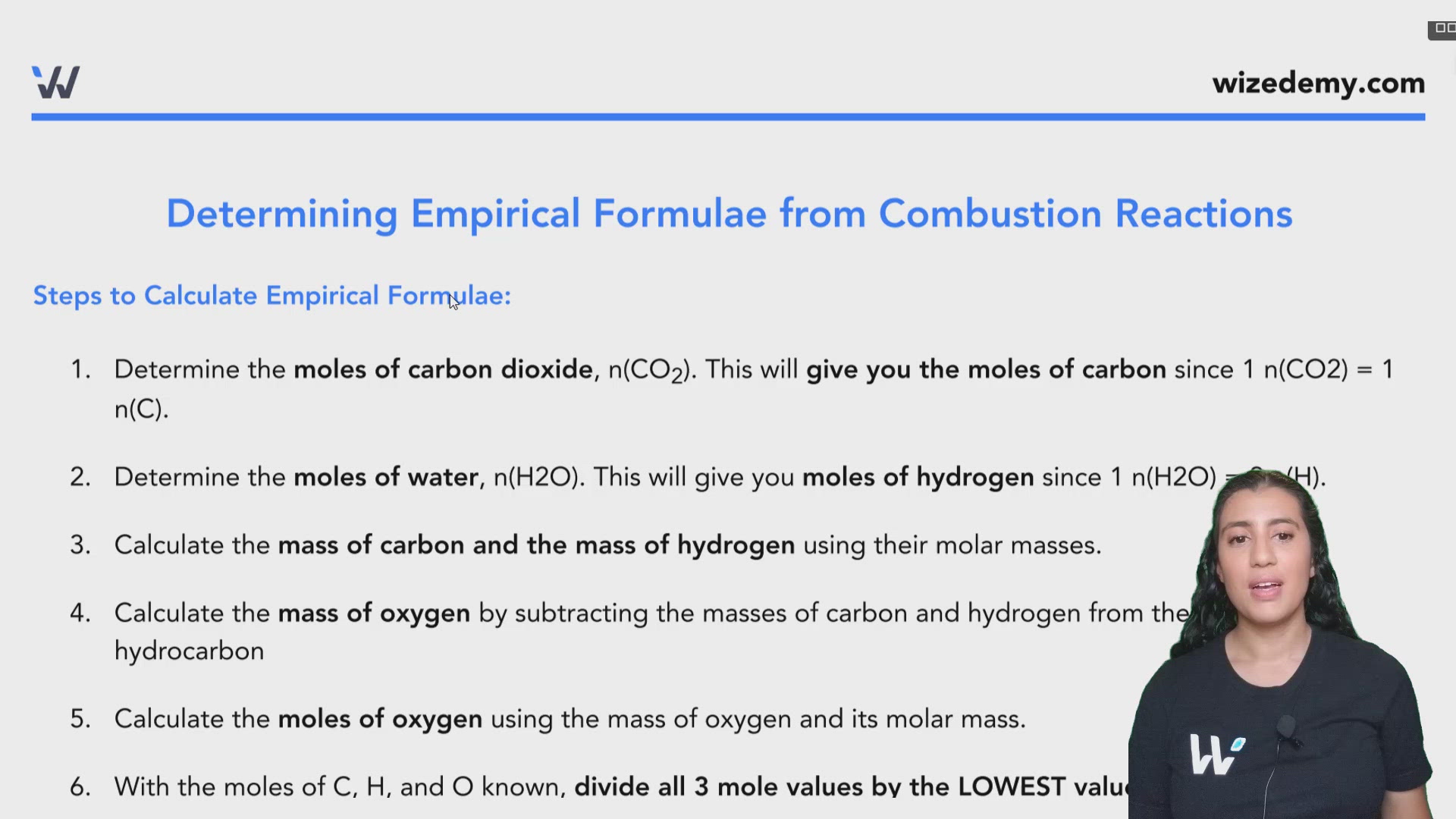
Determining Empirical Formulae from Combustion Reactions
Steps to Calculate Empirical Formulae:
- Determine the moles of carbon dioxide, n(CO2). This will give you the moles of carbon since 1 n(CO2) = 1 n(C).
- Determine the moles of water, n(H2O). This will give you moles of hydrogen since 1 n(H2O) = 2 n(H).
- Calculate the mass of carbon and the mass of hydrogen using their molar masses.
- Calculate the mass of oxygen by subtracting the masses of carbon and hydrogen from the mass of the hydrocarbon
- Calculate the moles of oxygen using the mass of oxygen and its molar mass.
- With the moles of C, H, and O known, divide all 3 mole values by the LOWEST value. If there are any fractions, multiply by a common factor to get whole numbers.
0:00 / 0:00
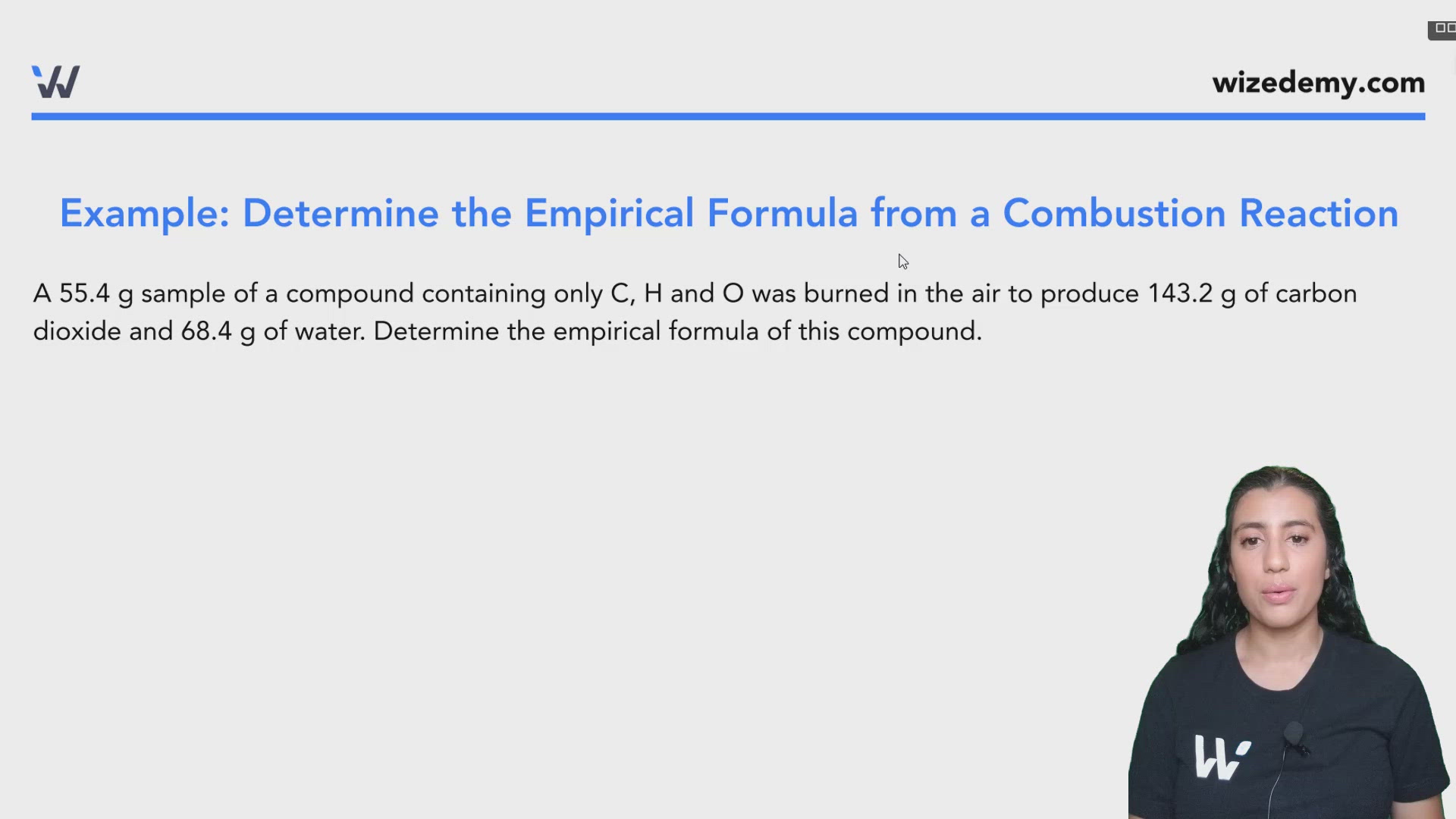
Example: Determine Empirical Formula from a Combustion Reaction
A 55.4 g sample of a compound containing only C, H and O was burned in the air to produce 143.2 g of carbon dioxide and 68.4 g of water. Determine the empirical formula of this compound.
1)
2)
3)
4)
5)
6)
Practice: Combustion Analysis Calculation
When 2.11 g of an unknown hydrocarbon (compound made up of only carbon and hydrogen atoms) was burned in excess oxygen as part of a combustion analysis. In the process 6.32 g of CO2 and 3.45 g of H2O are produced. What is the empirical formula of the hydrocarbon?