Wize University Chemistry Textbook > Periodic Table Trends
Electron Affinity Trend
Popular Courses
MCAT
General Course
Grade 12 Chemistry
Ontario High School
Grade 12 Chemistry
Canada High School
CHEM 1301A/B
Western University
CHEM 201
University of Calgary
General Chemistry
University Study Guides
AP Chemistry Exam Prep Course
AP Exam Prep
CHEM 1A03
McMaster University
CHEM 101
University of Alberta
CHEM 112
Queen's University
CHEM 121
University of British Columbia
High School Chemistry
US High School
DAT
General Course
Chemistry
General Course
General Chemistry
University Study Guides
CHEM 103
University of Alberta
CHEM 110
McGill University
CHEM 1E03
McMaster University
ENGG 204
University of Calgary
CHM135H1
University of Toronto
0:00 / 0:00
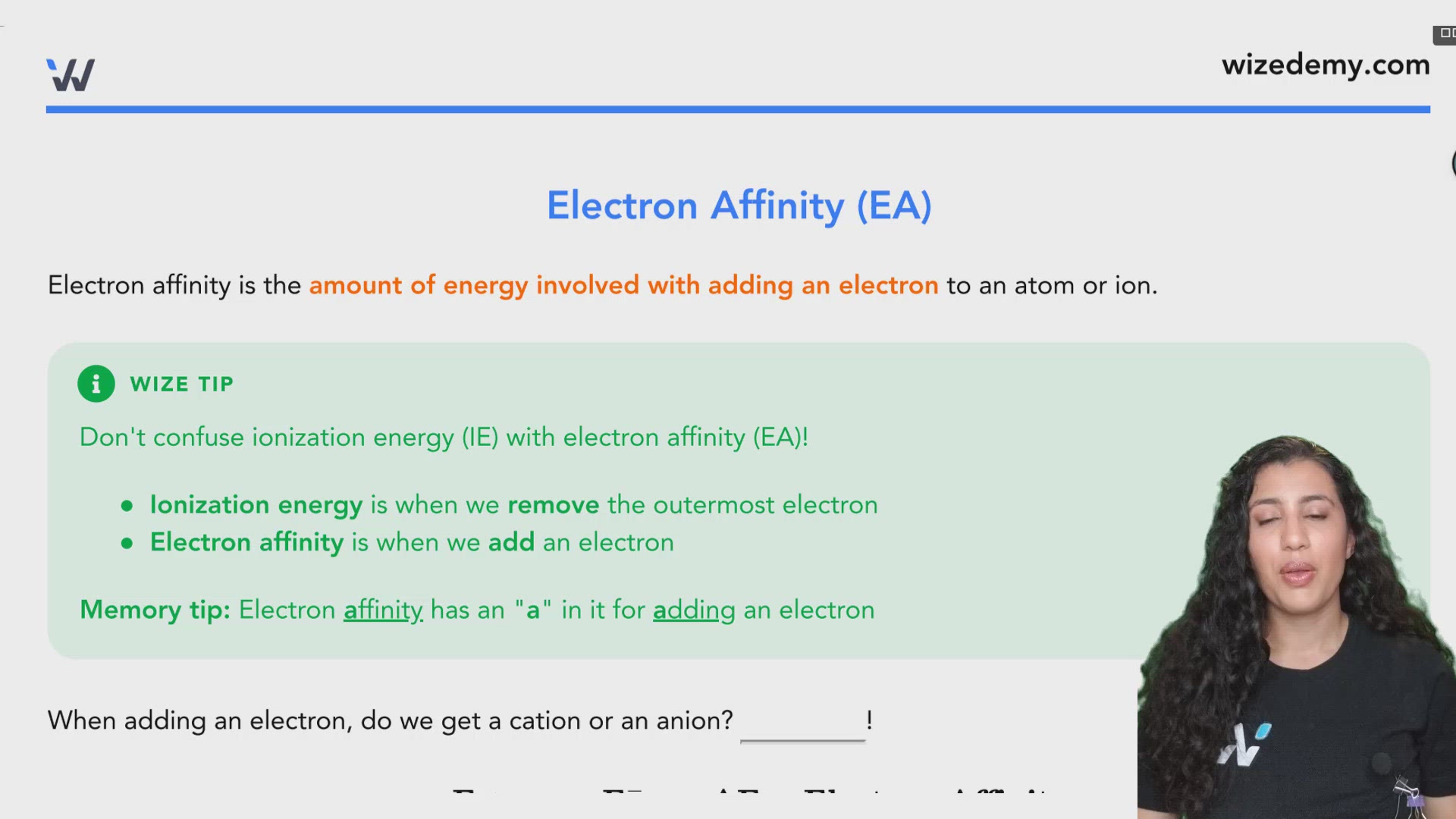
Electron Affinity (EA)
Electron affinity is the amount of energy involved with adding an electron to an atom or ion.
Wize Tip
Don't confuse ionization energy (IE) with electron affinity (EA)!
- Ionization energy is when we remove the outermost electron
- Electron affinity is when we add an electron
Memory tip: Electron affinity has an "a" in it for adding an electron
When adding an electron, do we get a cation or an anion?
anion
!- If EA is negative → energy is released/absorbed:released
- If this is the case, would the atom go to a higher/lower E state?lower
- This means the atom has become more/lessmorestable as a result of adding an electron
- Did this atom like or dislike having an electron added to it?like
- If EA is positive → energy is released/absorbed:absorbed
- If this is the case, would the atom go to a higher/lower E state?higher
- This means the atom has become more/less stablelessstable as a result of adding an electron
- Did this atom like or dislike having an electron added to it?dislike
Watch Out!
Use a negative EA as a reference point, unless the question states otherwise.
- This means that unless specified otherwise, when asked which element would have the largest electron affinity, assume they mean largest NEGATIVE electron affinity.
- This would mean that the element really liked getting an electron and lost energy, resulting in a more stable form.
The Periodic Trend
In general, as Zeff increases, the incoming electron experiences a greater electrostatic attraction and stabilization leading to a greater (negative) electron affinity

What about noble gases?
Do you think a noble gas would have a positive or negative electron affinity?
Positive
- Are noble gases stable?Yes!
- Would a noble gas want another electron added?No!
- If you tried to add an electron to a noble gas would that require energy or release energy?Require energy
Watch Out!
This trend excludes noble gases. Noble gases have stable, completely filled shells. Adding electrons to noble gases will break the noble gas configuration.
0:00 / 0:00
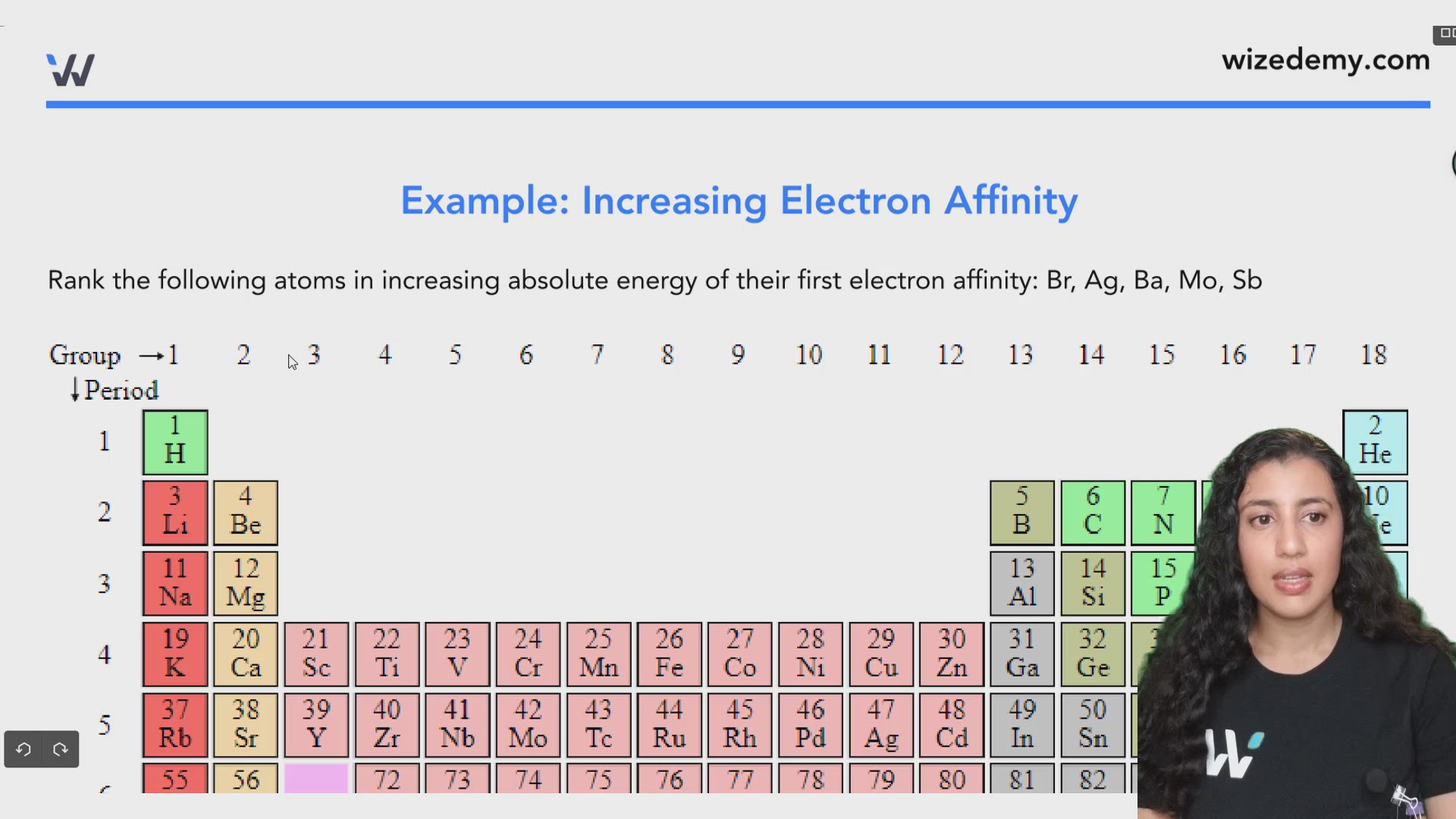
Example: Increasing Electron Affinity
Rank the following atoms in increasing absolute energy of their first electron affinity: Br, Ag, Ba, Mo, Sb

Ba < Mo < Ag < Sb < Br
Practice: Positive Electron Affinity
For most elements, the first electron affinity is negative; however, a few elements have a positive first electron affinity. Which atom has the most positive first electron affinity?
Practice: Highest Electron Affinity
Which of the following has the highest electron affinity?