Wize University Chemistry Textbook > Stoichiometry
Empirical vs Molecular Formulae
Popular Courses
CHEM 1301A/B
Western University
General Chemistry
University Study Guides
AP Chemistry Exam Prep Course
AP Exam Prep
CHEM 101
University of Alberta
DAT
General Course
CHM 1311
University of Ottawa
Chemistry
General Course
CHEM 103
University of Alberta
General Chemistry
University Study Guides
CHEM 120
University of Waterloo
CHEM 205
Concordia University
CHEM 121
Simon Fraser University
CHEM 120
McGill University
APSC 131
Queen's University
CHEM 130
University of British Columbia
CHEM 1100
University of Manitoba
CHEM 1481
Texas A & M University
CEM 141
Michigan State University
CHMA10H3
University of Toronto
SC/CHEM 1100 4.00
York University
0:00 / 0:00
Empirical Vs Molecular Formulas
Molecular Formulas
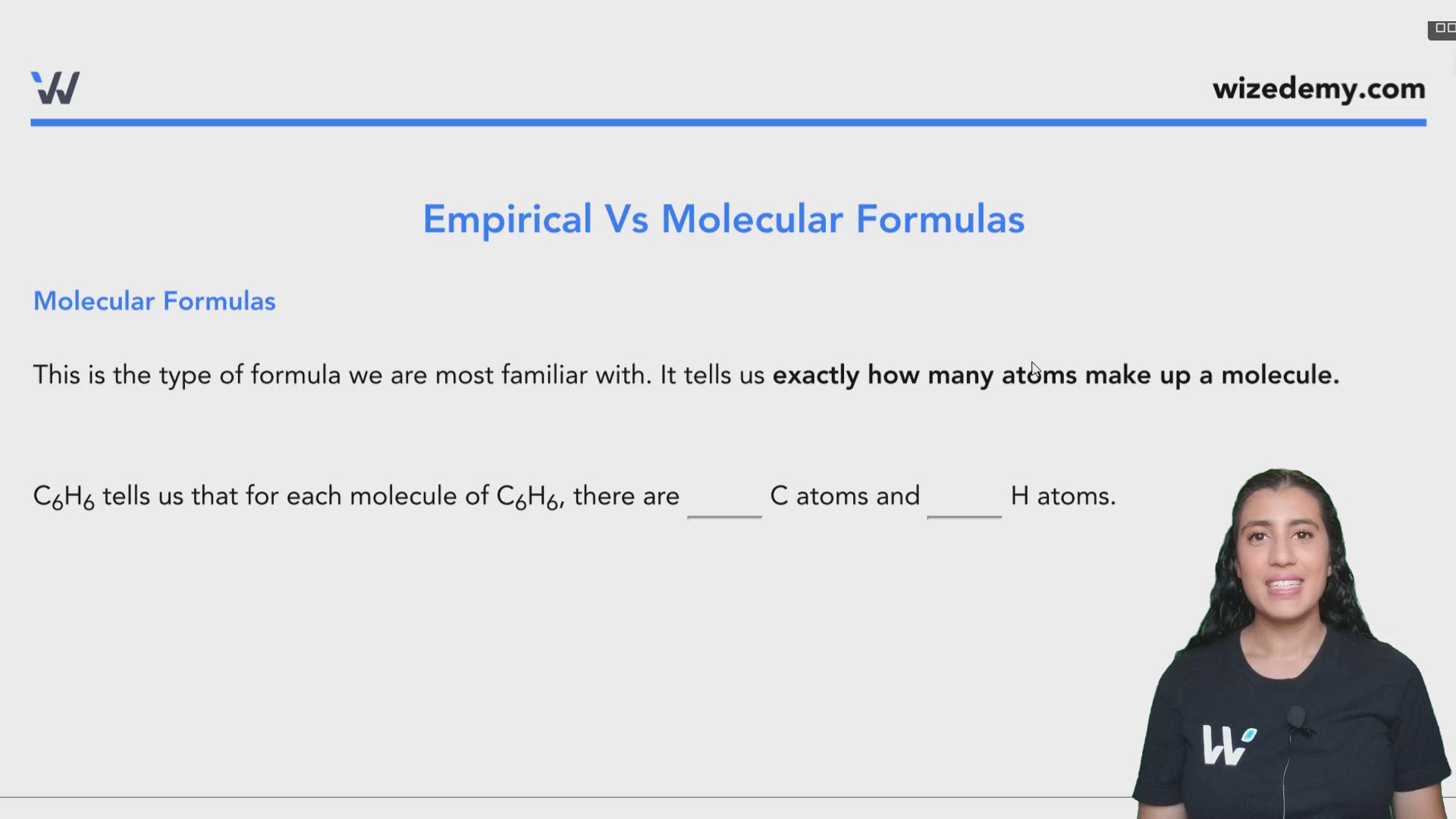
This is the type of formula we are most familiar with. It tells us exactly how many atoms make up a molecule.
Example:
C6H6 tells us that for each molecule of C6H6, there are
6
C atoms and 6
H atoms.Empirical Formulas
If we know the molecular formula, we can find the empirical formula by dividing the number of atoms by the greatest common factor.
You can think of the empirical formula as the smallest possible "unit" of the molecular formula.
Example:
The empirical formula of C6H6 would be:
CH
Example: Empirical Formulas
What are the empirical formulas of the following molecules?
C6H12O6 :
CH2O
Here we have 6 C atoms, 12 H atoms, and 6 O atoms per molecule.
The greatest common factor (the highest whole number that can go into 6 and 12) is 6!
Divide all 3 numbers by 6 to get the numbers of atoms in the empirical formula!
C5H12O :
C5H12O
Here we have 5, 12 and 1. The GCF that can go into all 3 of these numbers is just 1.
When we divide the numbers by 1 we get the same numbers and so in this case, the molecular formula is the same as the empirical formula!
N2O4 :
NO2
We have 2 and 4. The GCF that can go into both these numbers is 2. When we divide these numbers by 2 we get 1 and 2!