Wize University Chemistry Textbook > Intermolecular Forces and Physical Properties
Other Intermolecular Forces (more detailed)
Popular Courses
MCAT
General Course
CHEM 1301A/B
Western University
CHEM 201
University of Calgary
General Chemistry
University Study Guides
AP Chemistry Exam Prep Course
AP Exam Prep
CHEM 1A03
McMaster University
CHEM 101
University of Alberta
CHEM 121
University of British Columbia
DAT
General Course
Chemistry
General Course
CHEM 103
University of Alberta
General Chemistry
University Study Guides
CHEM 110
McGill University
CHEM 121
Simon Fraser University
CHEM 120
McGill University
CHEM 212
McGill University
CHEM 130
University of British Columbia
CHEM 1100
University of Manitoba
CHEM 1481
Texas A & M University
CEM 141
Michigan State University

0:00 / 0:00
Types of Intermolecular Forces
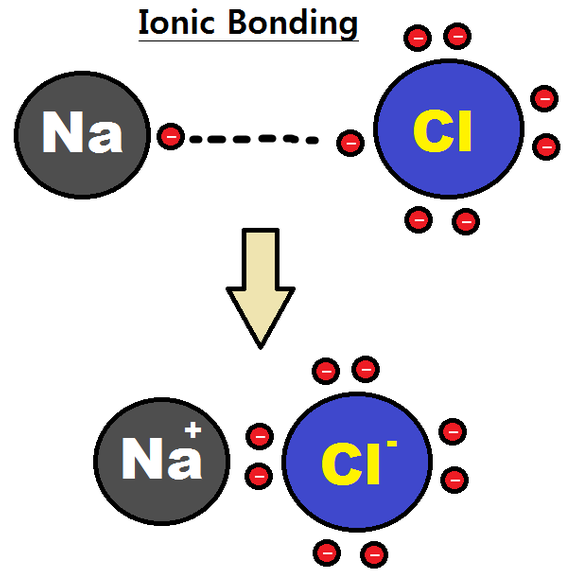
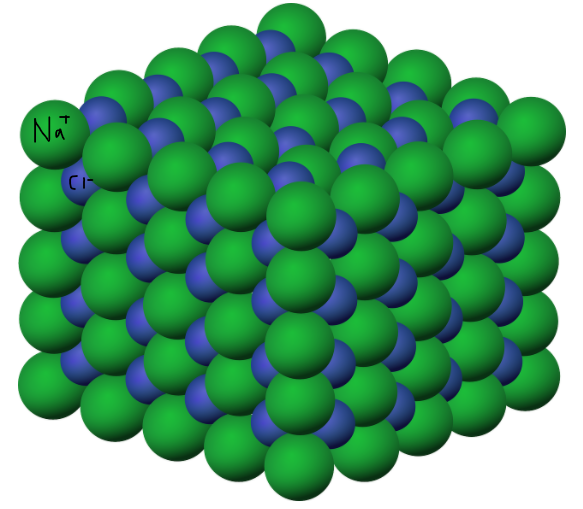
Ion - Ion
- Oppositely charged ions held together by electrostatic attraction
- aka Ionic bonding (Ionic bonding is an intramolecular bond between a non-metal and a metal)
- Strongest intermolecular force
Ion - Dipole
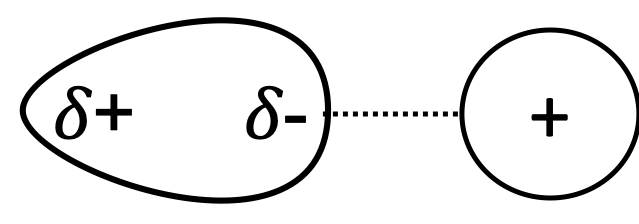
- Involves an ion interacting with a polar molecule (molecule with a net dipole)
- A positively charged ion will interact with the δ– side of the polar molecule
- A negatively charged ion will interact with the δ+ side of the polar molecule
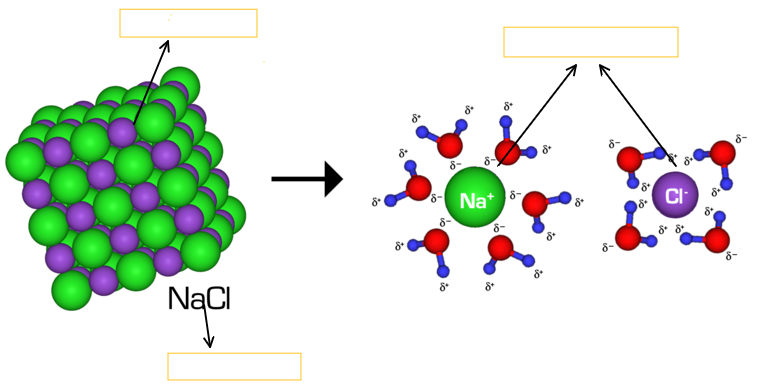
Blank on top left: ion-ion interactions
Blank on bottom left: ionic bond
Black on top right: ion-dipole
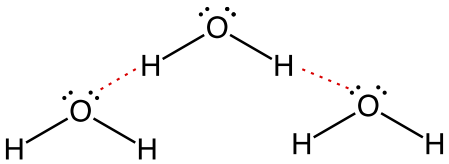
Hydrogen Bonding
- Hydrogen bonded to N, O, or F is attracted to lone pairs of electrons on other N, O or F
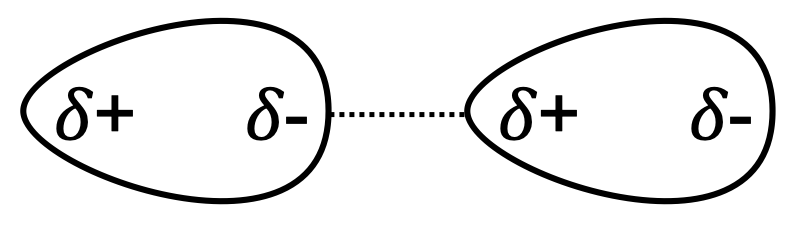
Dipole - Dipole
- Interaction between two polar molecules
- Opposite dipoles attract (δ– and δ+)
Ion - Induced Dipole:
- Ion causes a temporary dipole in non-polar species
- In the example below, the positively charged ion makes the non-polar species shift its electrons towards the positive charge, creating an uneven charge distribution in the non-polar species

Dipole - Induced Dipole
- Polar molecule causes a temporary dipole in non-polar species
- Similar to ion-induced dipole, except that in dipole-induced dipole it is a polar molecule instead of an ion that induces a temporary dipole in the non-polar species
- Weaker than ion-induced dipole forces

Induced Dipole - Induced Dipole
- Molecules interact randomly and distort each other's electron clouds, causing temporary dipoles
- Electrons randomly move around and at one point, more electrons may be on one side than the other in a non-polar molecule, creating a temporary dipole. That can happen with another non-polar molecule as well and the two can interact
- We call this random movement of electrons polarizability
- aka London dispersion forces (all molecules have this)

Intermolecular Forces
Intermolecular forces = forces between molecules

0:00 / 0:00
Example: Recognizing Intermolecular Forces
Choose the strongest type of interaction two of the same molecule pictured to the left as Lewis structures, will have with one another
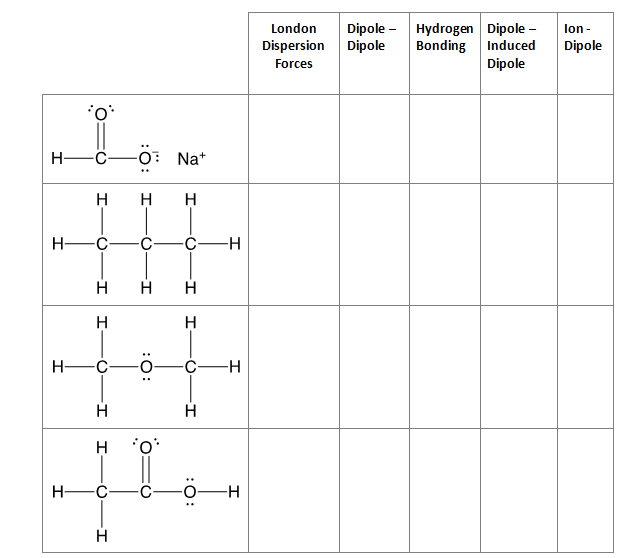
a) Ion-ion is not a choice here so the best option is ion-dipole (Na+ is the ion and HCOO- is the polar molecule)
b) London dispersion forces. This molecule is non-polar (no dipoles, no ions, no hydrogen bonding)
c) In the line diagram, 2 lone pairs are drawn on top of the oxygen atom, creating a polar molecule. The O is not bound to a H so hydrogen bonding is not possible. Dipole-dipole interactions are present in polar molecules.
d) Hydrogen bonding. This molecule is polar and has dipole-dipole forces but it also has hydrogen bonding, which is stronger. We can tell it has hydrogen bonding because the O is bound to a H.
0:00 / 0:00
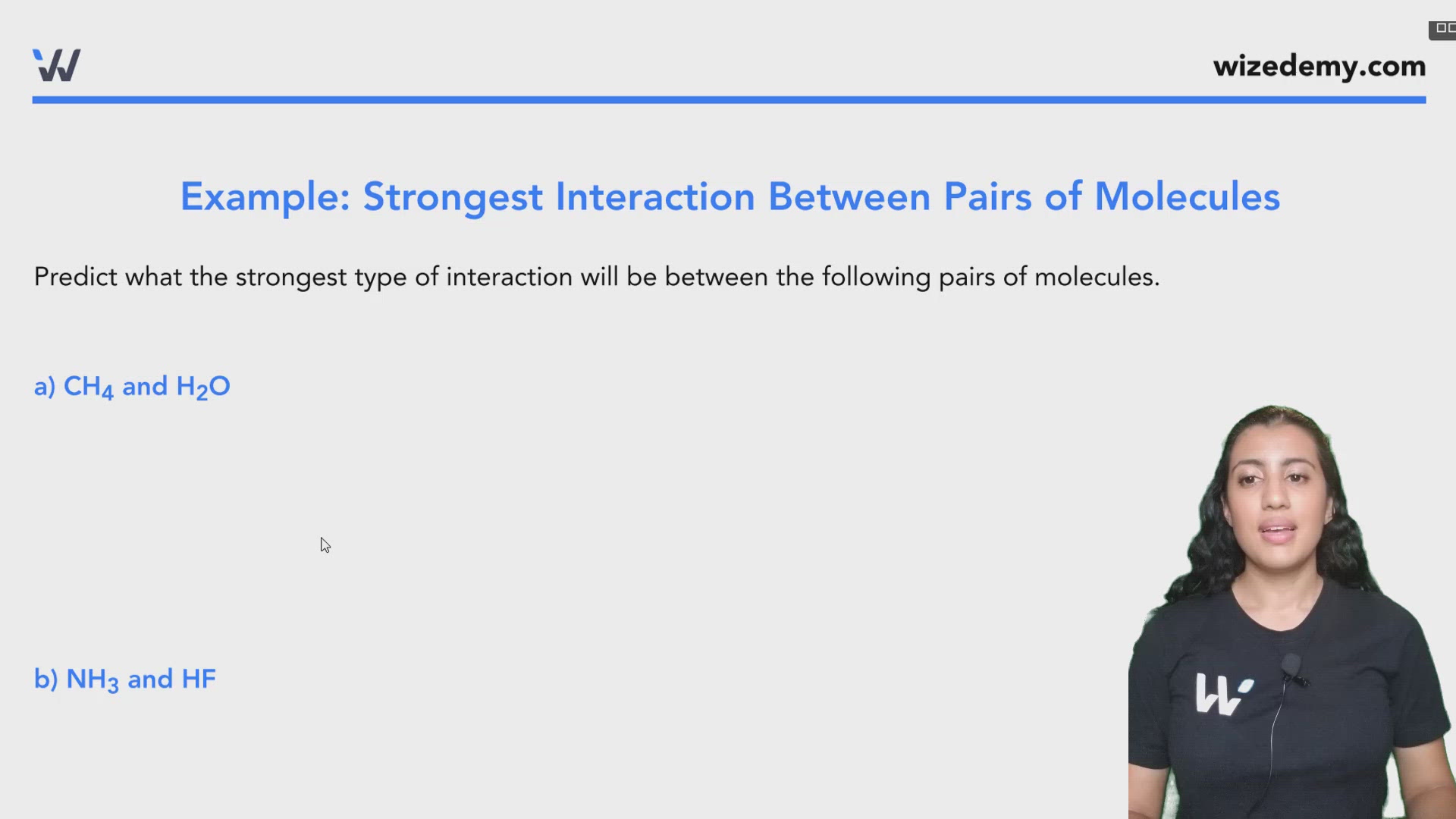
Example: Strongest Interaction Between Pairs of Molecules
Predict what the strongest type of interaction will be between the following pairs of molecules.
a) CH4 and H2O
Dipole-Induced dipole
b) NH3 and HF
This is a special case of dipole-dipole interactions called hydrogen bonding.
c) NaCl and H2O
Ion-Dipole (I-D).
d) H2 and Cl2
Induced Dipole-Induced Dipole (ID-ID) aka London dispersion forces
Practice: Ranking Intermolecular Interactions
Based on the three examples below, rank the strength of the intermolecular interaction from highest to lowest.
A) NH3 with NH3 B) CH4 with Ne C) Ca2+ with H2O
Practice: Intermolecular Forces
A student mixes HF with PCl3 at 0°C and forms a liquid mixture. What types of intermolecular forces are present between the two components of this liquid mixture, HF and PCl3?