Wize University Chemistry Textbook > Intermolecular Forces and Physical Properties
Intermolecular Forces
Popular Courses
MCAT
General Course
CHEM 1301A/B
Western University
CHEM 201
University of Calgary
General Chemistry
University Study Guides
AP Chemistry Exam Prep Course
AP Exam Prep
CHEM 1A03
McMaster University
CHEM 101
University of Alberta
CHEM 112
Queen's University
CHEM 121
University of British Columbia
CHEM*1040
University of Guelph
DAT
General Course
Chemistry
General Course
CHEM 1AA3
McMaster University
CHEM 103
University of Alberta
General Chemistry
University Study Guides
CHEM 110
McGill University
CHM135H1
University of Toronto
CHEM 154
University of British Columbia
CHEM 101
University of Victoria
CHEM 120
University of Waterloo

0:00 / 0:00
Intramolecular vs Intermolecular Forces
Intramolecular Forces: A force acting between atoms within a molecule. These forces are relatively strong.
Examples: covalent bonding, ionic bonding
Intermolecular Forces: Attractive forces (electrostatic in nature) acting between molecules, atoms, ions. These forces are relatively weak.
- Hydrogen bonding
- Dipole Dipole
- London Dispersion Forces/Van der Waals forces
Wize Tip
"Intra" means within while "inter" means between!

Does the bond that is "sewn" with a needle represent an intramolecular or intermolecular bond/force?
Intramolecular Bond
Does the band that is attached by a velcro strap represent an intramolecular or intermolecular bond/force?
Intermolecular Force
What do you think will happen if we try to pull the water molecules apart? Which forces would break first?
Intermolecular forces will be broken first. This makes it clear that intramolecular forces are stronger.
Intermolecular forces are broken by physical changes (ex. boiling a liquid into a gas breaks apart the intermolecular forces which is why the gas molecules are able to spread far out from one another)
0:00 / 0:00
Intermolecular Forces
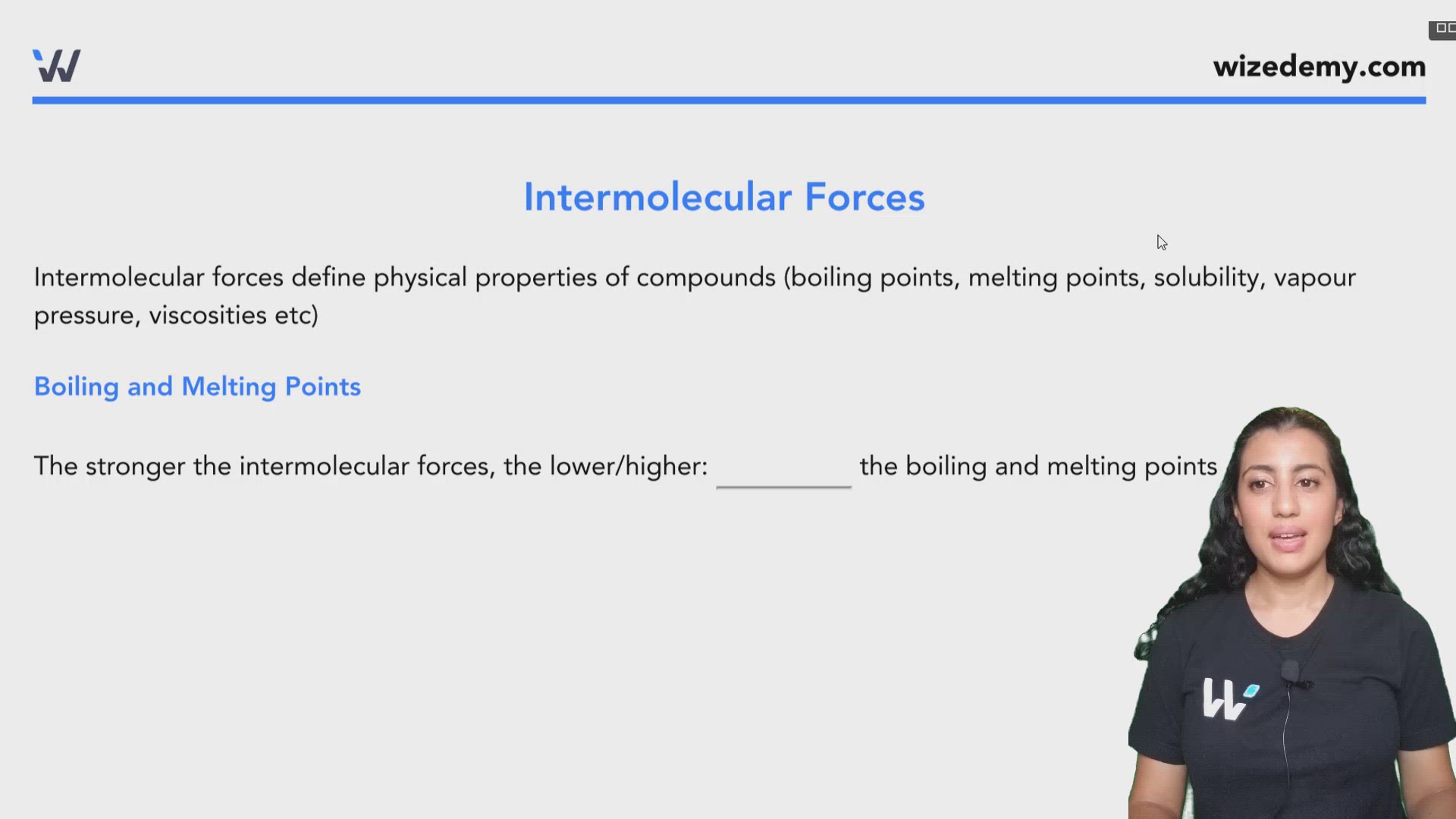
Intermolecular forces define physical properties of compounds (boiling points, melting points, solubility, vapour pressure, viscosities etc)
Boiling and Melting Points
The stronger the intermolecular forces, the lower/higher:
higher
the boiling and melting pointsIntermolecular Forces
1. Hydrogen Bonding
Wize Concept
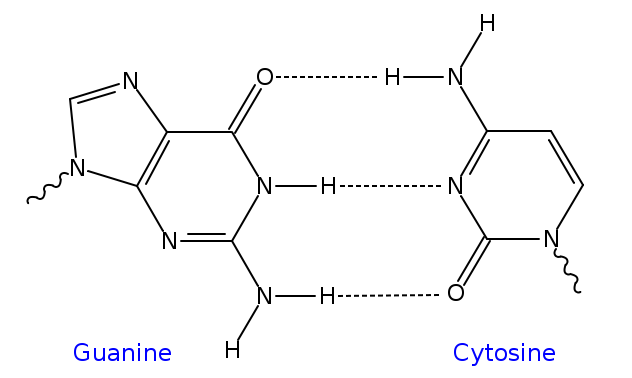
To form a H bond you Need:
A H from H-F, H-O, or H-N bond to interact with a lone pair of electrons on another F, O, or N atom in a second molecule.

Wize Concept
Identifying features: Compound contains an O-H, N-H, or F-H bond.
Strength: The strongest intermolecular force.
Cause: The partial negative charge on the electronegative atom (N, O, or F) attracts the partial positive on the hydrogen atom that is bound to a highly electronegative atom (N, O, or F)
More H bonds=higher/lower:
higher
bpWize Tip
Recall the order of EN:
F > O > N > Cl > Br > I > S > C ~ H
F, O, and N are the most electronegative elements. We also know that F is more EN than O, and O is more EN than N.
This is why a hydrogen bond that involves F will be the strongest! O second strongest and N third strongest!
2. Dipole-Dipole Interactions
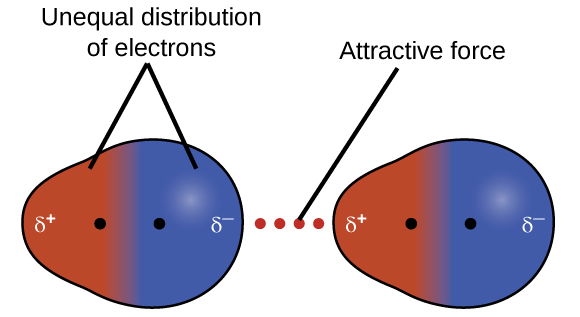
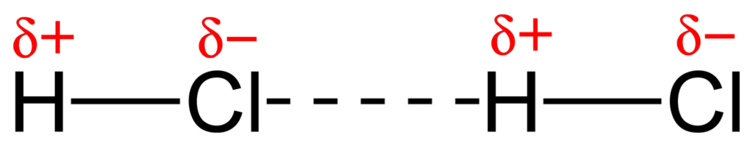
This happens when the positive end of one polar molecule interacts with the negative end of another polar molecule!
Watch Out!
Remember in order to be a polar molecule the molecule must have a net dipole!
Wize Concept
Identifying features: polar molecule
Strength: The second strongest intermolecular force.
Cause: Attraction of negative and positive charges (less extreme attraction than in H bonding)
3. London Dispersion Forces (LDF) (aka Van der Waals Forces)
These forces are involved in interactions between non-polar parts of molecules
This happens because a temporary instantaneous dipole can happen in a molecule as electrons move around. At a given moment they might not be evenly distributed, leading to a separation in charge. LDF is between 2 molecules with instantaneous dipoles.
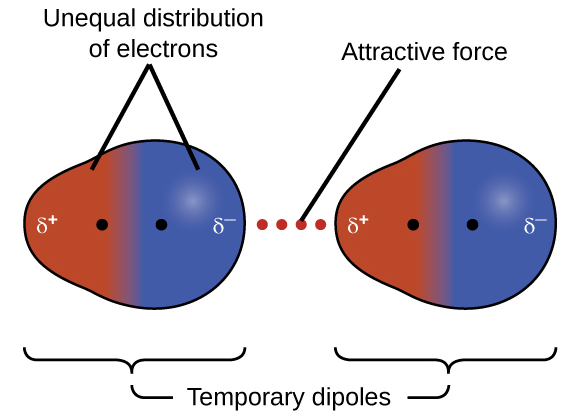
Wize Concept
Identifying features: All compounds have these forces!
Strength: The weakest intermolecular force.
Cause: The electrons of one molecule being attracted to the nuclei of another.
Soluble in: non-polar or polar substances?
non-polar
substances (Like Dissolves Like)Watch Out!
Molecules that can hydrogen bond have london dispersion forces and dipole-dipole interactions (because they are polar) as well!
But not all polar molecules (that have dipole-dipole forces) can hydrogen bond.
Example: Intermolecular Forces
Based on the interaction of the following two components, what is the strongest intermolecular force? What other forces can be found?

F is a very strongly electronegative atom, so we would expect to see a H with a partially positive charge and F with a partial negative charge. The partially negative F would interact with the partially positive H from the other molecule. Normally we would call this a Dipole-Dipole interaction, but as this is an interaction between F (a NOF element) and H, this is Hydrogen Bonding.
The other forces we can see would be London Dispersion forces, as all atoms and molecules will have these.
Example: Intermolecular Forces
What is the strongest intermolecular force that can be found for the following interaction? What other forces are present?
Xe and Ne
The only forces here are London Dispersion forces. There are no ions and no dipole available, so there can only be instantaneous dipoles needed for London Dispersion forces.
Practice: Strongest Intermolecular Force
Choose the strongest intermolecular forces in the following compounds.
HCF3