Wize University Chemistry Textbook > Chemical Reactions
Acids and Bases
Popular Courses
MCAT
General Course
General Chemistry
University Study Guides
AP Chemistry Exam Prep Course
AP Exam Prep
DAT
General Course
Chemistry
General Course
General Chemistry
University Study Guides
CHEM 1E03
McMaster University
CHEM 120
University of Waterloo
CHY 102
Toronto Metropolitan University
CHEM 205
Concordia University
CHEM 121
Simon Fraser University
CHEM 112B
Queen's University
CHY 103
Toronto Metropolitan University
CHEM 1100
University of Manitoba
CHEM 1481
Texas A & M University
CHMA10H3
University of Toronto
SC/CHEM 1100 4.00
York University
CHEM 1035
Virginia Tech
CHM 2045
University of Florida
CHEM 1001
Carleton University
0:00 / 0:00
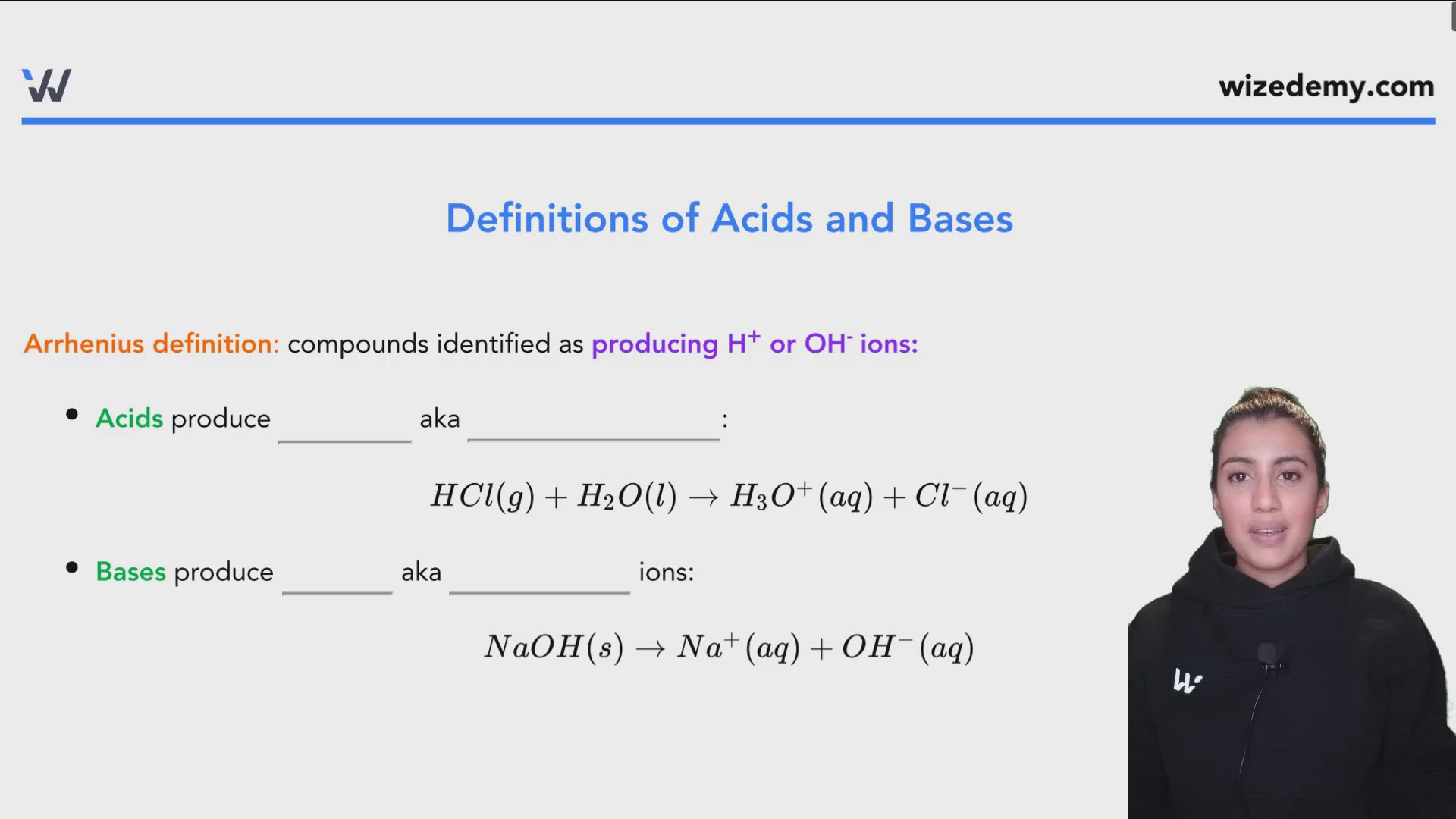
Definitions of Acids and Bases
Arrhenius definition: compounds identified as producing H+ or OH- ions:
- Acids produceH3O+akahydronium ions:
- Bases produceOH-akahydroxideions:
**Bronsted - Lowry definition: compounds identified as H+ acceptors or donors
- AcidsdonateH+ ions
- BasesacceptH+ ions
0:00 / 0:00
Acids
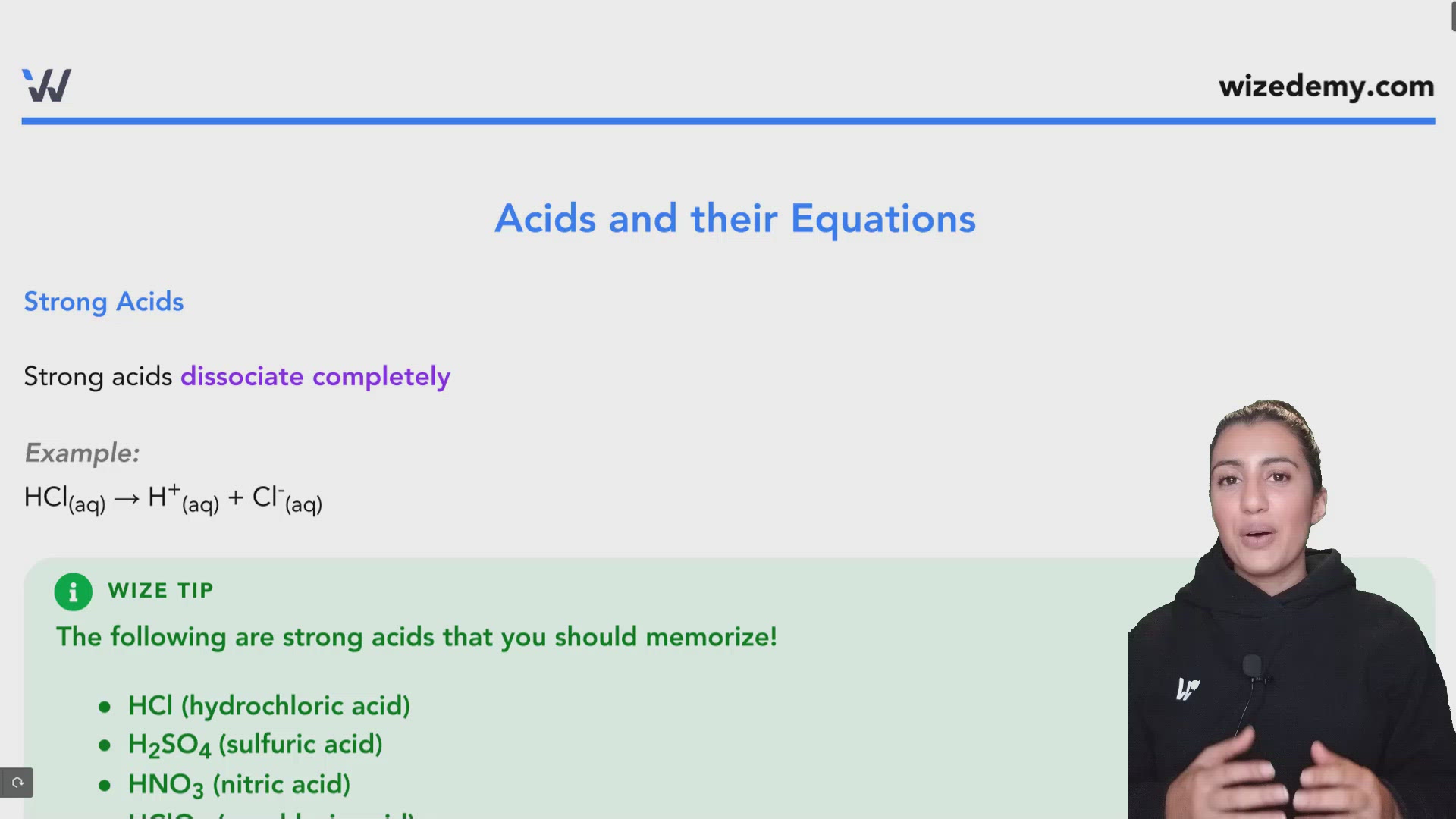
Strong Acids
Strong acids dissociate completely.
Example:
HCl(aq) → H+(aq) + Cl-(aq)
Wize Tip
The following are strong acids that you should memorize!
- HCl (hydrochloric acid)
- H2SO4 (sulfuric acid)
- HNO3 (nitric acid)
- HClO4 (perchloric acid)
- HBr (hydrobromic acid)
- HI (hydroiodic acid)
Weak Acids
Weak acids dissociate incompletely.
0:00 / 0:00
Bases
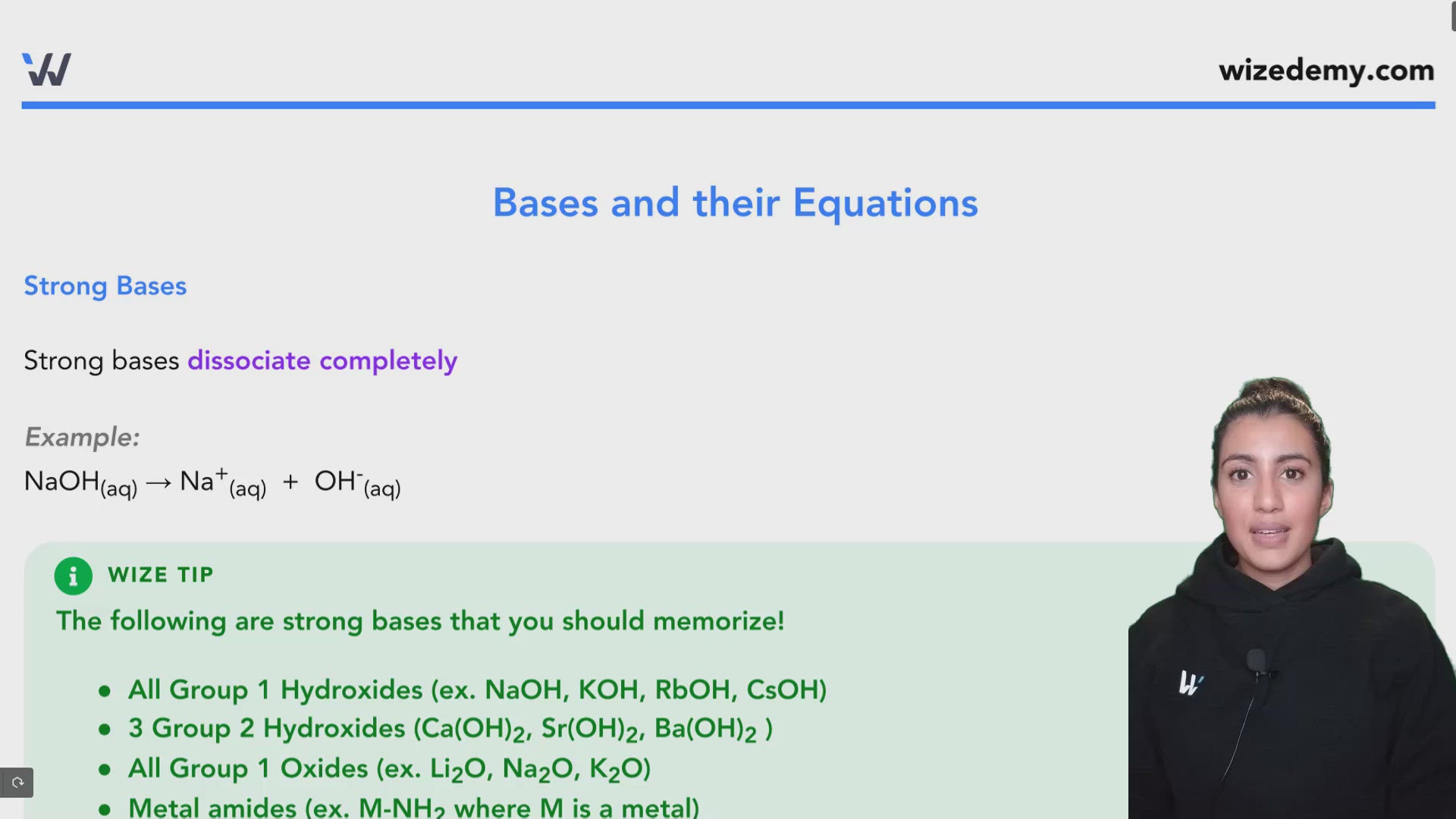
Strong Bases
Strong bases dissociate completely.
Example:
NaOH(aq) → Na+(aq) + OH-(aq)
Wize Tip
The following are strong bases that you should memorize!
- All Group 1 Hydroxides (ex. NaOH, KOH, RbOH, CsOH)
- 3 Group 2 Hydroxides (Ca(OH)2, Sr(OH)2, Ba(OH)2 )
- All Group 1 Oxides (ex. Li2O, Na2O, K2O)
- Metal amides (ex. M-NH2 where M is a metal)
Weak Bases
Weak bases dissociate incompletely.
Neutralization Reactions
Neutralization reaction: a reaction where an acid and a base react together to produce a salt and water
Example:
NaOH(aq) + HCl(aq) → NaCl(s) + H2O(l)