Wize University Chemistry Textbook > Chemical Reactions
Net Ionic Equations
Popular Courses
MCAT
General Course
General Chemistry
University Study Guides
AP Chemistry Exam Prep Course
AP Exam Prep
CHEM 1A03
McMaster University
DAT
General Course
Chemistry
General Course
General Chemistry
University Study Guides
CHEM 1E03
McMaster University
CHEM 120
University of Waterloo
CHEM 205
Concordia University
CHEM 121
Simon Fraser University
CHEM 112B
Queen's University
CHEM 1100
University of Manitoba
CHEM 1481
Texas A & M University
CHMA10H3
University of Toronto
SC/CHEM 1100 4.00
York University
CHM 2045
University of Florida
CHEM 1035
Virginia Tech
CHEM 1001
Carleton University
CHEM 6A
University of California - San Diego
0:00 / 0:00
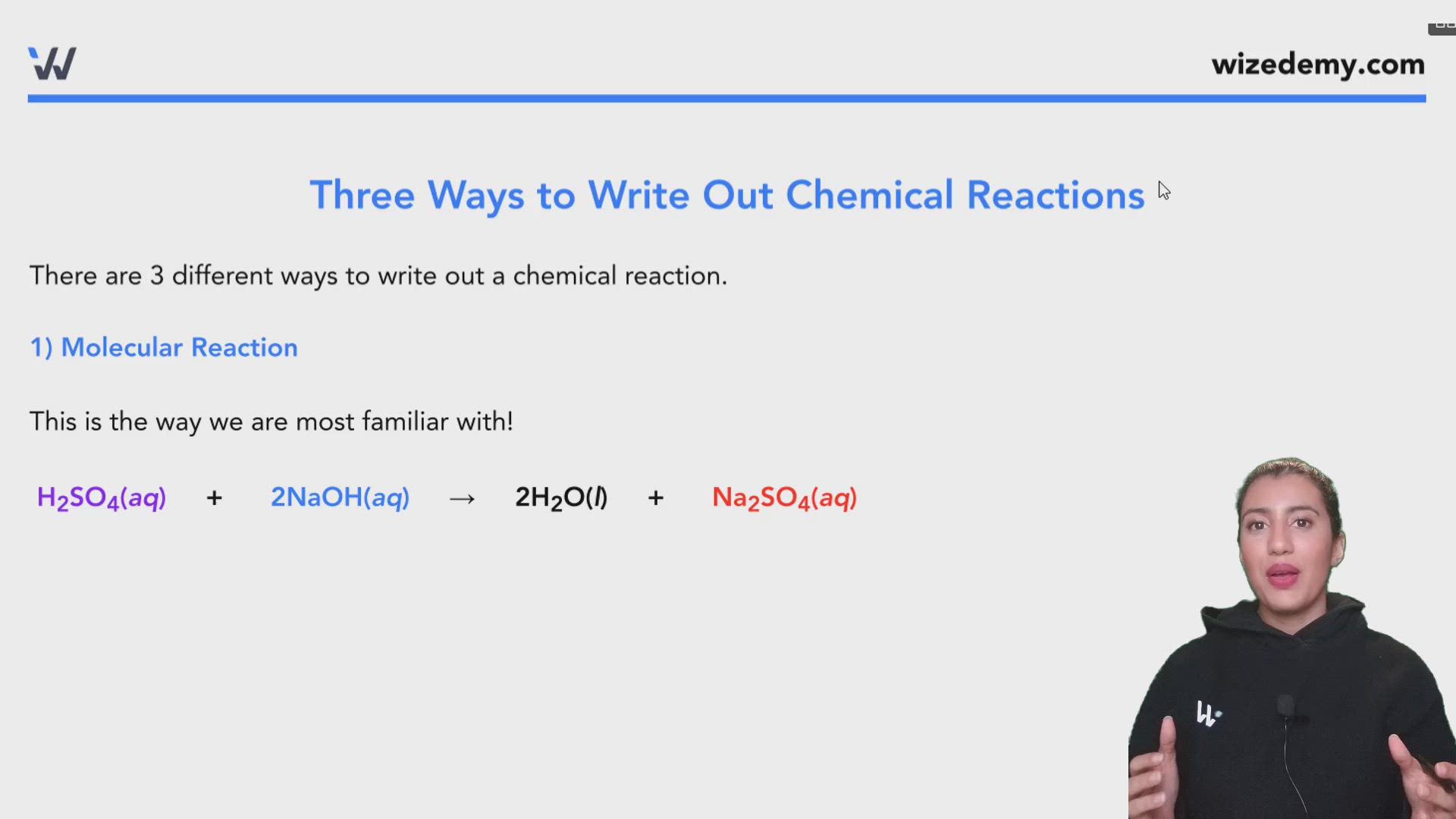
Three Ways to Write Out Chemical Reactions
There are 3 different ways to write out a chemical reaction.
1) Molecular Reaction
This is the way we are most familiar with!
H2SO4(aq) + 2NaOH(aq) → 2H2O(l) + Na2SO4(aq)
2) Complete Ionic Equation
To write the complete ionic equation, we need to look at the molecular reaction and identify which of the molecules can dissociate into ions. Then write out the equation with all of the ions.
Wize Tip
Things that won't dissociate include: solids, liquids, gases, weak acids, weak bases, and combinations of ions that we said are insoluble (from the solubility chart)
Things that will dissociate include: strong acids, strong bases, and combinations of ions that we said are soluble (from the solubility chart)


Next, since we figured out all the molecules that dissociate and balanced the equations, we just put all the ions into the equation so they replace the aqueous molecules:
2H+(aq) + SO42-(aq) + 2Na+(aq) + 2OH-(aq) → 2H2O(l) + 2Na+(aq) + SO42-(aq)
3) Net Ionic Equation:
For this equation, we just take the complete ionic equation and cross anything out that appears in equal quantities on both sides so that we are left with the net equation.
Complete Ionic Equation:
2H+(aq) + SO42-(aq) + 2Na+(aq) + 2OH-(aq) → 2H2O(l) + 2Na+(aq) + SO42-(aq)
2H+(aq) + 2OH-(aq) --> 2H2O(l)
and this can be further simplified to get the net ionic equation:
H+(aq) + OH-(aq) --> H2O(l)
Wize Tip
When we talk about ionic equations, you may see the term spectator ions used. Spectator ions are the ions that remain unchanged on both sides of the reaction. In this case, the spectator ions are SO42- and Na+.

Mark Yourself Question
- Grab a piece of paper and try this problem yourself.
- When you're done, check the "I have answered this question" box below.
- View the solution and report whether you got it right or wrong.
Practice: Three Ways to Write Chemical Reactions
Write the molecular, complete ionic and the net ionic equations for the following reaction:
Pb(NO3)2 (aq) + Na2SO4 (aq) → PbSO4 (s) + 2NaNO3 (aq)

0:00 / 0:00
Relating Net Ionic Equations to Ionization of Acids and Bases
Part 1
This is a molecular reaction between a (strong/weak)
strong
acid and a (strong/weak) strong
base.Review: What type of reaction is this?
Neutralization reaction
If we were asked for the Net Ionic Equation (NIE), then we would need to see which species in the reaction can fully dissociate into ions.
Will HCl(aq) fully dissociate?
Yes because strong acids fully dissociate.
Will NaOH(aq) fully dissociate?
Yes because strong bases fully dissociate.
Will NaCl(aq) fully dissociate?
Yes because it is a compound that has a group 1 ion in it (Na+), which makes it soluble and it will fully dissociate.
Will H2O(l) fully dissociate?
No because liquids do not dissociate.
Now we can write out the Complete Ionic Equation:
Finally, we just cross out anything that appears in equal amounts on both sides to get NIE:

Part 2

Now what about if we were asked to write the NIE for this reaction between a
Weak
Acid and Strong
Base: Review: What type of reaction is this?
Neutralization reaction
Will KOH fully dissociate?
Yes
Will HNO2 fully dissociate?
No
Will KNO2 fully dissociate?
Yes
Will H2O(l) fully dissociate?
No
So let's write out our Complete Ionic Equation:
(only change the species that can fully dissociate into ions, leave things that cannot fully dissociate as they are!)

Now just cross out what appears on both sides to get the NIE:
