Wize University Chemistry Textbook > Chemical Reactions
Strong, Weak, and Non-Electrolytes
Popular Courses
MCAT
General Course
General Chemistry
University Study Guides
CHEM 1A03
McMaster University
DAT
General Course
Chemistry
General Course
General Chemistry
University Study Guides
CHEM 1E03
McMaster University
CHM135H1
University of Toronto
CHEM 120
University of Waterloo
CHEM 205
Concordia University
CHEM 121
Simon Fraser University
CHEM 112B
Queen's University
CHEM 1100
University of Manitoba
CHEM 1481
Texas A & M University
CHMA10H3
University of Toronto
SC/CHEM 1100 4.00
York University
CHM 2045
University of Florida
CHEM 1035
Virginia Tech
CHEM 1001
Carleton University
CHEM 6A
University of California - San Diego
0:00 / 0:00
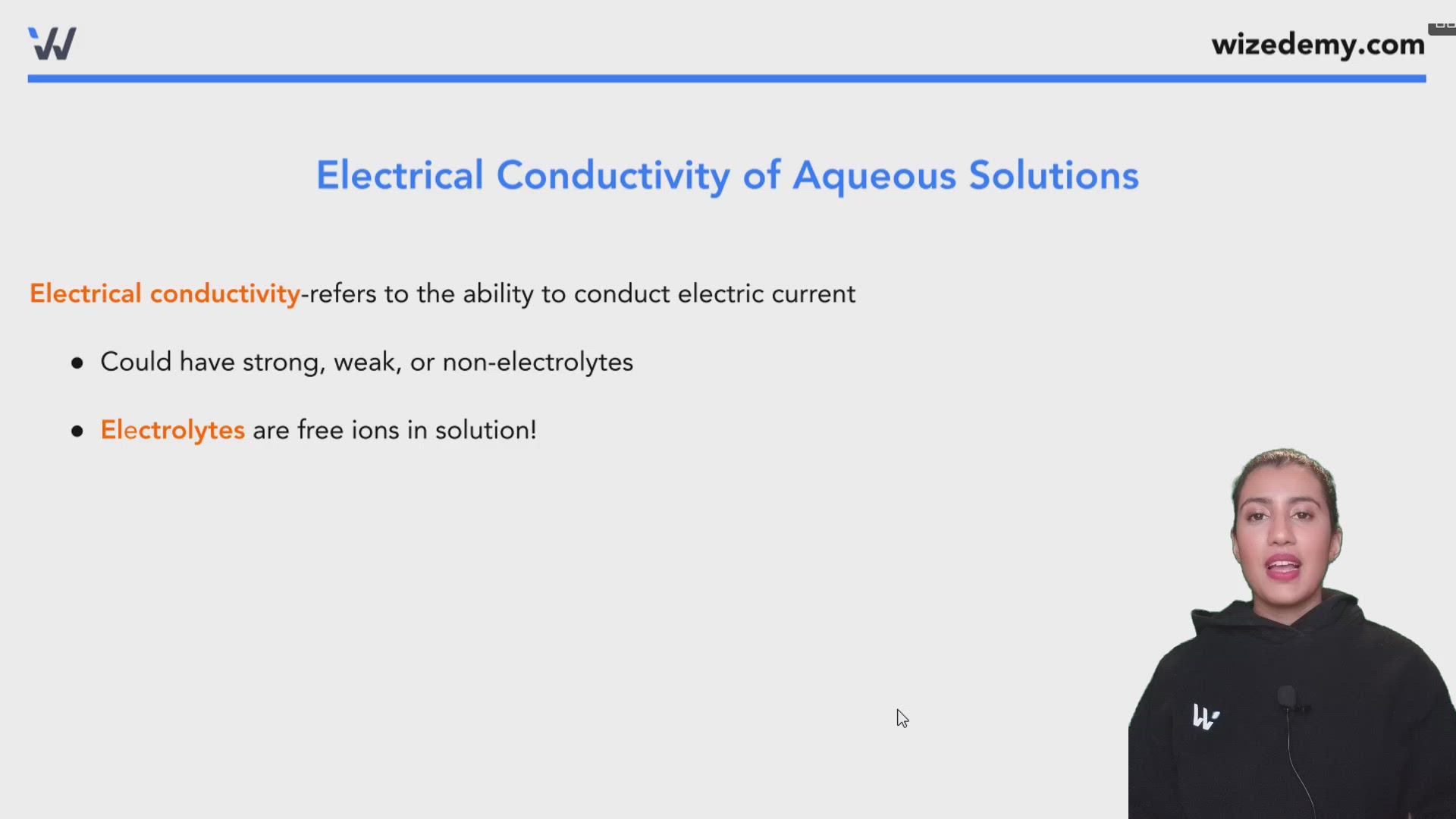
Electrical Conductivity of Aqueous Solutions
Electrical conductivity-refers to the ability to conduct electric current
- Could have strong, weak, or non-electrolytes
- Electrolytes are free ions in solution!
Strong Electrolytes-dissolve to give solutions that conduct electricity efficiently
Completely dissociate in solution
Examples: ionic compounds, strong acids, and strong bases
Example:
Weak Electrolytes-dissolve to give solutions that don't conduct as much as strong electrolytes
Only produce few ions when they dissolve in water
Examples: Weak acids and weak bases (do not fully dissociate like strong acids and strong bases do, will see an equilibrium instead)
Example:
Non-electrolytes-solutions that do not conduct electricity
Substances that dissolve in water but don't produce any ions
Example: Covalent compounds like CH3OH(aq)