Wize University Chemistry Textbook > Chemical Reactions
Oxidation States
Popular Courses
MCAT
General Course
Grade 12 Chemistry
Ontario High School
Grade 12 Chemistry
Canada High School
CHEM 1302A/B
Western University
General Chemistry
University Study Guides
AP Chemistry Exam Prep Course
AP Exam Prep
CHEM 1A03
McMaster University
CHEM 112
Queen's University
CHEM 112
Queen's University
High School Chemistry
US High School
Chemistry
General Course
DAT
General Course
General Chemistry
University Study Guides
CHEM 1E03
McMaster University
ENGG 204
University of Calgary
Chemistry 12
British Columbia High School
CHEM 102
University of Alberta
CHEM 120
University of Waterloo
CHEM*1050
University of Guelph
CHEM 205
Concordia University
0:00 / 0:00
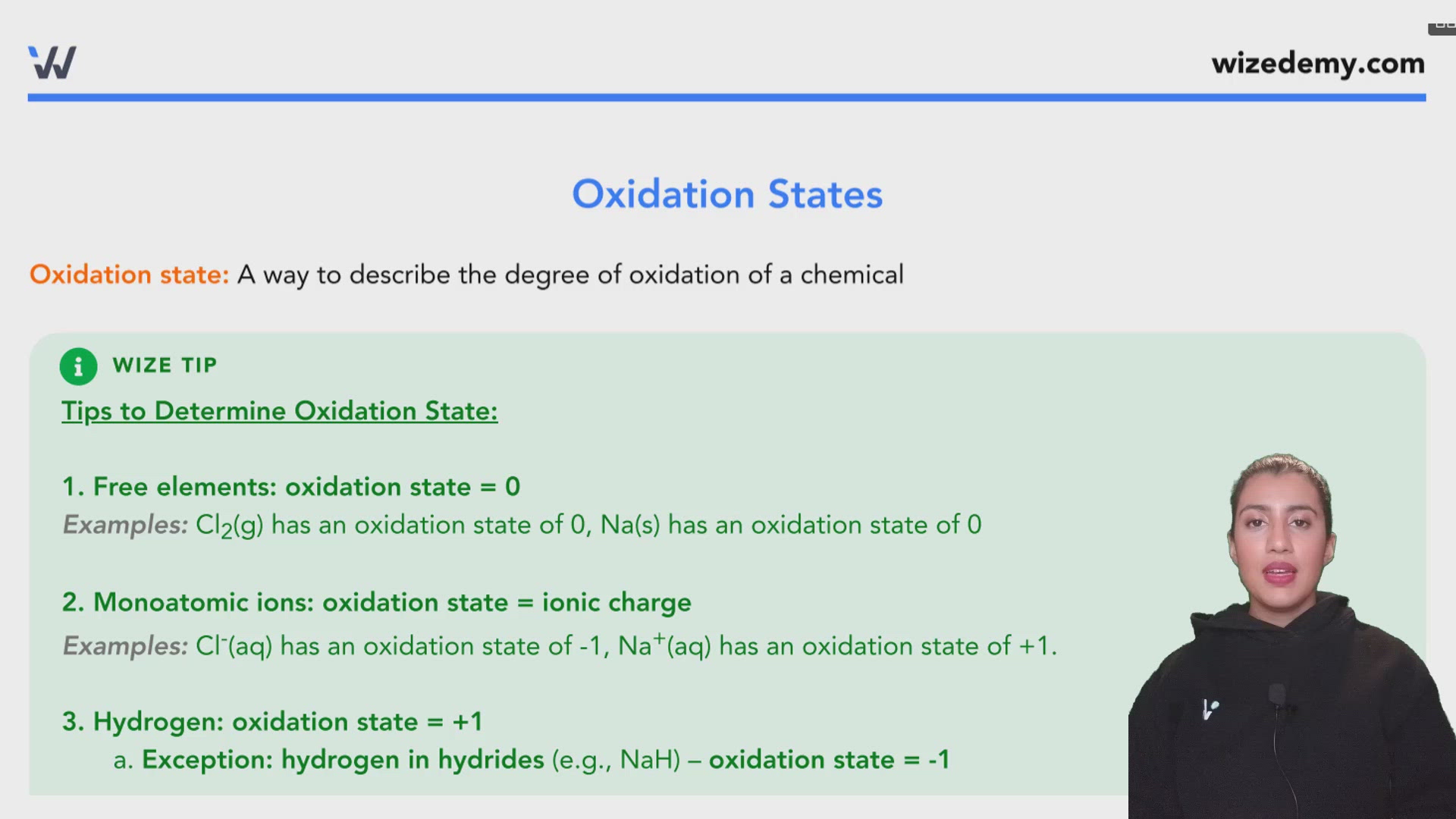
Oxidation States
Oxidation state: A way to describe the degree of oxidation of a chemical
Wize Tip
Tips to Determine Oxidation State:
1. Free elements: oxidation state = 0
Examples: Cl2(g) has an oxidation state of 0, Na(s) has an oxidation state of 0
2. Monoatomic ions: oxidation state = ionic charge
Examples: Cl-(aq) has an oxidation state of -1, Na+(aq) has an oxidation state of +1.
3. Hydrogen: oxidation state = +1
a. Exception: hydrogen in hydrides (e.g., NaH) – oxidation state = -1
4. Oxygen: oxidation state = -2
a. Exception: oxygen in peroxides (e.g., H2O2) – oxidation state = -1
5. For neutral molecules, oxidation numbers add up to zero.
For polyatomic ions, oxidation numbers add up to the ion charge.
Examples: Cl2(g) has an oxidation state of 0, NaCl oxidation numbers add up to 0, SO42- oxidation numbers add up to 2-.
0:00 / 0:00
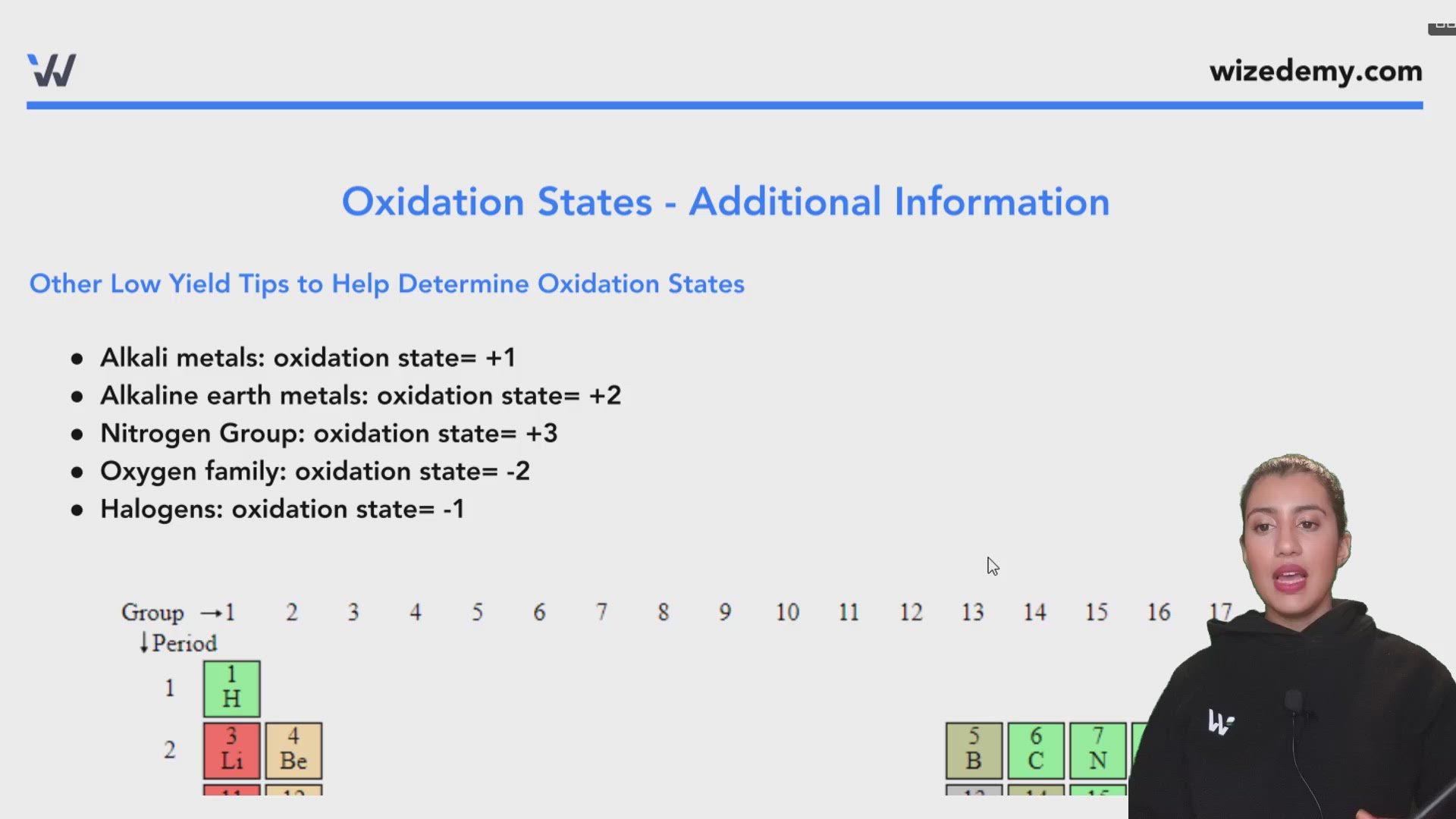
Oxidation States - Additional Information
Other Low Yield Tips to Help Determine Oxidation States
- Alkali metals: oxidation state= +1
- Alkaline earth metals: oxidation state= +2
- Nitrogen Group: oxidation state= -3
- Oxygen family: oxidation state= -2
- Halogens: oxidation state= -1
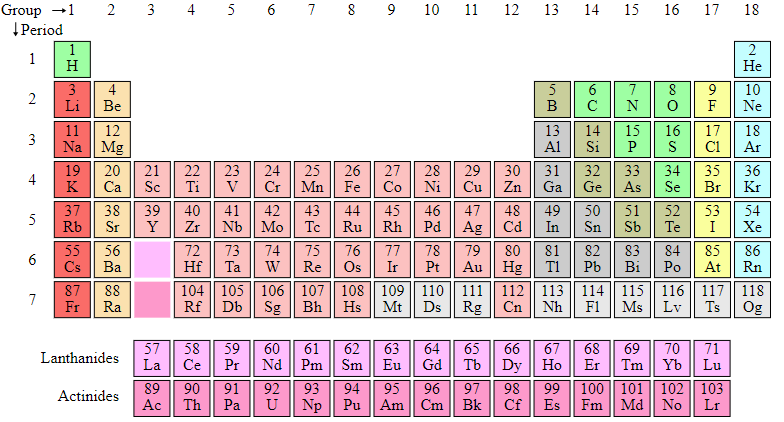
Note on Transition Metals
Transition metals can have different charges (ex. Pb2+ and Pb4+)
As a result, transition metals can also have different oxidation states!
Example:
What is the oxidation state of Cu in CuCl?
+1
What is the oxidation state of copper in Cu(NO3)2?
2+
When naming compounds involving transition metals, the oxidation state of the transition metal is written in Roman numerals and put in brackets:
- copper(I) chloride: CuCl
- copper(II) nitrate: Cu(NO3)2
0:00 / 0:00
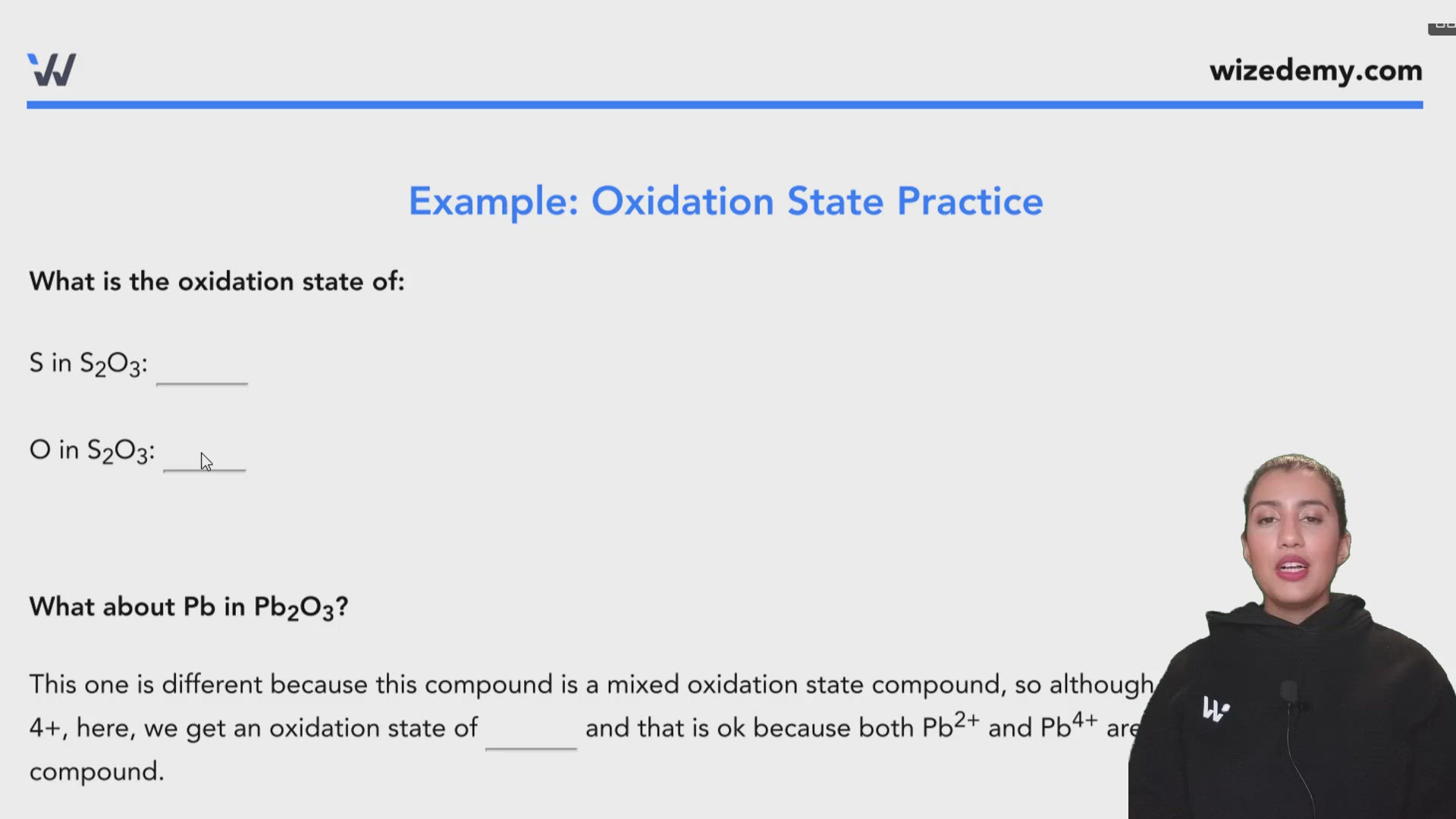
Example: Oxidation State Practice
What is the oxidation state of:
S in S2O3:
+3
O in S2O3:
-2
What about Pb in Pb2O3?
This one is different because this compound is a mixed oxidation state compound, so although Pb should have 2+ or 4+, here, we get an oxidation state of
3+
and that is ok because both Pb2+ and Pb4+ are present in the compound.What is the oxidation state of Br in BrO3- ?
What is the oxidation state for the following: (enter answer as -1 or +2 for example)
a) P in P2O5:
b) Cr in Na2Cr2O7:
c) Al in Al2(SO4)3:
d) Na in Na2O2:
e) O in Na2O2:
f) N in NH3: