Wize University Chemistry Textbook > Valence Bond Theory (Hybridization)
Valence Bond Theory
Popular Courses
General Chemistry
University Study Guides
CHEM 121
University of British Columbia
Chemistry
General Course
CHEM 1AA3
McMaster University
DAT
General Course
General Chemistry
University Study Guides
CHEM 121
Simon Fraser University
SC/CHEM 1000 3.00
York University
CHEM-1100
University of Windsor
CHEM 1100
University of Manitoba
CHEM 1481
Texas A & M University
CH110
Wilfrid Laurier University
CEM 141
Michigan State University
CHY 113
Toronto Metropolitan University
CHMA10H3
University of Toronto
SC/CHEM 1100 4.00
York University
CHM 2045
University of Florida
CHEM 1001
Carleton University
CHEM 6A
University of California - San Diego
CHEM 111
University of British Columbia

0:00 / 0:00
Introduction to Valence Bond Theory
- Valence bond theory (VBT) is another theory of bonding. It is a more advanced theory because it is based on the atomic orbitals obtained from quantum mechanics.
- While VSEPR theory provides an adequate theoretical basis for simple inorganic compounds with a central atom and some number of peripheral atoms it is not adequate to discuss more complex chemical systems
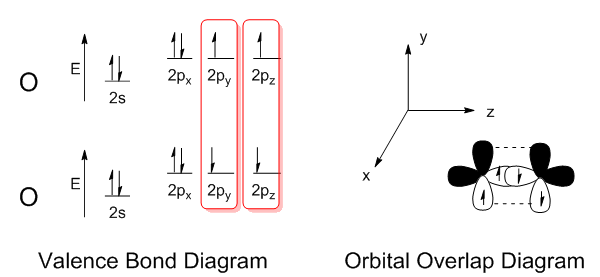
- In VBT a singly occupied atomic orbital overlaps with another singly occupied atomic orbital from the adjacent atom creating a bond. An example for O2 is shown below.
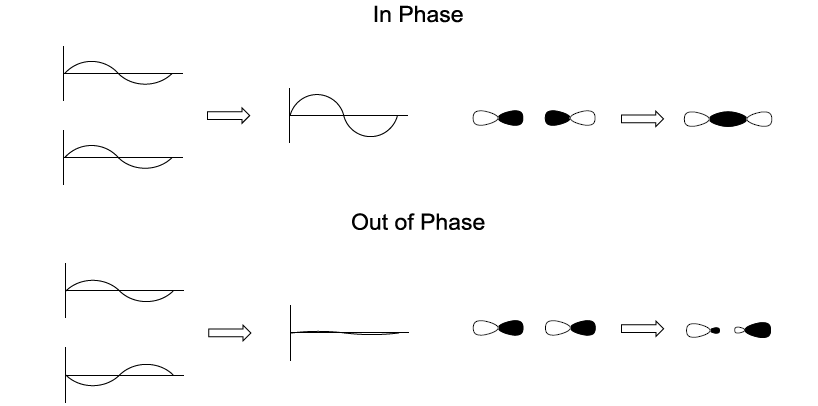
- The basis of VBT is that overlapping atomic orbitals of the same phase produce bonds and if the phases are opposite they do not. This is similar to wave mechanics.
- There are two ways orbitals can overlap. Sigma type overlap, and pi type overlap. Sigma overlap is when the overlap occurs along the internuclear axis (between two nuclei) and pi overlap occurs above and below the internuclear axis.
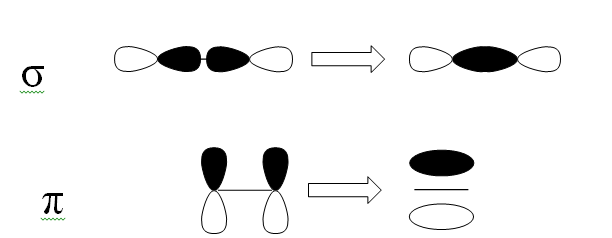
- Notation: We use the following notation do denote bonds X(O1-O2) where X is the type of bonding (sigma or pi for this course), O1 and O2 are the types of orbitals involved.
- Shown below are the two types of diagrams you are responsible for being able to draw.
0:00 / 0:00
Valence Bond Theory and Hybrid Atomic Orbitals
Bonding is a complex phenomenon, so chemists use different models to more accurately explain the different aspects of bonding!
(1) VSEPR Theory
- Valence shell electron pair repulsion describes molecular shapes (e.g. CH4 has tetrahedral molecular geometry). But VSEPR doesn't tell us anything about what the orbitals or energy levels look like.

(2) Valence Bond Theory (VBT)
- A covalent bond forms when orbitals of two atoms overlap and a pair of electrons, one spin up and one spin down, occupy this overlap region (in QM this means the two orbitals' wave functions are in phase)
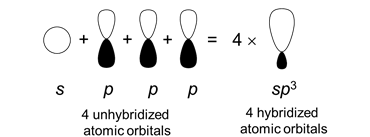
- Hybrid orbitals form during bonding
- # atomic orbitals = # of hybrid orbitals formed
- type of hybrid orbital depends on the types of atomic orbitals that are mixed (e.g. s with p vs s with s)
- the shape of the resulting hybrid orbital is the one that maximizes orbital overlap (more overlap → stronger bond)
Single bond example (sigma bond):

Wize Concept
These four hybridized sp3 orbitals are degenerate!

Notice how the orbitals involved in bonding overlap in order for the electrons from each atom to come together and form a bonding pair. This overlap can be characterized based on the type of overlap observed. In this case we see “end-on” bonding, or s-bonding (sigma bonding). End-on s-bonds show a great deal of overlap, and therefore are very stable.
Double bond example (pi bond):
Let’s look at another example to see how Valence Bond Theory handles double bonds. Imagine the simplest molecule containing a C=C double bond, ethene.
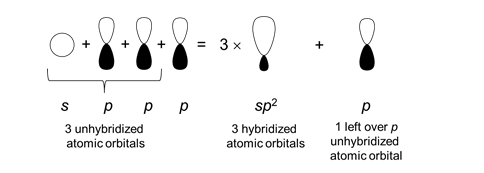
Once again, here we see carbon making 4 bonds (2 single bonds and a double bond) so we know we will have to hybridize. In this case we have 3 electron groups around each carbon, so we will have 3 hybridized orbitals and one leftover unhybridized p orbital.

Wize Concept
The three hybridized sp2 orbitals are degenerate! The unhybridized p orbital is higher in energy.
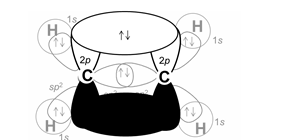
Here we see a “side-on” bond between the two p orbitals. “Side-on” bonds are known as π-bonds (pi bonds). These have lesser overlap than σ-bonds (sigma bonds), so they are not as stable.
Wize Concept
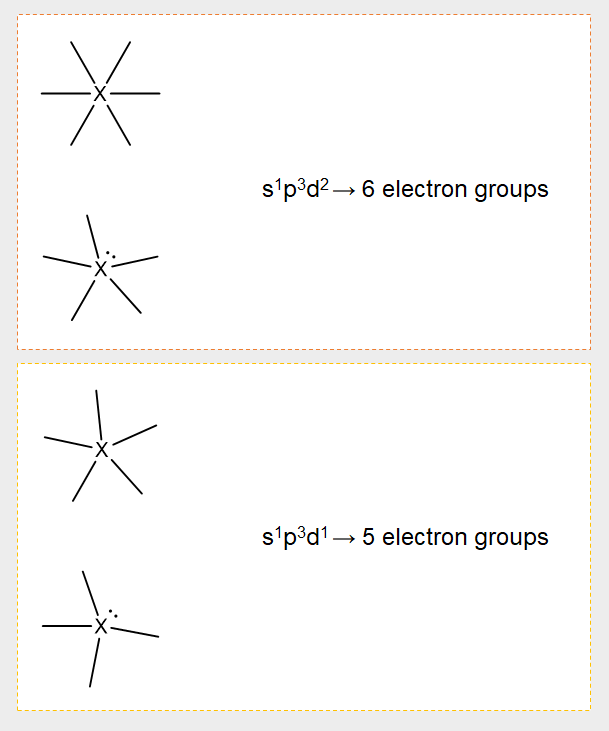
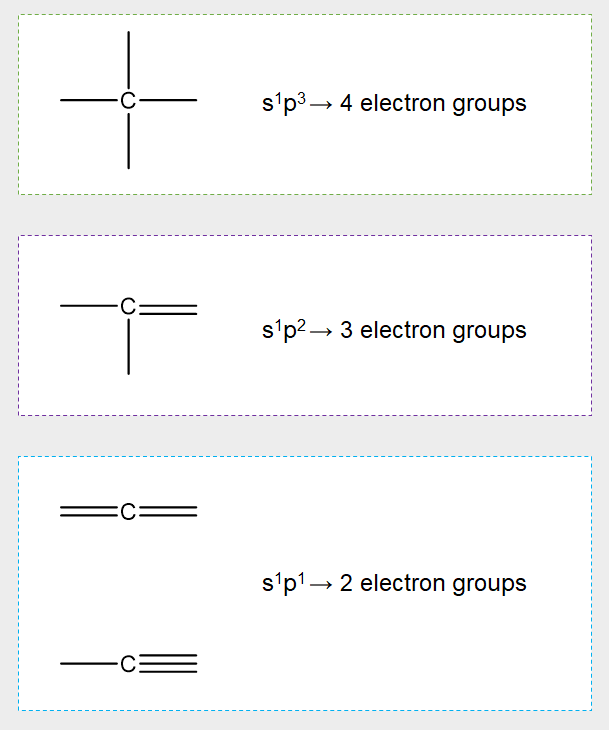
The quickest way to determine the hybridization of an atom in a molecule is to add up the exponents:
0:00 / 0:00
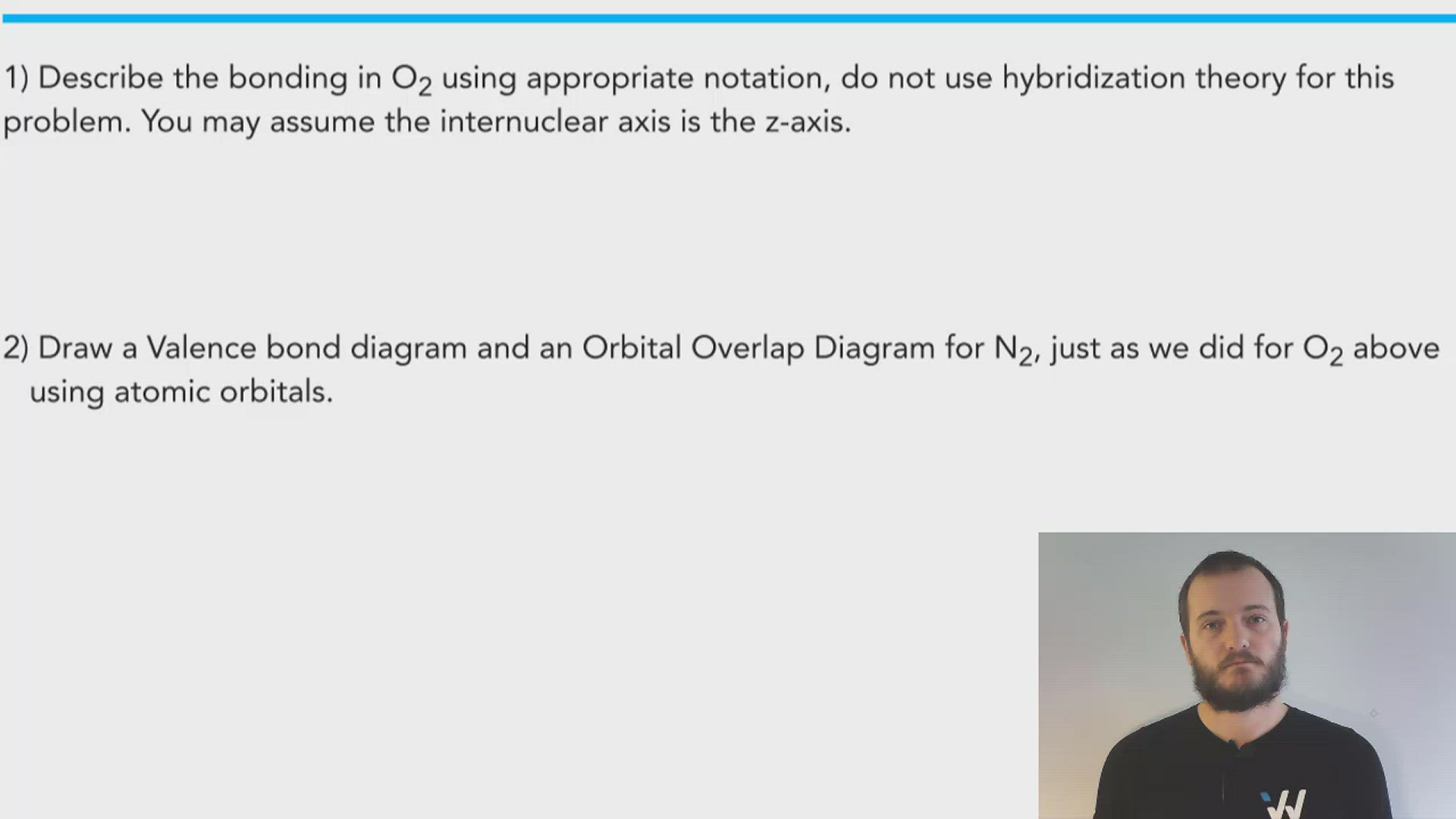
1) Describe the bonding in O2 using appropriate notation, do not use hybridization theory for this problem. You may assume the internuclear axis is the z-axis.
σ(2pz-2pz) and π(2py-2py)
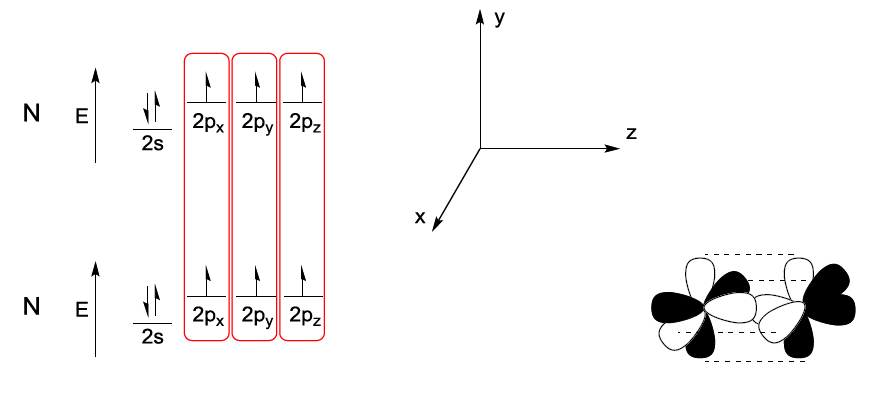
2) Draw a Valence bond diagram and an Orbital Overlap Diagram for N2, just as we did for O2 above
using atomic orbitals.
The structure of methyldiazene is shown below. Which orbitals make up the bond between atoms A and B? In the options below the first orbital listed is from atoms A, and the second orbital listed is from atom B.
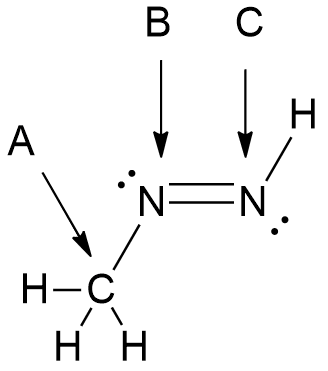
The structure of methyldiazene is shown below. Which orbitals make up the bond between atoms B and C? In the options below the first orbital listed is from atoms B, and the second orbital listed is from atom C.