Wize University Chemistry Textbook > Valence Bond Theory (Hybridization)
Practice with Sigma and Pi Bonds
Popular Courses
General Chemistry
University Study Guides
AP Chemistry Exam Prep Course
AP Exam Prep
CHEM 121
University of British Columbia
CHEM 1AA3
McMaster University
Chemistry
General Course
DAT
General Course
General Chemistry
University Study Guides
CHEM 121
Simon Fraser University
CHEM 1100
University of Manitoba
CHEM 1481
Texas A & M University
CEM 141
Michigan State University
CHMA10H3
University of Toronto
SC/CHEM 1100 4.00
York University
CHM 2045
University of Florida
CHEM 1001
Carleton University
CHEM 6A
University of California - San Diego
CHEM 111
University of British Columbia
CHEM 112
University of Saskatchewan
CHEM 1P91
Brock University
CHM 1301
University of Ottawa

0:00 / 0:00
Sigma (σ) and Pi (π) Bonds
There are two ways orbitals can overlap:
- Sigma (σ) type overlap, and pi (π) type overlap.
- Sigma overlap is when 2 electrons in a bond are localized between 2 nuclei (along the internuclear axis)
- Formed from the end-to-end overlap of hybridized orbitals (or orbitals s orbital for H)
- Pi overlap is when 2 electrons are localized in the region above and below the plane formed by 2 bonded nuclei (occurs above and below the internuclear axis)
- Formed from side to side alignment of unhybridized p orbitals in adjacent atoms to form a bond
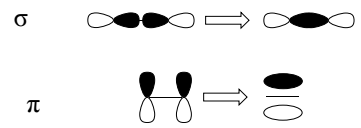
Figure 14.2 Sigma and Pi type Overlap.
If asked how many sigma and pi bonds there are in a molecule, it's very simple to count!
Wize Tip
For every single bond you see = 1 sigma bond
For every double bond you see= 1 sigma bond AND 1 pi bond
For every triple bond you see= 1 sigma bond AND 2 pi bonds
Ex. In this molecule of aspartic acid, how many sigma and pi bonds are there?

Propyne, H3CCCH, has how many sigma () and pi () bonds, respectively?