Wize University Chemistry Textbook > Introduction to Organic Chemistry
Nomenclature [more functional groups]
Popular Courses
General Chemistry
University Study Guides
CHEM 112
Queen's University
Chemistry
General Course
CHEM 1AA3
McMaster University
General Chemistry
University Study Guides
CHEM 123
University of British Columbia
APSC 132
Queen's University
CHEM 112B
Queen's University
CHEM 130
University of British Columbia
CHEM 1100
University of Manitoba
CHEM 1481
Texas A & M University
CEM 141
Michigan State University
CHMA10H3
University of Toronto
SC/CHEM 1100 4.00
York University
CHM 2045
University of Florida
CHEM 1001
Carleton University
CHEM 111
University of British Columbia
CHEM 112
University of Saskatchewan
CHEM 1P91
Brock University
CHMA11H3
University of Toronto

0:00 / 0:00
Functional Groups
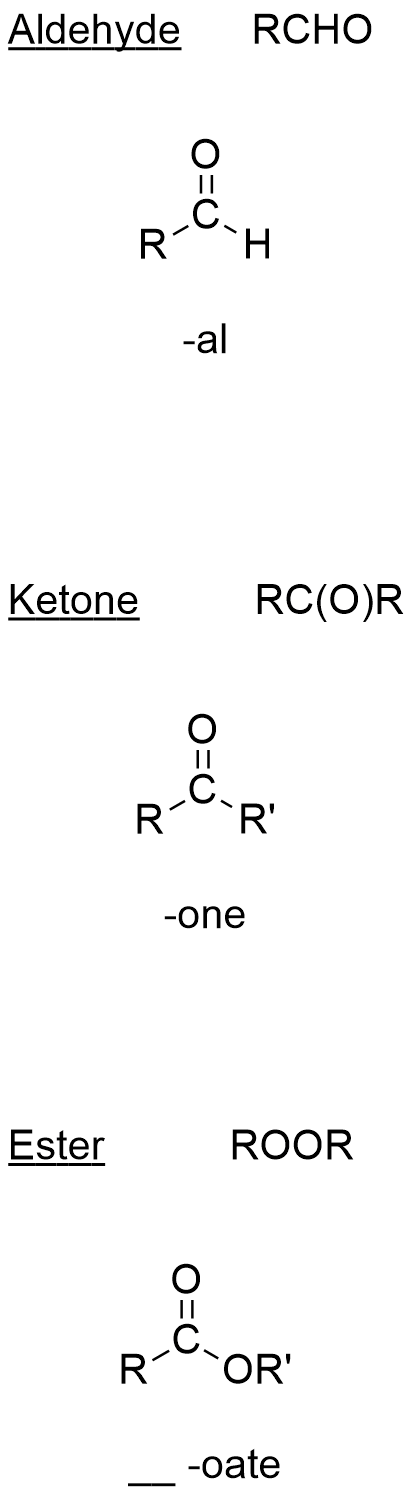
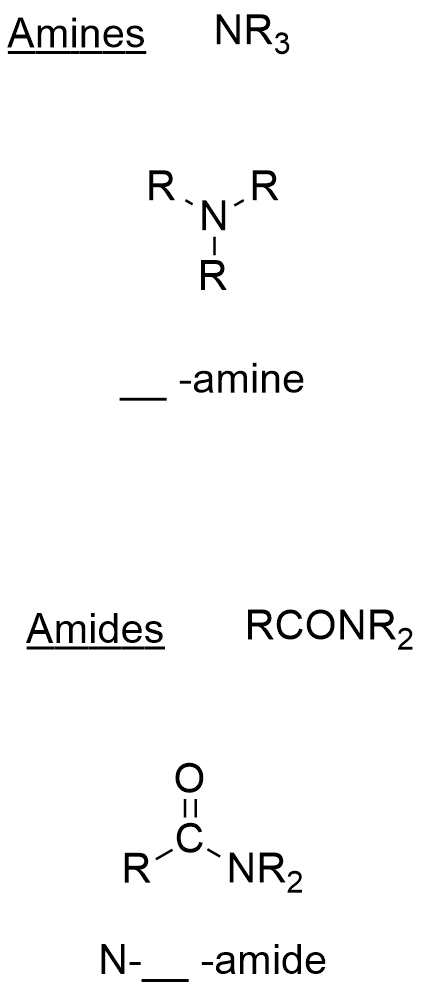
- To study organic chemistry in a systematic way we need to be able to look at a molecule and find common fragments (called functional groups) which we can the generalize to all organic molecules
- Functional group Identification is crucial for naming an organic molecule. The functional groups you are responsible for are shown below along with their suffix
Memorization Box

0:00 / 0:00
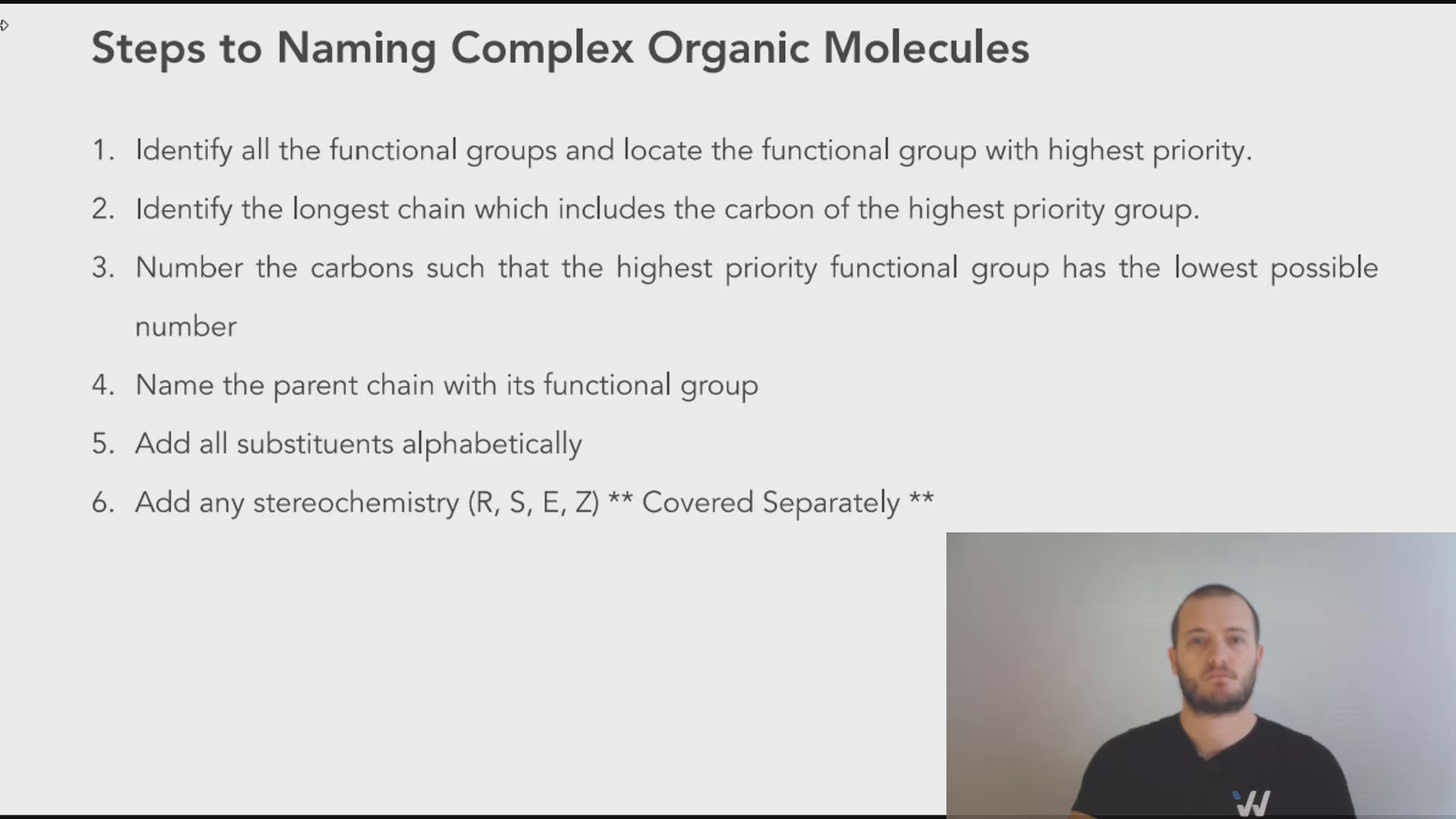
Steps to Naming Complex Organic Molecules
- Identify all the functional groups and locate the functional group with highest priority.
- Identify the longest chain which includes the carbon of the highest priority group.
- Number the carbons such that the highest priority functional group has the lowest possible number
- Name the parent chain with its functional group
- Add all substituents alphabetically
- Add any stereochemistry (R, S, E, Z) ** Covered Separately **

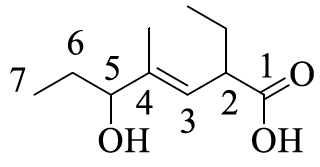
- The carboxylic acid is the highest priority group
- The Longest chain that includes the COOH is 7 carbons long
- Start numbering at the COOH carbon
- Parent molecule is hept-3-eneoic acid
- We have one ethyl, one hydroxyl and one methyl so the name becomes:
- The only stereochemistry indicated is the double bond which is so the name is :

0:00 / 0:00
Naming Organic Molecules with Odd Functional Groups
- Esters, ethers, sulphides, and amides are weird because they interrupt carbon chains.
- For ethers, sulphides, and amines we name each group coming off as a substituent and place ether, sulphide or amine at the end of the name as shown below.

For esters, the group attached to the oxygen atom becomes the substituent and the carbon of the ester becomes carbon 1, as long as there is no higher priority group.

Example: Nomenclature Practice
Name the following:
a)
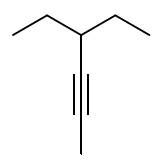
b)
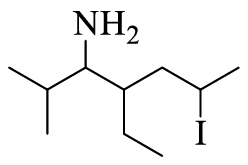
Practice: Nomenclature
The name of the following compounds is:
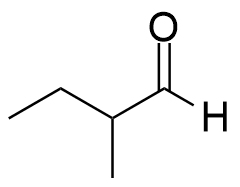
Practice: Nomenclature
Choose the option below that depicts 3-methylhexanoic acid
Functional Group Parent Names Cheatsheet
