Popular Courses
General Chemistry
University Study Guides
CHEM 112
Queen's University
Chemistry
General Course
CHEM 1AA3
McMaster University
General Chemistry
University Study Guides
APSC 132
Queen's University
CHEM 112B
Queen's University
CHEM 130
University of British Columbia
CHEM 1100
University of Manitoba
CHEM 1481
Texas A & M University
CHMA10H3
University of Toronto
SC/CHEM 1100 4.00
York University
CHM 2045
University of Florida
CHEM 1001
Carleton University
CHEM 111
University of British Columbia
CHEM 112
University of Saskatchewan
CHEM 1P91
Brock University
CHMA11H3
University of Toronto
CHEM 1110
University of Manitoba
CHM 1301
University of Ottawa

0:00 / 0:00
The SN2 Mechanism
- SN2 gets its name because it is a nucleophilic substitution SN and it's kinetics display an overall 2nd order reaction.
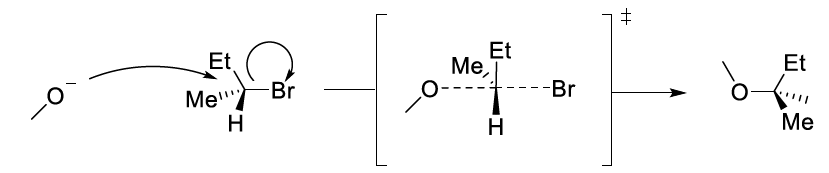
SN2 Mechanism
- Arrow 1: Nucleophile attacks electrophilic carbon
- Arrow 2: Leaving group leaves with electron from the bond to the electrophile
- The transition state is shown in square brackets. When you are asked to draw a mechanism you DO NOT have to draw the transition state
- Involves an inversion of the stereochemistry at the carbon being attacked. This means that if the reaction is proceeding by an SN2 mechanism any stereochemistry present at the electrophile will be inverted.
Draw the product of the following nucleophilic substitution.


0:00 / 0:00
Factors which Favour an SN2 Mechanism
Nucleophile
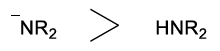
- For SN2 reactions we are attacking a neutral carbon center with our nucleophile so the nucleophile must be strong. When comparing nucleophiles three factors must be considered, In Order!
1. Charge
2. Basicity
Stronger base is faster, remember ARIO
3. Sterics

Electrophile
- In an SN2 reaction the electrophile must be sterically free (not much stuff around) so that the nucleophile can fit in to attach from the back side.

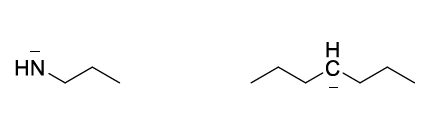
Choose the nucleophile or electrophile which will react fastest in an SN2 reaction. Rationalize your choice.
a)
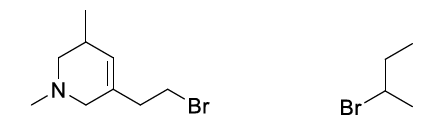
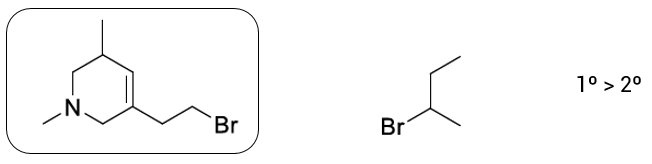
b)
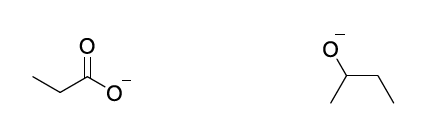

c)
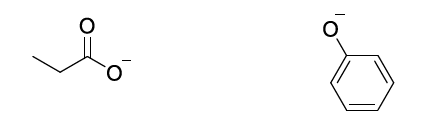

d)