Wize University Chemistry Textbook > Organic Chemistry Reactions
Substitution Reactions Practice
Popular Courses
General Chemistry
University Study Guides
CHEM 112
Queen's University
Chemistry
General Course
CHEM 1AA3
McMaster University
General Chemistry
University Study Guides
APSC 132
Queen's University
CHEM 112B
Queen's University
CHEM 130
University of British Columbia
CHEM 1100
University of Manitoba
CHEM 1481
Texas A & M University
CHMA10H3
University of Toronto
SC/CHEM 1100 4.00
York University
CHM 2045
University of Florida
CHEM 1001
Carleton University
CHEM 111
University of British Columbia
CHEM 112
University of Saskatchewan
CHEM 1P91
Brock University
CHMA11H3
University of Toronto
CHEM 1110
University of Manitoba
CHM 1301
University of Ottawa
Predict which mechanism the following reactions will follow (SN1 or SN2)
a)
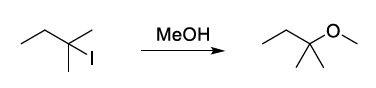
b)
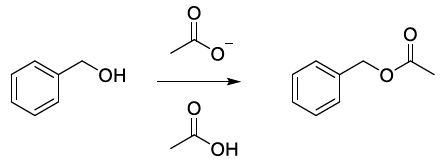
c)
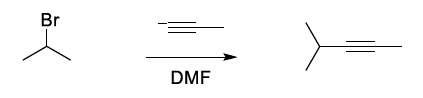
d)
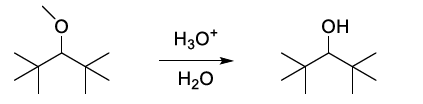

Mark Yourself Question
- Grab a piece of paper and try this problem yourself.
- When you're done, check the "I have answered this question" box below.
- View the solution and report whether you got it right or wrong.
A graduate student preforms two reactions in order to make some new ethers. In the first reaction the student mixes 3-chloro-2-methylprop-1-ene and methanol and in the second the student mixes 4-chloro-2-methylbut-1-ene with methanol. The next day the student examines the reaction and finds that one has completely finished and the other is not even 10% complete. Which reaction has completely finished? Why?