Wize University Chemistry Textbook > Organic Chemistry Reactions
Elimination Reactions
Popular Courses
General Chemistry
University Study Guides
Chemistry
General Course
General Chemistry
University Study Guides
APSC 132
Queen's University
CHEM 112B
Queen's University
CHEM 130
University of British Columbia
CHEM 1100
University of Manitoba
CHEM 1481
Texas A & M University
CHMA10H3
University of Toronto
SC/CHEM 1100 4.00
York University
CHM 2045
University of Florida
CHEM 1001
Carleton University
CHEM 111
University of British Columbia
CHEM 112
University of Saskatchewan
CHEM 1P91
Brock University
CHMA11H3
University of Toronto
CHM 1301
University of Ottawa
CHEM 1110
University of Manitoba
CHEM 1300
University of Manitoba
CHEM 119
Texas A&M University
0:00 / 0:00
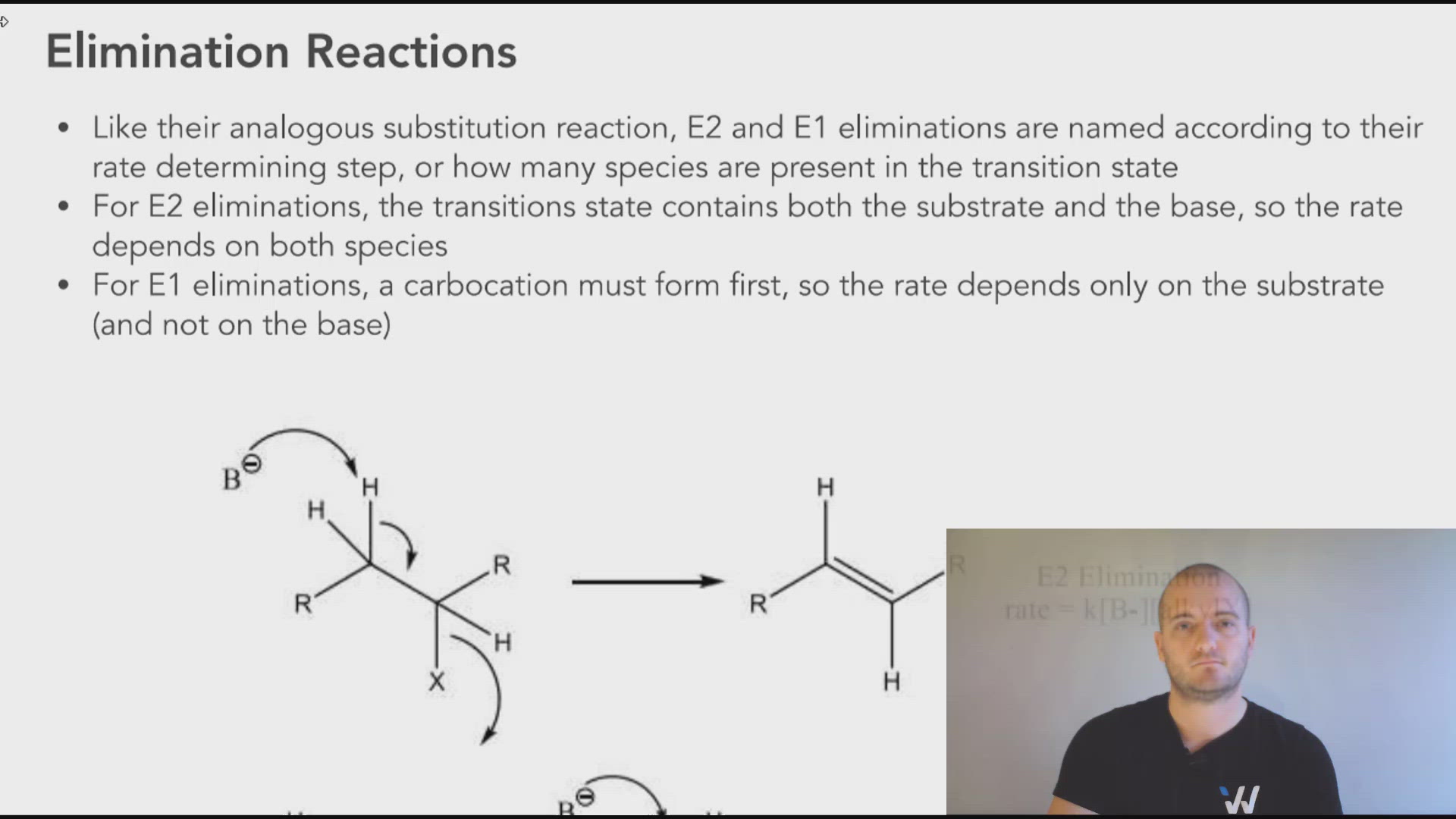
Elimination Reactions
- Like their analogous substitution reaction, E2 and E1 eliminations are named according to their rate determining step, or how many species are present in the transition state
- For E2 eliminations, the transitions state contains both the substrate and the base, so the rate depends on both species
- For E1 eliminations, a carbocation must form first, so the rate depends only on the substrate (and not on the base)

0:00 / 0:00
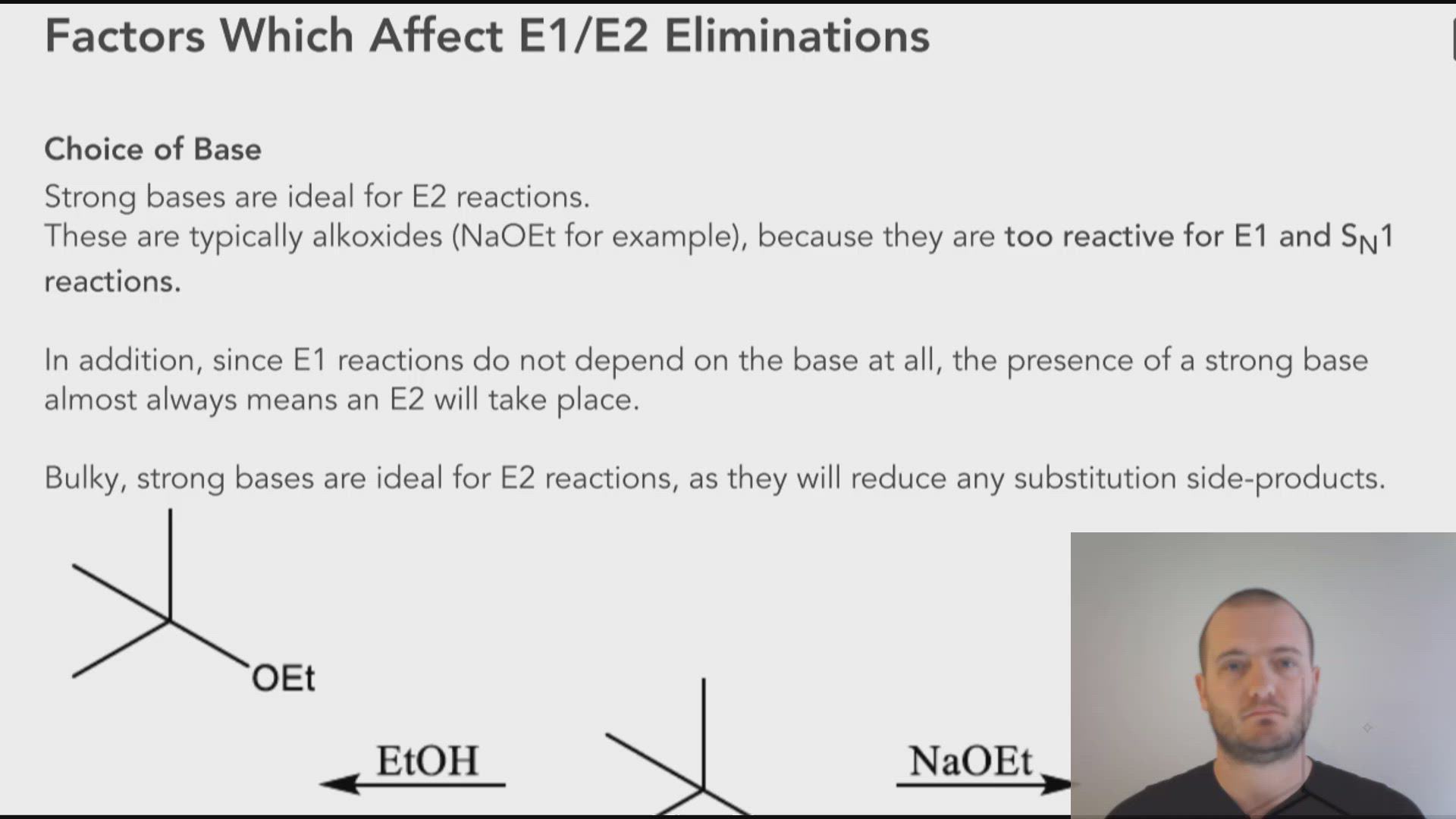
Factors Which Affect E1/E2 Eliminations
Choice of Base
Strong bases are ideal for E2 reactions.
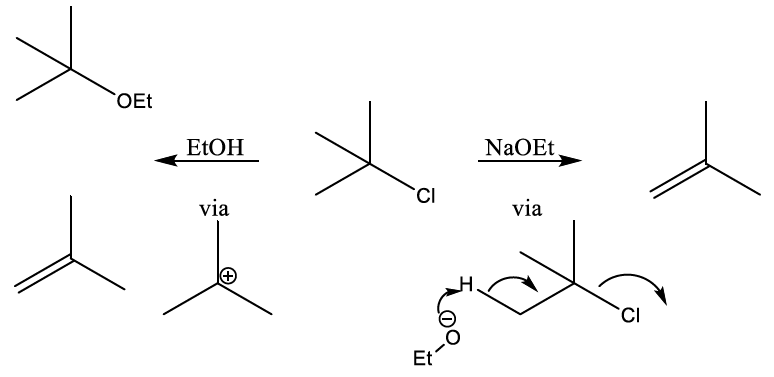
These are typically alkoxides (NaOEt for example), because they are too reactive for E1 and SN1 reactions.
In addition, since E1 reactions do not depend on the base at all, the presence of a strong base almost always means an E2 will take place.
Bulky, strong bases are ideal for E2 reactions, as they will reduce any substitution side-products.
Substrates for E1
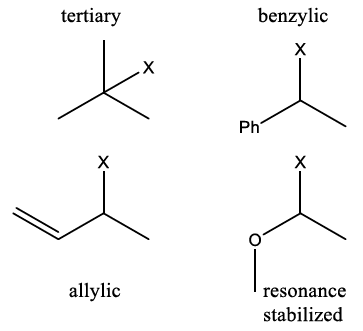
Anytime you are able to stabilize a carbocation, you should be aware that an E1 elimination may occur -But SN1 reactions can also happen!
Predict which elimination mechanism (E1 or E2) is most likely to be operative in the reactions below: