Wize University Chemistry Textbook > Thermodynamics Part 2: (2nd Law-entropy, 3rd Law, Gibbs Free Energy, Spontaneity)
Entropy [detailed-more equations]
Popular Courses
MCAT
General Course
General Chemistry
University Study Guides
CHEM 112
Queen's University
DAT
General Course
Chemistry
General Course
General Chemistry
University Study Guides
CHEM 1E03
McMaster University
CHM135H1
University of Toronto
CHEM 102
University of Alberta
CHEM 123
University of British Columbia
APSC 132
Queen's University
CHEM 112B
Queen's University
CHEM 130
University of British Columbia
CHEM 1100
University of Manitoba
CHEM 1481
Texas A & M University
CHEM 122
Simon Fraser University
CEM 141
Michigan State University
PHYS 111
University of Victoria
CHMA10H3
University of Toronto
SC/CHEM 1100 4.00
York University

0:00 / 0:00
Additional Equations for Entropy
- This equation is specifically for a reversible process:
- For a reversible process
- For an irreversible (spontaneous) process
- Note: If no subscript is given on ΔS assume it is ΔSsys
- Spontaneous (irreversible) process: A process which proceeds in one direction and may only proceed backwards if work is done. eg. Piston, electric current, natural processes
- loss of usable work
- are spontaneous reactions always fast?No!
- think about diamonds->graphite
- Non-spontaneous process: A process which only proceeds by the addition of work.
- ex. of a non-spontaneous irreversible process is pushing a piston to force a gas into a smaller volume
- spontaneous is natural whereas non spontaneous is unnatural (needs human intervention)
- Reversible Process: A Process that is non-spontaneous in both directions
2nd Law: Applications The 6 cases
Case 1: Spontaneous Process in an isolated system
Case 2: Isochoric or Isobaric Processes
Case 3: Isothermal Processes
Case 4: Adiabatic Reversible Process
- For a reversible adiabatic process: ΔS_system = 0, ΔS_universe = 0.
- For an irreversible adiabatic process: ΔS_system > 0, ΔS_surroundings = 0, and thus ΔS_universe > 0.
Case 5: Reversible Phase Change (Phase change at the melting/boiling point)
Remember. If the phase Change is happening at a different temperature we can use Kirchoff’s Law to deal with that.
Case 6: Chemical Reactions
In the same way we can use standard heats of formation to calculate a reaction enthalpy at room temperature and
pressure, we can use So
0:00 / 0:00
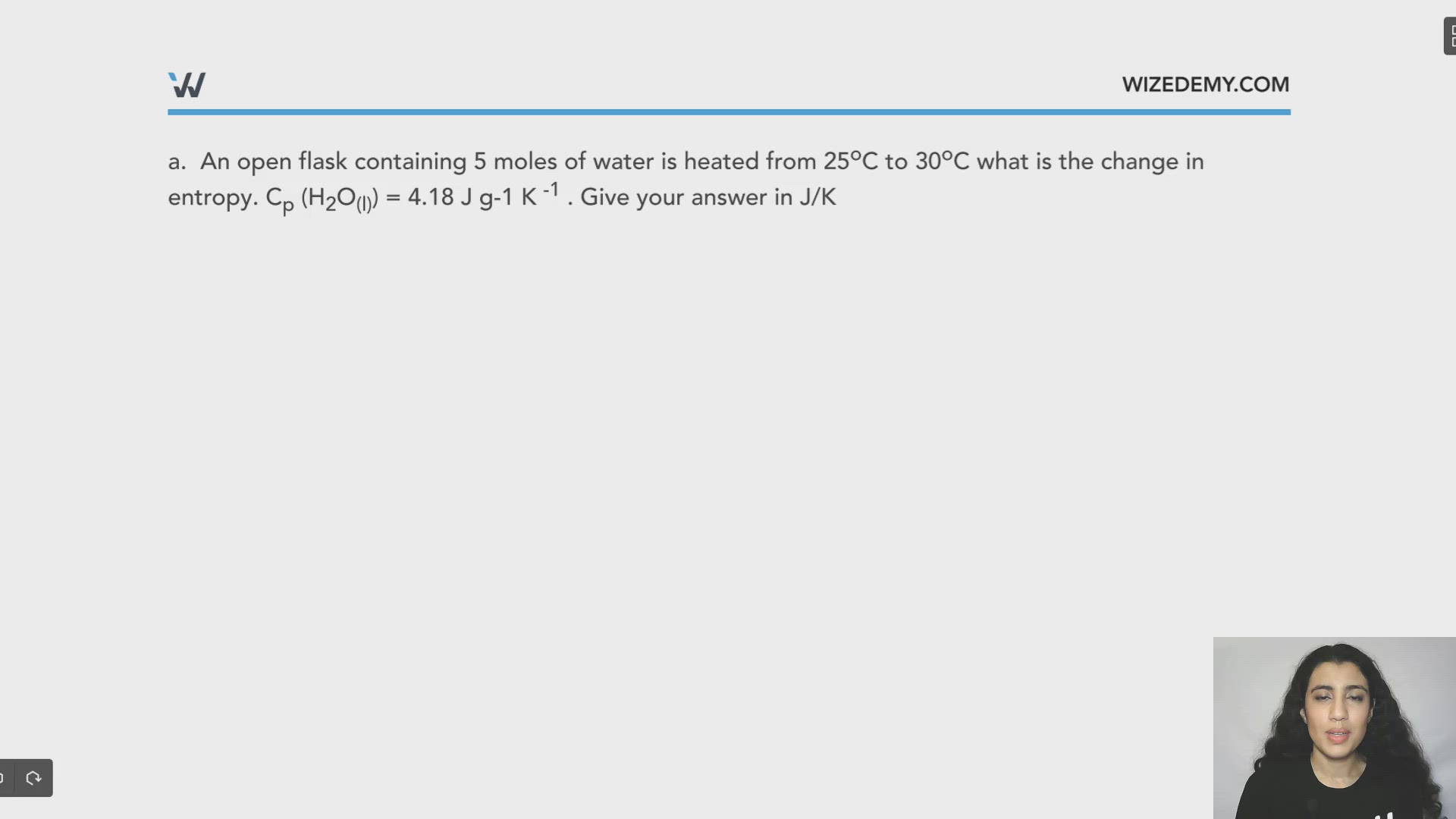
a. An open flask containing 5 moles of water is heated from 25oC to 30oC what is the change in entropy. Cp (H2O(l)) = 4.18 J g-1 K -1 . Give your answer in J/K
Isobaric Heating;
deltaS=n(Cv)ln (T2/T1)
0:00 / 0:00
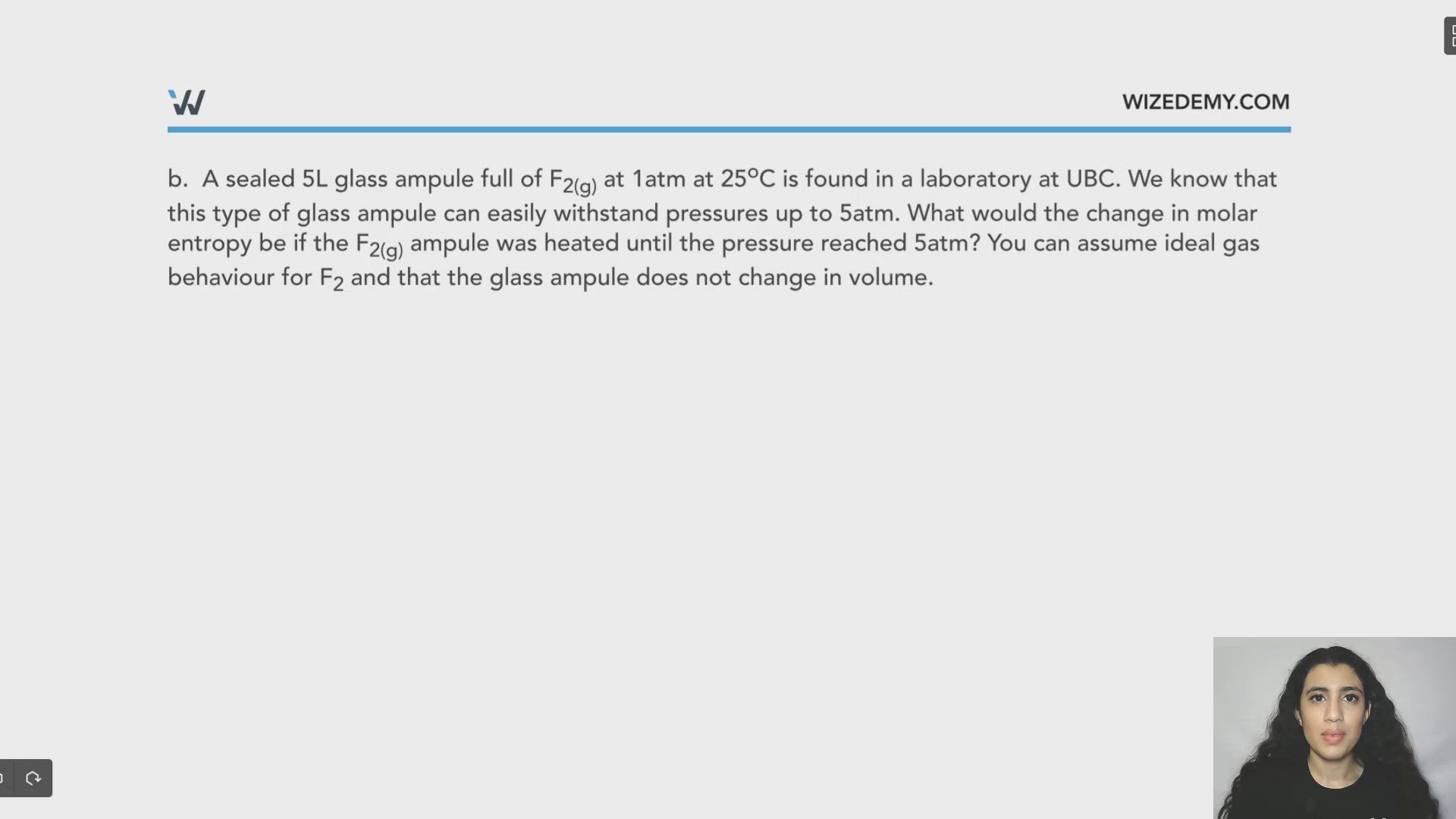
b. A sealed 5L glass ampule full of F2(g) at 1atm at 25oC is found in a laboratory at UBC. We know that this type of glass ampule can easily withstand pressures up to 5atm. What would the change in entropy be if the F2(g) ampule was heated until the pressure reached 5atm? You can assume ideal gas behaviour for F2 and that the glass ampule does not change in volume.