Popular Courses
MCAT
General Course
CHEM 1302A/B
Western University
General Chemistry
University Study Guides
AP Chemistry Exam Prep Course
AP Exam Prep
CHEM 1A03
McMaster University
CHEM 112
Queen's University
CHEM 203
University of Calgary
DAT
General Course
Chemistry
General Course
General Chemistry
University Study Guides
CHEM 1E03
McMaster University
Chemistry 12
British Columbia High School
CHEM 154
University of British Columbia
CHEM 102
University of Alberta
CHEM 123
University of British Columbia
CHEM*1050
University of Guelph
CHY 102
Toronto Metropolitan University
CHEM 120
McGill University
SC/CHEM 1001 3.00
York University
APSC 132
Queen's University

0:00 / 0:00
2nd Law of Thermodynamics
Entropy (S) is a measure of disorder or randomness in a system.
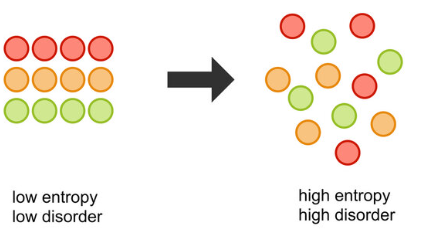
The 2nd Law of Thermodynamics states that disorder of the universe increases in a spontaneous process.
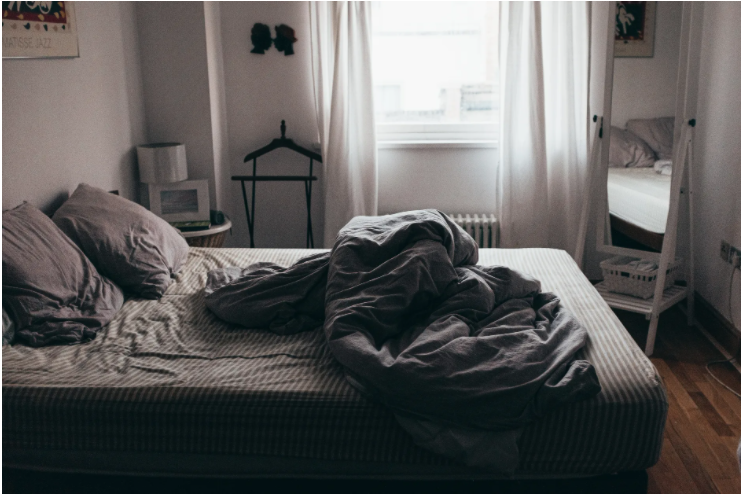
In other words, things naturally tend to go towards disorder and the universe is constantly getting more and more disordered!
Entropy Equations
Entropy is defined as:
ΔSsurr=entropy of the surroundings (in J/molK)
qsurr=heat in the surroundings (in J)
T=Temperature (in K)
Recall:
At constant pressure and temperature:
The 2nd law of thermodynamics states that whenever a spontaneous event takes place in the universe, the total entropy of the universe increases:
Chemical Reactions
In the same way we can use standard heats of formation to calculate a reaction enthalpy at room temperature and
pressure, we can use So (values will be provided to you in a table)

0:00 / 0:00
Factoring Affecting Entropy Changes
Entropy for Different Phases

Entropy When a Higher Pressure is Applied to a Gas
If we have two gases, and apply a higher pressure to one of them, will the gas with the higher pressure applied have more or less entropy?
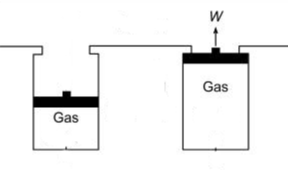
The gas with the higher pressure applied to it will have (more/less)
more
organized molecules and therefore there is (more/less) less
disorder, meaning there is (more/less) less
entropy!Entropy of a Solid Alone vs Dissolved in a Liquid

Example:
KCl(s) vs KCl(aq)
There is (more/less)
more
entropy when the solid is dissolved in a solvent. Entropy of a Gas Alone vs Dissolved in a Solvent
Example: Think of shaking a bottle of pop CO2(g) vs CO2(aq)
The gas would have (more/less)
less
more entropy when dissolved in the solvent.Entropy of Similar Substances in the Same Physical State
How would entropy change with increasing mass?
Entropy would (increase/decrease)
increase
Example:
H2(g) (MM=2g/mol) vs Ar(g) (MM=40g/mol) vs CO2(g) (MM=44g/mol)
How would entropy change as we increase the number of atoms in the molecule?
Entropy would (increase/decrease)
increase
Example:
CH4(g) vs C2H6(g) vs C10H22(g)
How would entropy be different if we compared the following two molecules?
Cyclopentane vs C5H12
Would entropy increase or decrease with increasing molecular freedom or flexibility?
Increase!
Entropy in a Chemical Equation
Example:
CH4(g) + 2O2(g) → CO2(g) + 2H2O(l)
If we were asked if entropy increases or decreases in this equation, what would you consider?
- look at the phases on the reactants side and products side of the equation
- If the phases are all the same, you can also look at the number of moles on each side
- Here there are two gases on the left, and one gas and one liquid on the right
- Since there is a liquid on the right, that is less disordered so overall from reactants to products the reaction got less disordered!
Therefore, entropy
decreased!
We could also say that ΔS is <
0 
0:00 / 0:00
Example: Qualitatively Estimating Entropy Changes
Determine if the entropy change will be positive or negative for the following reactions:
- On the left side we only have a solid
- On the right side we have a solid, a liquid, and a gas
- Since there is a liquid and gas on the right side, we automatically know that there is more disorder on the right side
- There are also more molecules on the right than the left
- The entropy change is positive (entropy increases going to the right)
- Each reactant and product are in the gaseous phase
- On the left side, there are 3 moles of gas
- On the right side, there are 2 moles of gas
- The entropy change is negative since there are less moles of gas on the products side of the reaction
- 1 mole of gas on the left side
- 2 moles of gas on the right side
- Since there are more moles of gas on the right side it means that there is more disorder on the right side
- The entropy change is positive (entropy increases going to the right)
Using the following data, calculate the standard entropy of the reaction shown below. Enter your answer in units of J / (mol*K)
Using the ΔH° of fusion for water 6.03 kJ/mol and the ΔS° of fusion for water 22.1 J K–1 mol–1, calculate the ΔSuniv for ice melting at –10°C, 0°C, and 10°C. Remember: the universe transfers heat in a reversible way.