Wize University Chemistry Textbook > Thermodynamics: Part 1: (0th law, 1st law, Calorimetry, Enthalpy)
Introduction to Thermodynamics
Popular Courses
MCAT
General Course
CHEM 1302A/B
Western University
General Chemistry
University Study Guides
CHEM 1A03
McMaster University
CHEM 112
Queen's University
CHEM 203
University of Calgary
DAT
General Course
Chemistry
General Course
General Chemistry
University Study Guides
CHEM 1E03
McMaster University
CHM135H1
University of Toronto
CHEM 154
University of British Columbia
CHEM 102
University of Alberta
CHEM 123
University of British Columbia
CHEM*1050
University of Guelph
CHY 102
Toronto Metropolitan University
CHEM 121
Simon Fraser University
CHEM 120
McGill University
SC/CHEM 1000 3.00
York University
APSC 132
Queen's University
0:00 / 0:00
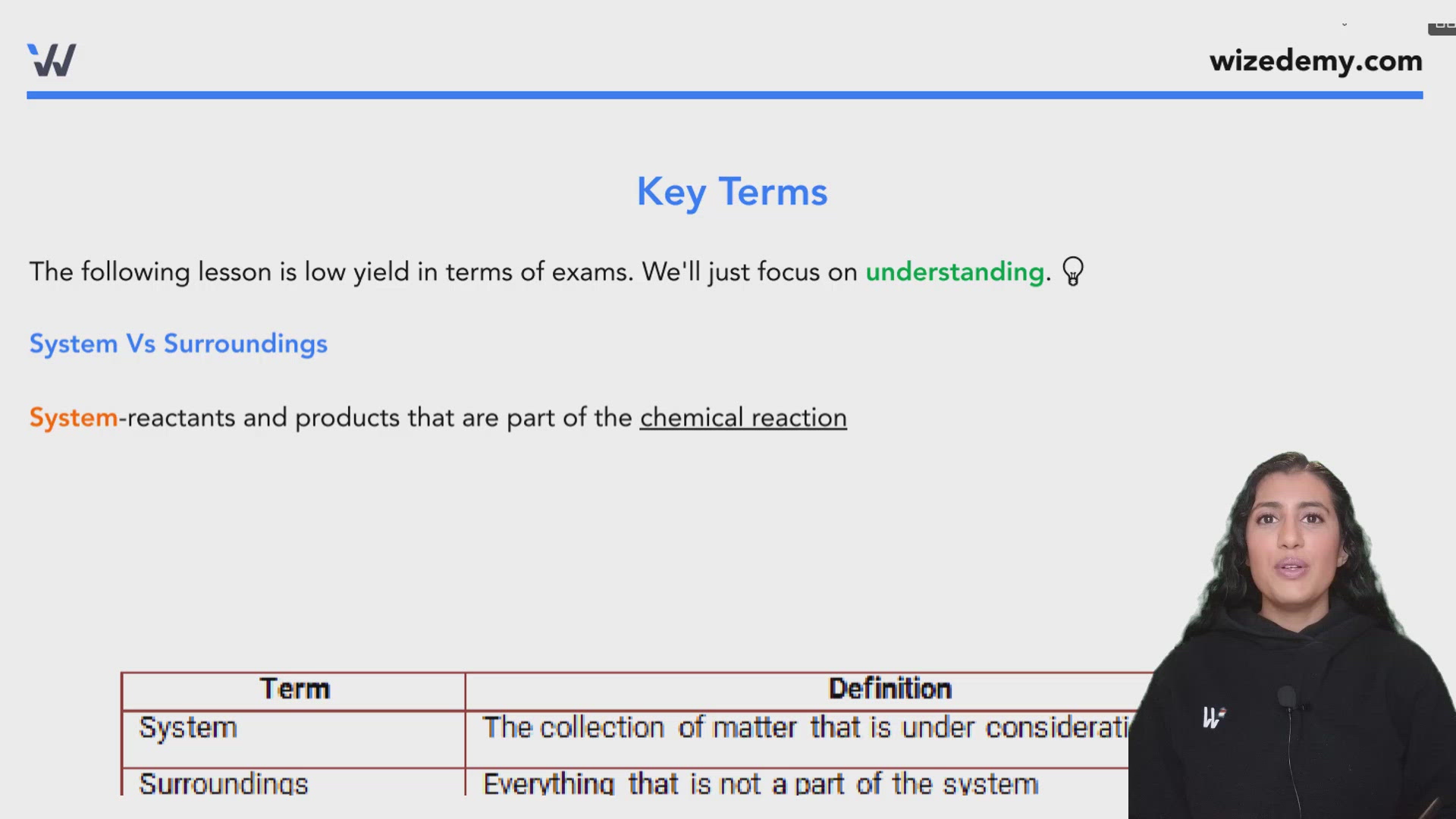
Key Terms
The following lesson is low yield in terms of exams. We'll just focus on understanding. 💡
System Vs Surroundings
System-reactants and products that are part of the chemical reaction

Open Vs Closed Vs Isolated Systems

Examples:
- open system → cup of coffee
- closed system → bottle of pop
- isolated system → perfect thermos
0:00 / 0:00
State Variables
The following lesson is low yield in terms of exams. We'll just focus on understanding. 💡
State variable (aka, state function): is a variable that depends only on the current state of a system, NOT on the path taken to that state.
Example:
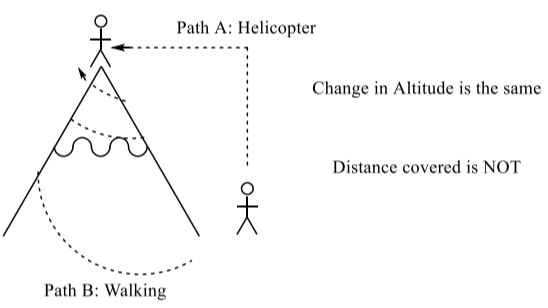
Is the distance travelled or change in altitude a state function?
The change in altitude is a state function because no matter which pathway was taken (walking or helicopter, the change in altitude was the same).
Distance is not a state function because when there was a different pathway taken, there was a different distance travelled!
0:00 / 0:00
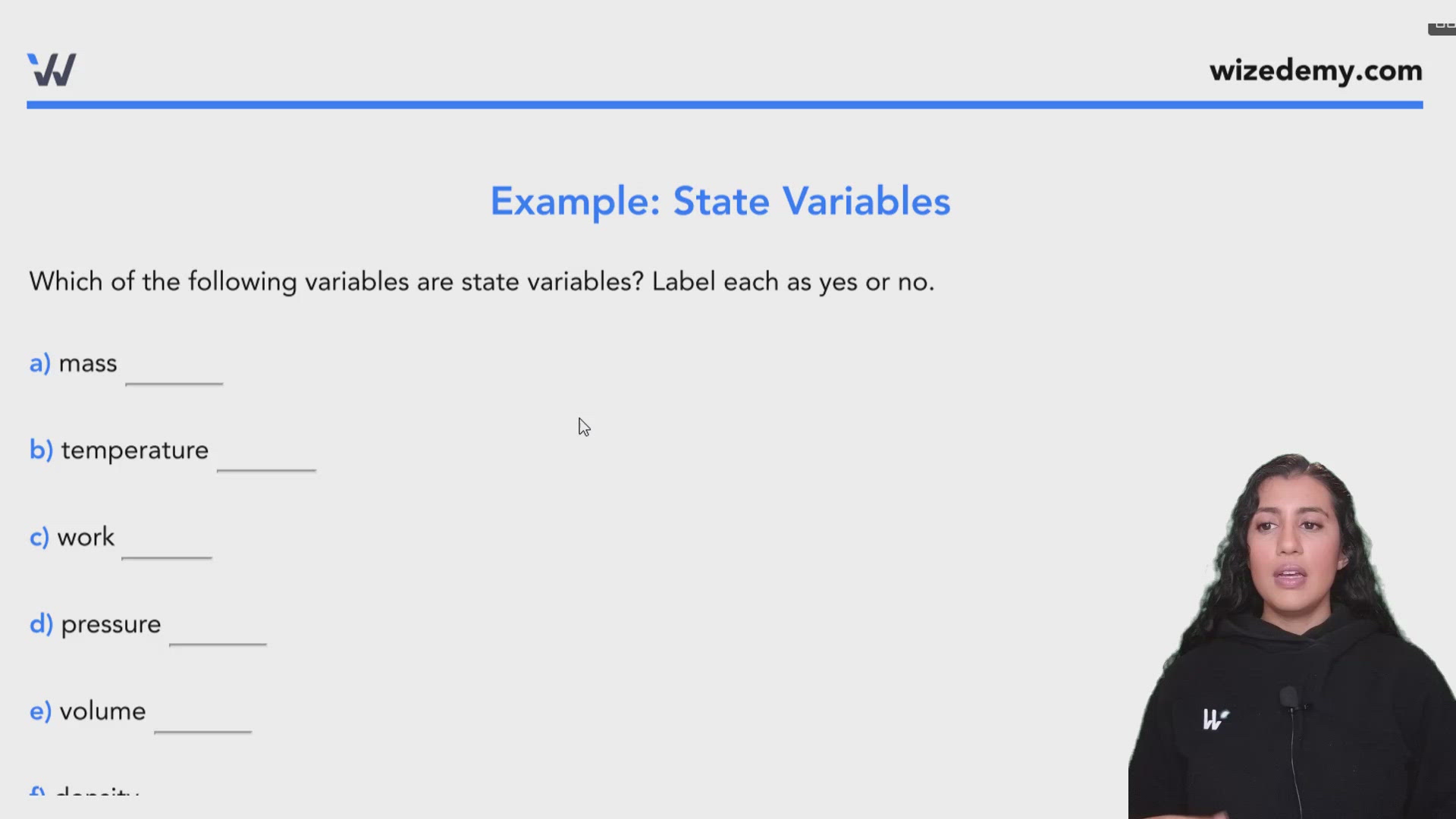
Example: State Variables
Which of the following variables are state variables? Label each as yes or no.
a) mass
yes
b) temperature
yes
c) work
no
d) pressure
yes
e) volume
yes
f) density
yes
0:00 / 0:00
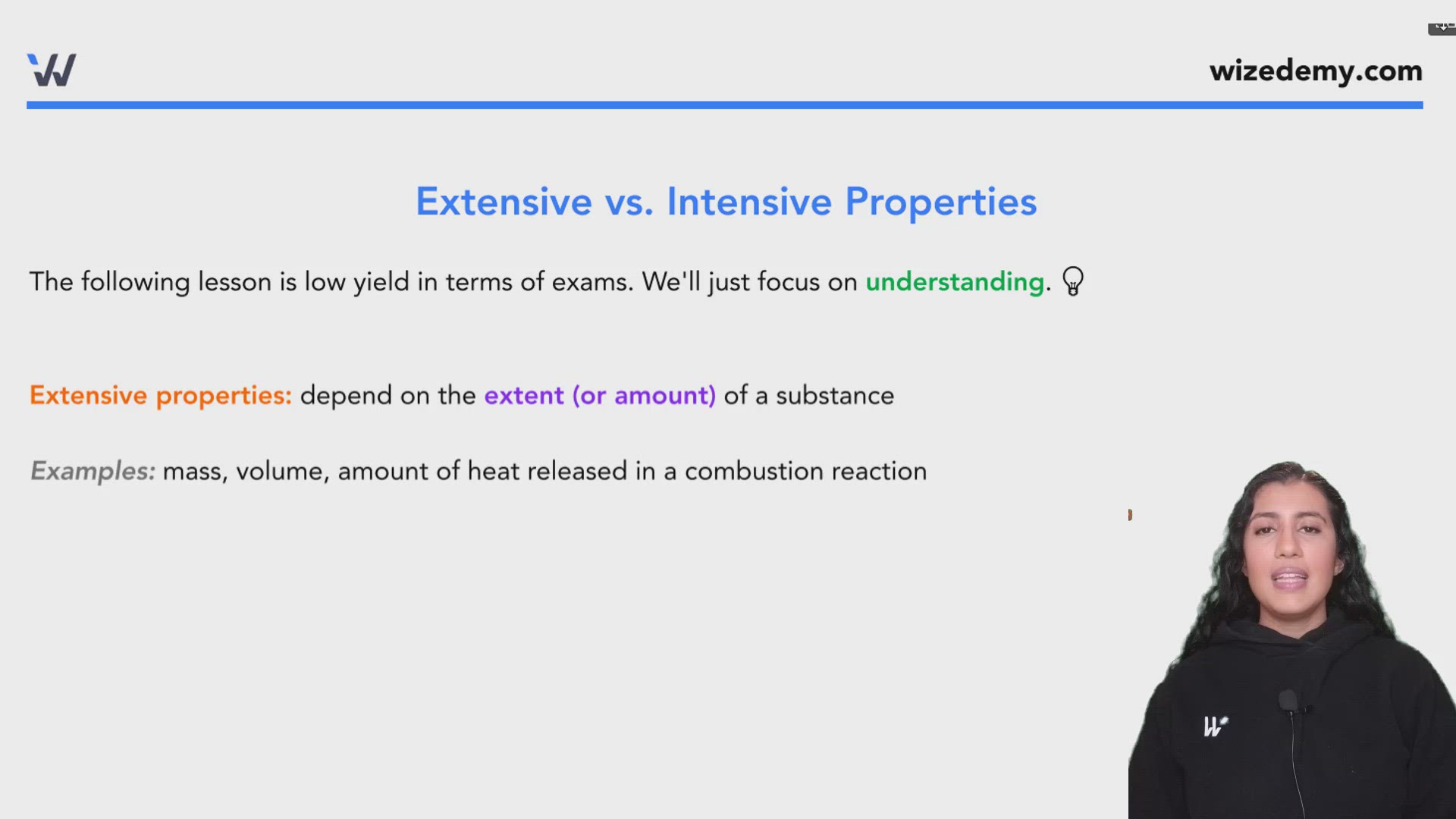
Extensive vs. Intensive Properties
The following lesson is low yield in terms of exams. We'll just focus on understanding. 💡
Extensive properties: depend on the extent (or amount) of a substance
Examples: mass, volume, amount of heat released in a combustion reaction
Intensive properties: does not depend on the amount of substance
Examples: melting point, boiling point, density
Think* no matter how much water you are boiling in a pot, water will always boil at 100oC and melt at 0oC!
When we take a ratio of 2 extensive properties what do we get?
An intensive property!
Example: mass/volume=density
0:00 / 0:00
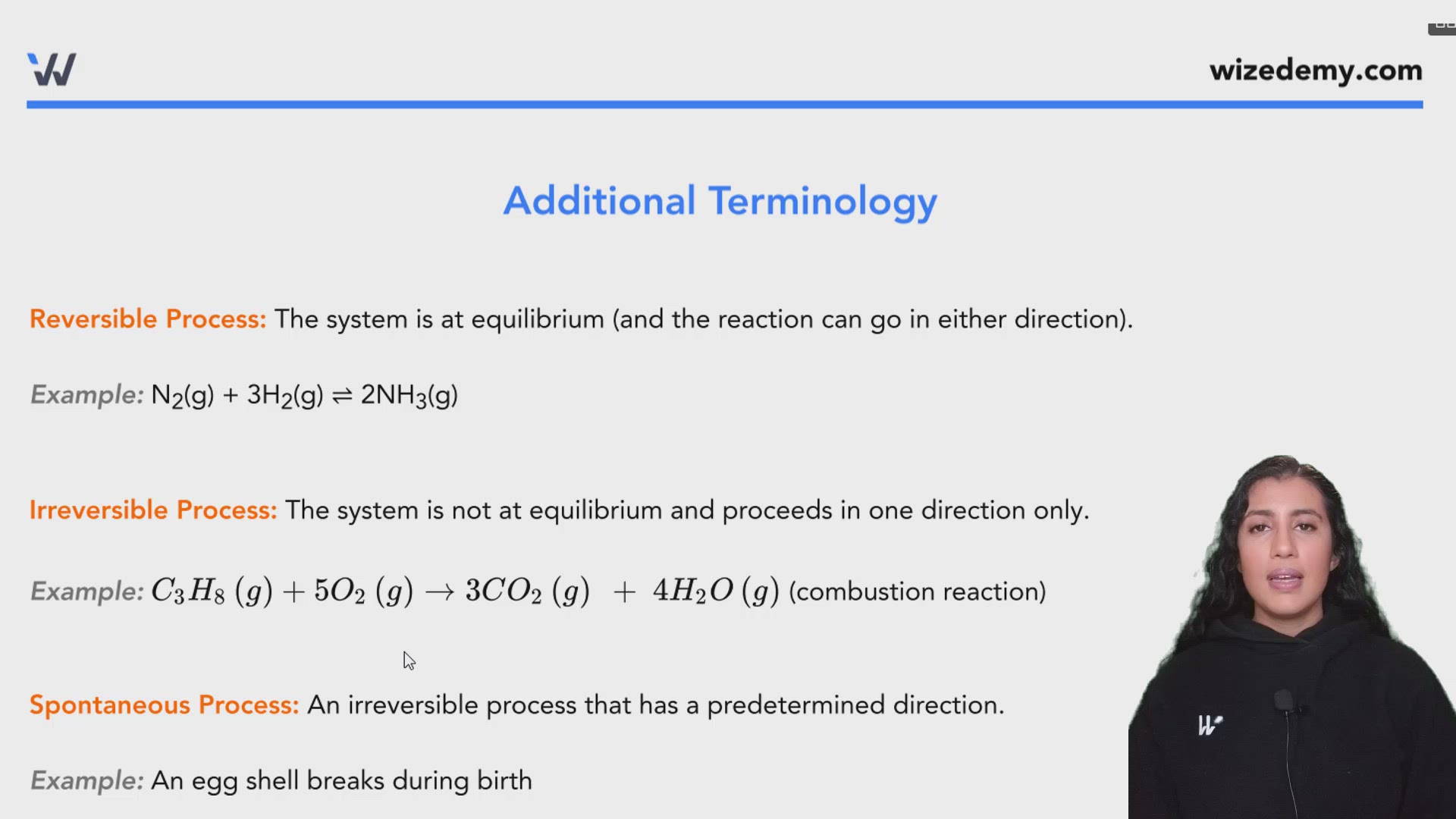
Additional Terminology
Reversible Process: The system is at equilibrium (and the reaction can go in either direction).
Example: N2(g) + 3H2(g) ⇌ 2NH3(g)
Irreversible Process: The system is not at equilibrium and proceeds in one direction only. This reaction is spontaneous in the forward direction.
Example: (combustion reaction)
Spontaneous Process: An irreversible process that has a predetermined direction.
Example: An egg shell breaks during birth
Isothermal: There is no change in temperature for the system
Isobaric: There is no change in pressure
Isochoric: There is no change in volume
Adiabatic: No heat exchange (no heat enters or leaves the system)
Exothermic: A Process in which heat is
released
(absorbed/released) to the surroundings
(system/surroundings)Endothermic: A Process in which heat is
absorbed
(absorbed/released) into the the system
(system/surroundings) Standard Conditions: Pressure of all gases is 1 atm, all solutions have 1M concentration, and temperature is 298K (25C). This is denoted as Ho So Go etc.