Wize University Chemistry Textbook > Molecular Orbital Theory
Molecular Orbital Theory
Popular Courses
General Chemistry
University Study Guides
CHEM 121
University of British Columbia
DAT
General Course
Chemistry
General Course
General Chemistry
University Study Guides
CHEM 121
Simon Fraser University
CHEM 1011
Dalhousie University
APSC 131
Queen's University
CHEM 1100
University of Manitoba
CHEM 1481
Texas A & M University
CEM 141
Michigan State University
CHMA10H3
University of Toronto
SC/CHEM 1100 4.00
York University
CHEM 1021
Dalhousie University
CHM 2045
University of Florida
CHEM 1001
Carleton University
CHEM 6A
University of California - San Diego
CHEM 111
University of British Columbia
CHEM 112
University of Saskatchewan
CHEM 1P91
Brock University
0:00 / 0:00
Introduction
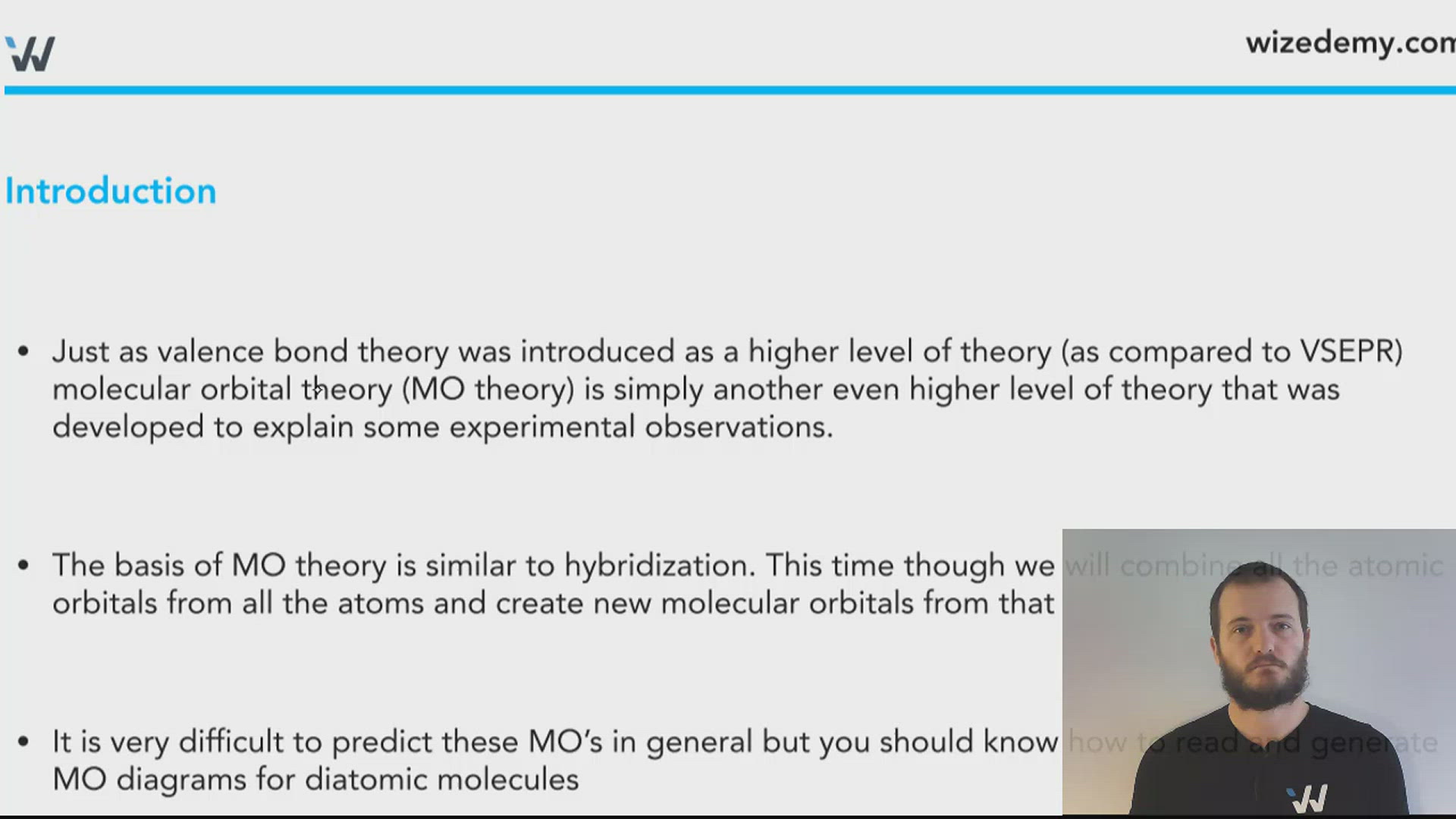
- Just as valence bond theory was introduced as a higher level of theory (as compared to VSEPR) molecular orbital theory (MO theory) is simply another even higher level of theory that was developed to explain some experimental observations.
- The basis of MO theory is similar to hybridization. This time though we will combine all the atomic orbitals from all the atoms and create new molecular orbitals from that
- It is very difficult to predict these MO’s in general but you should know how to read and generate MO diagrams for diatomic molecules
- Another concept becomes important in MO theory and that is the idea of bonding and anti-bonding orbitals. Anti-bonding orbitals are orbitals in which there is a node between the two atoms in question as is shown below

- Once orbitals have been identified as bonding or anti-bonding we can discuss bond order. Bond order is a measure of bond strength. ie a triple bond would have a bond order of 3. To calculate the bond order from a MO diagram (we’ll see this soon) you need to use the equation shown below.
- Bond order describes the degree of bonding between the two atoms and estimates the strength of the bond. The higher the bond order, the stronger the bond and therefore the shorter the bond.
- If the bond order = 0, there is no bonding between the atoms and the molecule is unstable.
0:00 / 0:00
How to Draw MO Diagrams for Homonuclear Diatomics
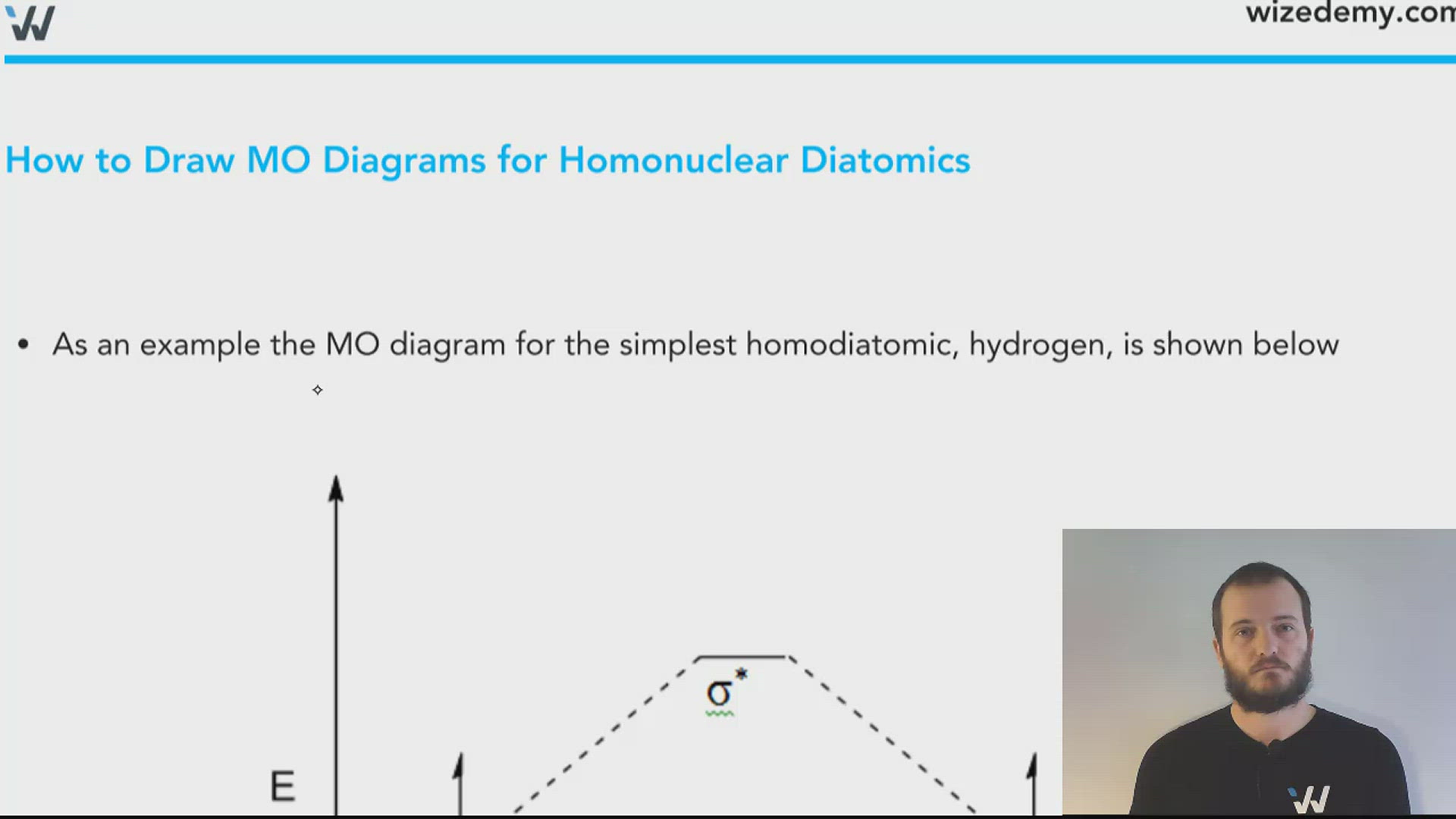
- As an example the MO diagram for the simplest homodiatomic, hydrogen, is shown below

- Note: Now the atoms and the homodiatomic are all on the same energy axis.
- Hydrogen has one electron so each side of the diagram is filled with one electron
- H2 has two electrons so the middle column of orbitals is filled with two electrons.
- Filling the orbitals follows the same three rules that we talked about in chapter 2.
- The MO picture for H2 is fairly simple because we only have one orbital on each atom.When we move to the second row of the periodic table we have to consider the p orbitals.

- Both the π and π* orbitals are comprised of two degenerate pi orbitals.
- This orbital diagram is the same for all homodiatomics of the second row from Li to N.
- When we move to the right of nitrogen along the second row there is a small change to the MO picture. The σ2p switches places with the π2p as shown in figure 8.4 below.
- The reason for this is complex but a partial explanation is obtained by noting that the 2s-2p orbital gap in oxygen is larger (due to electronegativity) and so less 2s-2p “mixing” is observed.

- O2 is a good example of why we need MO theory. MO theory predicts that O2 is paramagnetic whereas VBT does not.

0:00 / 0:00
Draw the full MO for Li2


0:00 / 0:00
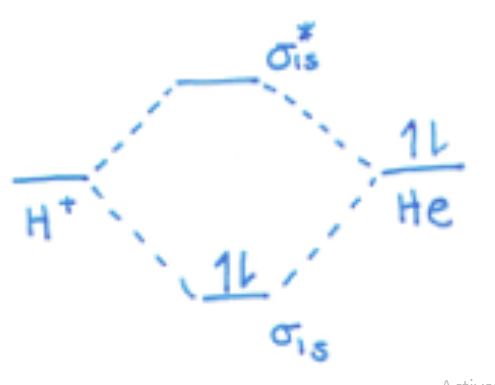
Draw the MO for HeH+
Which of the following diatomic molecules are paramagnetic? Use MO theory in your analysis.
i. O2
ii. N2
iii. O22+
iv. He2+
v. N2+
Choose the statement below about MO theory which is INCORRECT.

Mark Yourself Question
- Grab a piece of paper and try this problem yourself.
- When you're done, check the "I have answered this question" box below.
- View the solution and report whether you got it right or wrong.
Draw the MO for NO.