Wize University Chemistry Textbook > Other Examples of Equilibria (ex. Solubility)
Factors that Affect Solubility
Popular Courses
CHEM 1302A/B
Western University
General Chemistry
University Study Guides
AP Chemistry Exam Prep Course
AP Exam Prep
CHEM 112
Queen's University
CHEM 203
University of Calgary
CHM 1311
University of Ottawa
DAT
General Course
Chemistry
General Course
General Chemistry
University Study Guides
ENGG 204
University of Calgary
CHEM 102
University of Alberta
CHEM 112B
Queen's University
CHEM 123
University of Waterloo
CHEM 130
University of British Columbia
CHEM 1100
University of Manitoba
CHEM 1481
Texas A & M University
CHEM 206
Concordia University
CHMA10H3
University of Toronto
SC/CHEM 1100 4.00
York University
CHEM 1001
Carleton University

0:00 / 0:00
Factors that affect solubility:
Lower solubility:
- Common ion effect: the solubility of a salt is reduced by the presence of another salt having a common ion (the ion that is common to both salts); Le Chatelier predicts that the equilibrium will shift to the left to reduce the disturbance.
Higher solubility:
- Complex ion formation: reactions that use up one of the ions, to form a complex ion will increase the solubility of a salt. An ion made up of a metal ion bonded to one or more molecules or ions is called a complex ion.
- Acid-base neutralization: if the anion of the salt is the conjugate base of a weak acid, the solubility of the salt will increase in an acidic solution
0:00 / 0:00
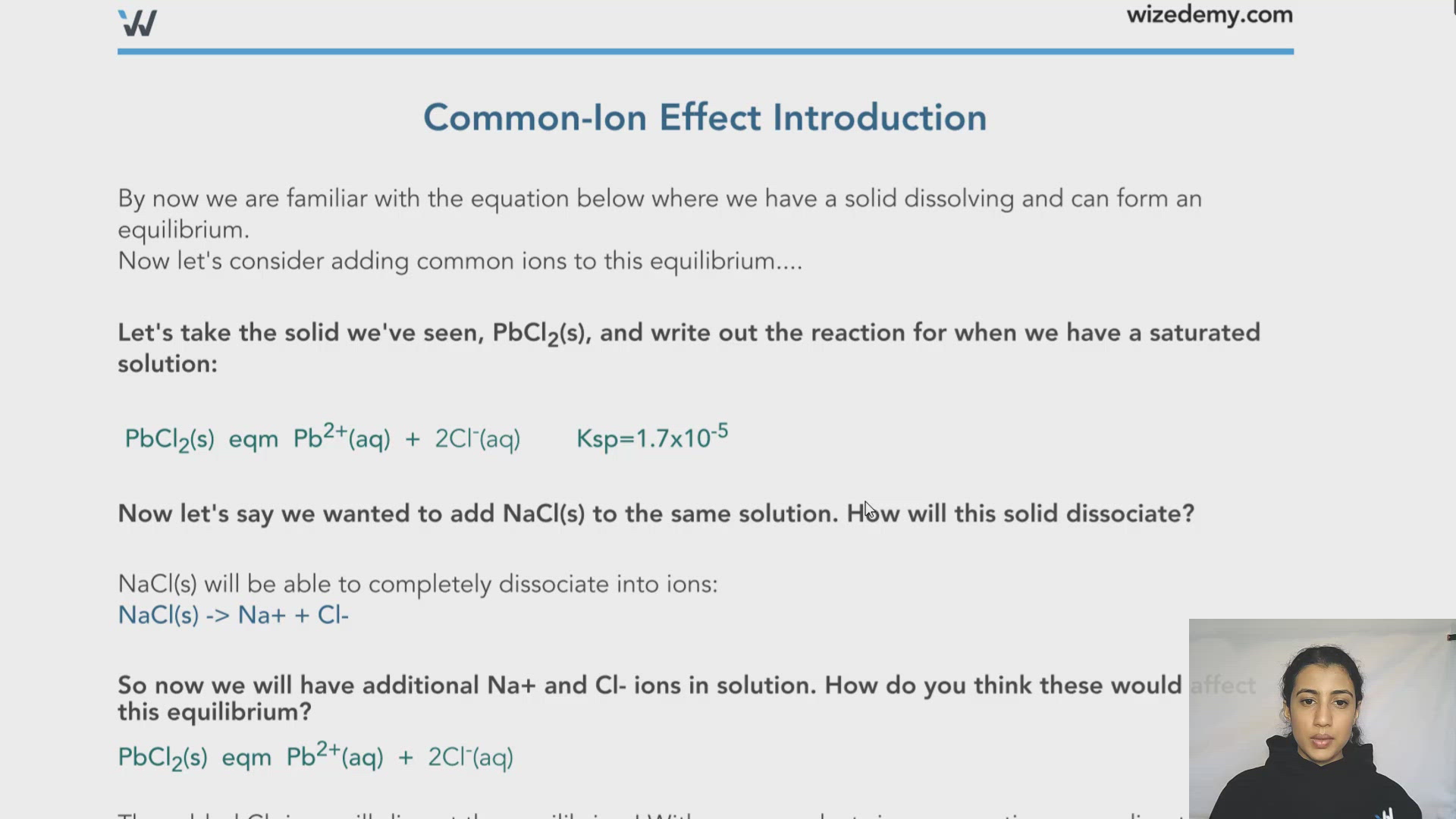
Common-Ion Effect Introduction
By now we are familiar with the equation below where we have a solid dissolving and can form an equilibrium.
Now let's consider adding common ions to this equilibrium....
Let's take the solid we've seen, PbCl2(s), and write out the reaction for when we have a saturated solution:
PbCl2(s) eqm Pb2+(aq) + 2Cl-(aq) Ksp=1.7x10⁻⁵
Now let's say we wanted to add NaCl(s) to the same solution. How will this solid dissociate?
NaCl(s) will be able to completely dissociate into ions:
NaCl(s) -> Na+ + Cl-
So now we will have additional Na+ and Cl- ions in solution. How do you think these would affect this equilibrium?
PbCl2(s) eqm Pb2+(aq) + 2Cl-(aq)
The added Cl- ions will disrupt the equilibrium! With more products in our equation, according to Le Chatelier's Principle, the reaction will shift to the
left
! Here, we call Cl- the common ion (an ion that enters the solution through 2 different sources)
In general, do common ions increase or decrease the solubility of a salt?
Decrease!
0:00 / 0:00
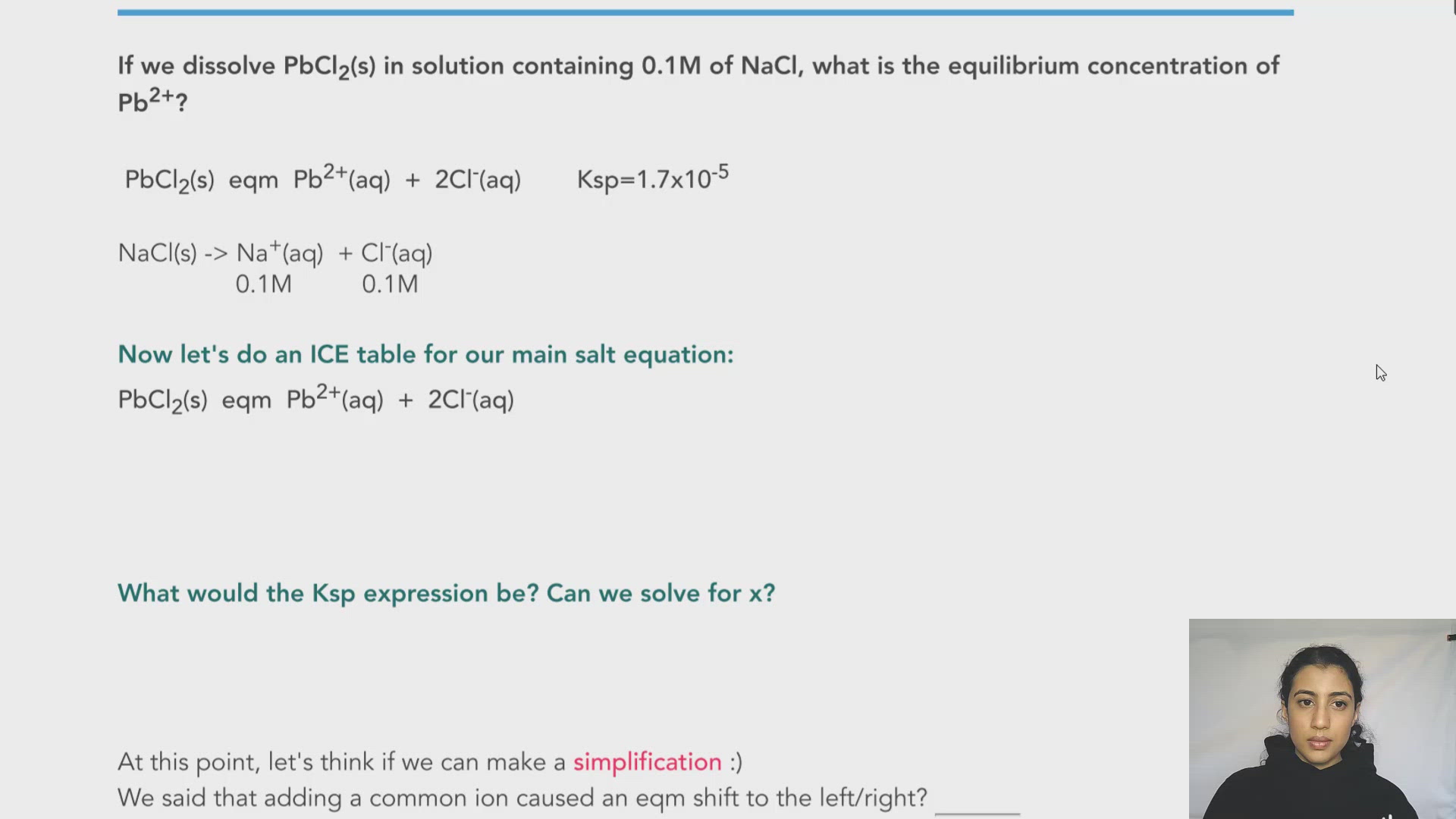
If we dissolve PbCl2(s) in solution containing 0.1M of NaCl, what is the equilibrium concentration of Pb2+?
PbCl2(s) eqm Pb2+(aq) + 2Cl-(aq) Ksp=1.7x10⁻⁵
NaCl(s) -> Na+(aq) + Cl-(aq)
0.1M 0.1M
Now let's do an ICE table for our main salt equation:
PbCl2(s) eqm Pb2+(aq) + 2Cl-(aq)
I 0 0.1M
C x +2x
E x 0.1 + 2x
What would the Ksp expression be? Can we solve for x?
Ksp=[Pb2+][Cl-]2
1.7x10-5=[x][0.1 + 2x]2
At this point, let's think if we can make a simplification :)
We said that adding a common ion caused an eqm shift to the left/right?
left
So the common ion caused an increase/decrease in the solubility of a salt:
Decrease
If this is the case, then do you think x (the molar solubility) for the salt would go down or up when a common ion is present?
Down!
With a common ion present, because the solubility of the salt is decreased, x becomes very small and we can ignore it when it is added to the concentration of ions that is already present.
*Assume the concentration of common ions is entirely due to the other solution!
Here we have the Cl- ions with an equilibrium concentration of 0.1 + 2x. 0.1 is a lot bigger than x and x is very tiny so:
0.1 + 2x ~0.1
Now we'll continue solving!
1.7x10-5=[x][0.1 + 2x]2
1.7x10-5=[x][0.1]2
x= 1.7 x10⁻³
[Pb2+]=x=1.7x10⁻³M
Early we calculated [Pb2+] when no common ions were present. The answer was 1.6x10⁻²M.
Now, with common ions present the [Pb2+] was:
1.7x10⁻³M
The concentrations of Pb2+ changed because the common ion reduced the solubility of PbCl2(s)!
Calculate the molar solubility of AgCl (Ksp = 1.60 × 10⁻¹⁰) in:
a) 2.50 L pure water.
b) 2.50 L solution containing 5.00 g of dissolved CaCl2. Molar mass of CaCl2 is 111.0 g/mol. Note that CaCl2 fully dissociates in water.
a)

Write the Ksp expression:
b) CaCl2 highly soluble in water and fully dissociates.
Use the equation: n=m/M (m=mass in g(g) and M=molar mass in g/mol)
To figure out concentration use the equation: n=cv (n=moles, c=concentration, v=volume (L)) rearrange to solve for c: c=n/v
Now we are starting with a Cl- concentration of 0.0360M and want to see how the solubility of the solid (AgCl(s)) changes:

Write the Ksp expression:
Ksp = [Ag+][Cl-] = (x)(0.0360 + x)
SHORTCUT: see the term “0.0360 + x”? Let's see if we can ignore x, check in k=(y-x) or k=(y+x) when y/k > 400 means we can ignore x, here y=0.0360. y/k=0.0360/1.6x10-10=225 million which is much greater than 400 so we can ignore the +x part!
1.60 × 10-10 = 0.0360x
x = 4.44 × 10⁻⁹ mol/L
Note that in the first scenario (pure water). the solubility of AgCl(s) was 1.26x10⁻⁵M. In the second scenario when we started with a common ion already present (in this case we had Cl- ions already present) this decreased the solubility to 4.44x10⁻⁹M. This makes sense because we started with a product so the reaction shifted more to the left, resulting in a smaller solubility of the solid!

Mark Yourself Question
- Grab a piece of paper and try this problem yourself.
- When you're done, check the "I have answered this question" box below.
- View the solution and report whether you got it right or wrong.
Find the molar solubility of SrCO3 (Ksp = 5.4 x 10⁻¹⁰) in pure water and in 0.13 M Sr(NO3)2. Report your answers to two significant figures in scientific notation. Do not include units in your answer.
Mark Yourself Question
- Grab a piece of paper and try this problem yourself.
- When you're done, check the "I have answered this question" box below.
- View the solution and report whether you got it right or wrong.
A student is preparing to test the molar solubility of PbHPO4 (s) (Ksp=3.5×10⁻¹²) in different aqueous solutions. When this salt dissociates, it produces Pb2+ (aq) and the amphiprotic ion HPO42− (aq).They prepare separate beakers with 100 mL of each of the following solutions to test:
- water
- 0.1 M Pb(NO3)2 (aq) (which fully dissociates in water)
- 1.0 M HCℓ (aq)
- 0.001 M NaOH (aq)
Unfortunately, the student forgot to label which beaker is which! They continue with their experiment and ranked each solution in terms of the molar solubility of PbHPO4 (s) in that solution. Use their data to complete the bottom row of the table below, and determine which solution is in which beaker.
