Wize University Chemistry Textbook > Other Examples of Equilibria (ex. Solubility)
Does a Precipitate Form?
Popular Courses
Grade 12 Chemistry
Ontario High School
Grade 12 Chemistry
Canada High School
CHEM 1302A/B
Western University
General Chemistry
University Study Guides
AP Chemistry Exam Prep Course
AP Exam Prep
CHEM 1A03
McMaster University
CHEM 112
Queen's University
CHEM 203
University of Calgary
High School Chemistry
US High School
DAT
General Course
Chemistry
General Course
General Chemistry
University Study Guides
Chemistry 12
British Columbia High School
CHM135H1
University of Toronto
CHEM 102
University of Alberta
CHEM 112B
Queen's University
CHEM 130
University of British Columbia
CHEM 1100
University of Manitoba
CHEM 1481
Texas A & M University
CHMA10H3
University of Toronto

0:00 / 0:00
Solubility Chart
The following table tells us if certain combinations of ions are soluble or insoluble!
Wize Concept
If a combination of ions is soluble, it means that no precipitate will form.
If a combination of ions is insoluble, it means a precipitate will form!
You can expect to see a question on your exam that asks you if a precipitate will form or not!

Decide whether the following salts would form a precipate or not:
1) NaCl
Na+ is a group 1 ion. When these are part of a compound, it will always be soluble.
Therefore, no precipitate will form!
NaCl → Na+ + Cl-
2) AgCl
Cl- is typically soluble when in a compound, BUT when it is paired with Ag+, that is an exception so the combination of these ions will actually be insoluble.
Insoluble means they won't dissolve into their ions and so we will form a precipitate
3) AgI
I- is typically soluble when in a compound, BUT when it is paired with Ag+, that is an exception so the combination of these ions will actually be insoluble.
Insoluble means they won't dissolve into their ions and so we will form a precipitate
4) NaNO3
Na+ is a group 1 ion. All group 1 ions are always soluble
NO3 is also an ion that is always soluble.
This combination will not form a precipitate.
NaNO3 → Na+ + NO3-
0:00 / 0:00
Q vs K to Predict Solubility
Recall:
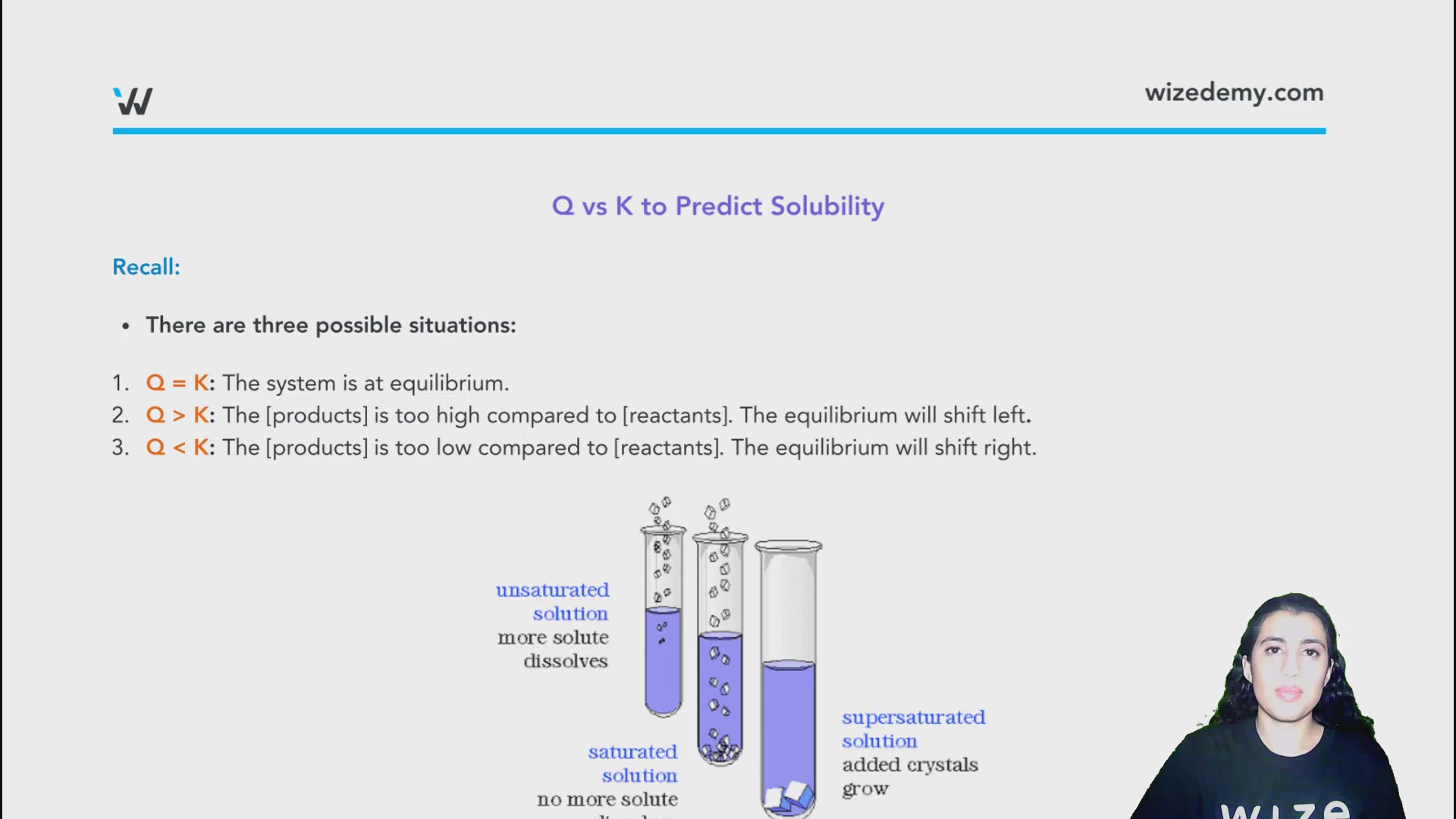
- There are three possible situations:
- Q = K: The system is at equilibrium.
- Q > K: The [products] is too high compared to [reactants]. The equilibrium will shift left.
- Q < K: The [products] is too low compared to [reactants]. The equilibrium will shift right.

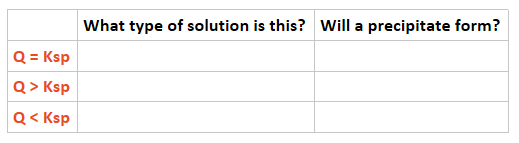
When asked to predict solubility, we should be able to identify whether a solution is unsaturated, saturated, or supersaturated!
0:00 / 0:00
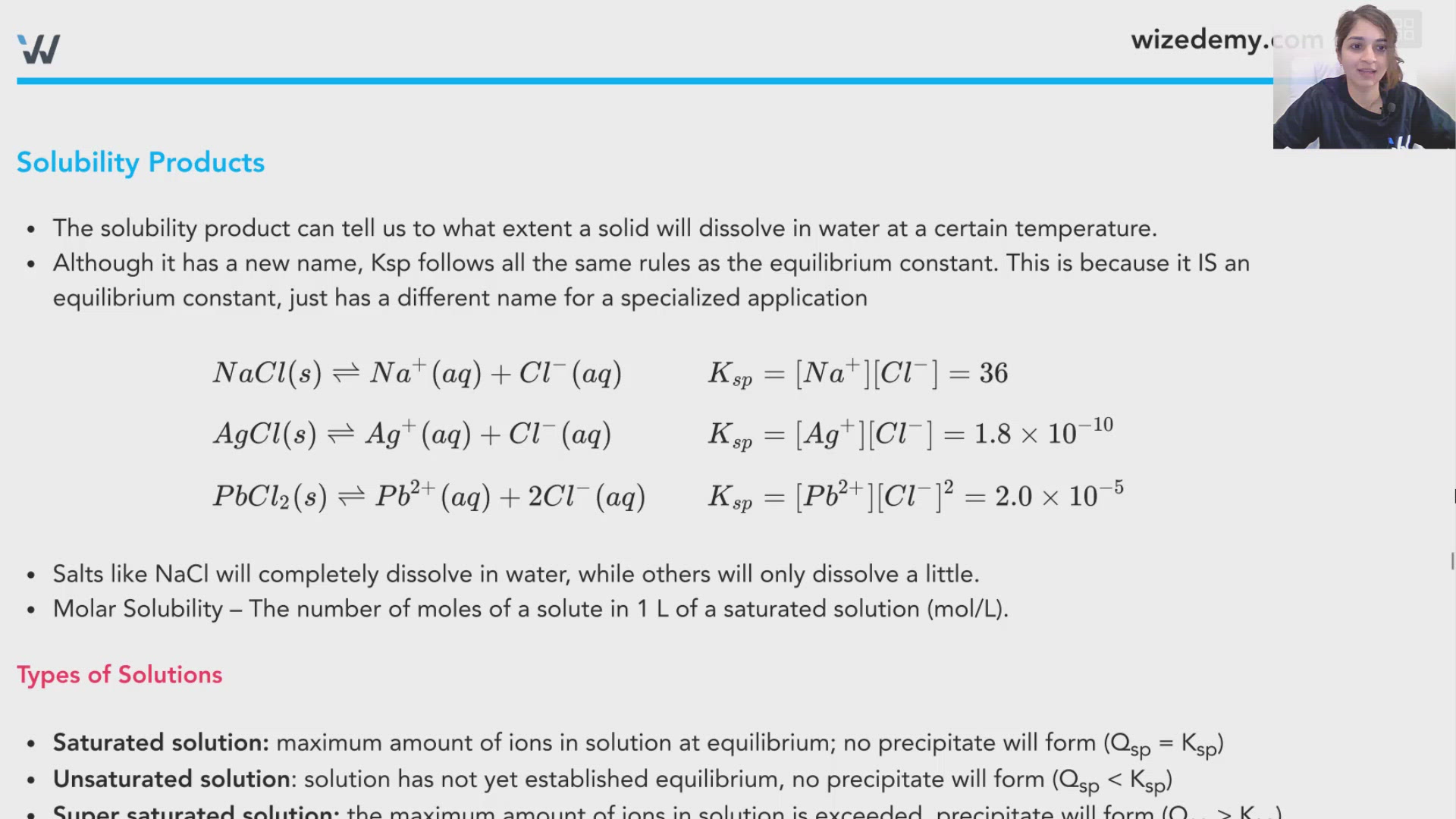
Solubility Products
- The solubility product can tell us to what extent a solid will dissolve in water at a certain temperature.
- Although it has a new name, Ksp follows all the same rules as the equilibrium constant. This is because it IS an equilibrium constant, just has a different name for a specialized application
- Salts like NaCl will completely dissolve in water, while others will only dissolve a little.
- Molar Solubility – The number of moles of a solute in 1 L of a saturated solution (mol/L).
Types of Solutions
- Saturated solution: maximum amount of ions in solution at equilibrium; no precipitate will form (Qsp = Ksp)
- Unsaturated solution: solution has not yet established equilibrium, no precipitate will form (Qsp < Ksp)
- Super saturated solution: the maximum amount of ions in solution is exceeded, precipitate will form (Qsp > Ksp)
0:00 / 0:00
Example: Does a Precipitate Form?
In the following example, do you think a precipitate is formed? If yes, what is the formula of the precipitate?
Pb(NO3)2 + 2KI
1) Write out all ions involved
Pb2+, NO3-, K+, I-
2) Consider different combinations of the ions that were not already done:
Pb2+ & I-, NO3- & K+
3) Determine if each combination would be soluble or insoluble:
We know that I- is generally soluble, but Pb2+ is one of the exceptions so this compound is insoluble
For our second set of ions, anything with NO3- is soluble!
4) Since we do have a precipitate we must now give the formula for the precipitate:
Pb2+ and I-
PbI2
Write the complete chemical reaction:
Pb(NO3)2
(aq)
+ 2KI(aq)
→ PbI2(s)
+ 2KNO3(aq)
Wize Tip
In a chemical reaction, (aq) means that the substance is dissolved in aqueous solution (aka it is soluble),
whereas (s) means that the substance is in solid form and is insoluble in solution (aka forms a precipitate)
This reaction can be referred to as a precipitation reaction.
0:00 / 0:00
Example: Salt Solubility Practice
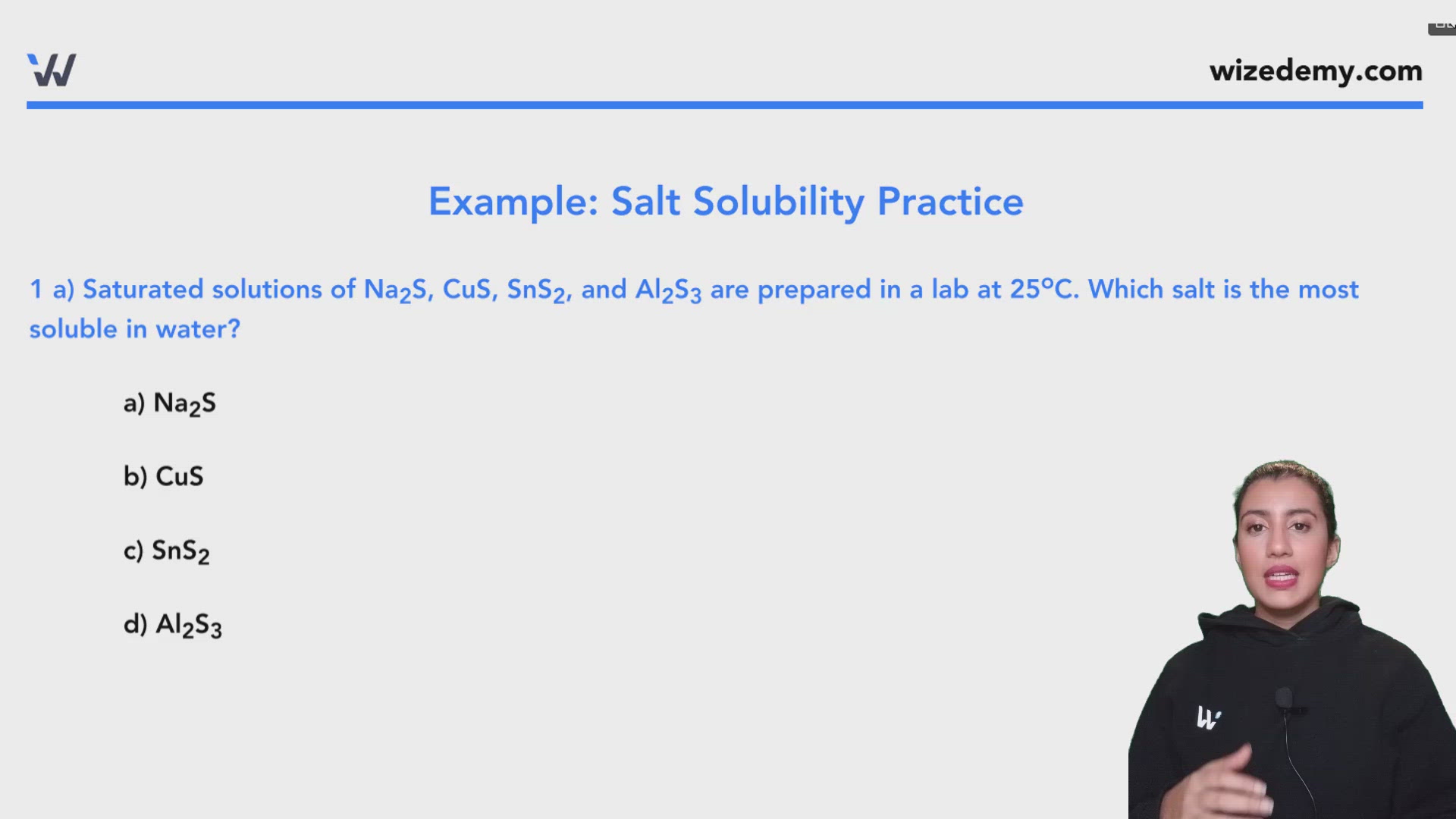
1 a) Saturated solutions of Na2S, CuS, SnS2, and Al2S3 are prepared in a lab at 25oC. Which salt is the most soluble in water?
a) Na2S
b) CuS
c) SnS2
d) Al2S3
Think of the salt solubility rules. Rule #1 is any group 1 cation will be soluble.
a) has Na+ (a group 1 ion)
b) Cu and S, we know S has a charge of -2, since we see no charges, Cu must have a charge of 2+
c) Sn has a charge of 4+ here (S has 2-, divide both charges by 2 to get the compound as written in c))
d) Al3+ and S2-
Therefore Na+ is the only 1+ ion so a) will have the highest solubility!
1 b) Which of the options above would produce the highest [S2-]?
This question is asking us the same thing a) did.
If we have the highest [S2-], it means that the salt was most soluble!
Therefore a) is your answer.
2) Which of the following salts has the lowest solubility?
a) copper (I) perchlorate
b) ammonium sulphide
c) potassium hydroxide
d) mercury(II) sulphate
a) Perchlorate (ClO4-) with any compound is always soluble.
b) Ammonium is NH4+. This compound with anything is always soluble.
c) K+ is a group 1 ion. This salt is soluble.
d) Sulphate (SO42-) is generally soluble but it has a lot of exceptions. Hg2+ is one of them and so the compound is insoluble.
The question is asking us which would have the lowest solubility, so we would choose the insoluble option: d)
0:00 / 0:00
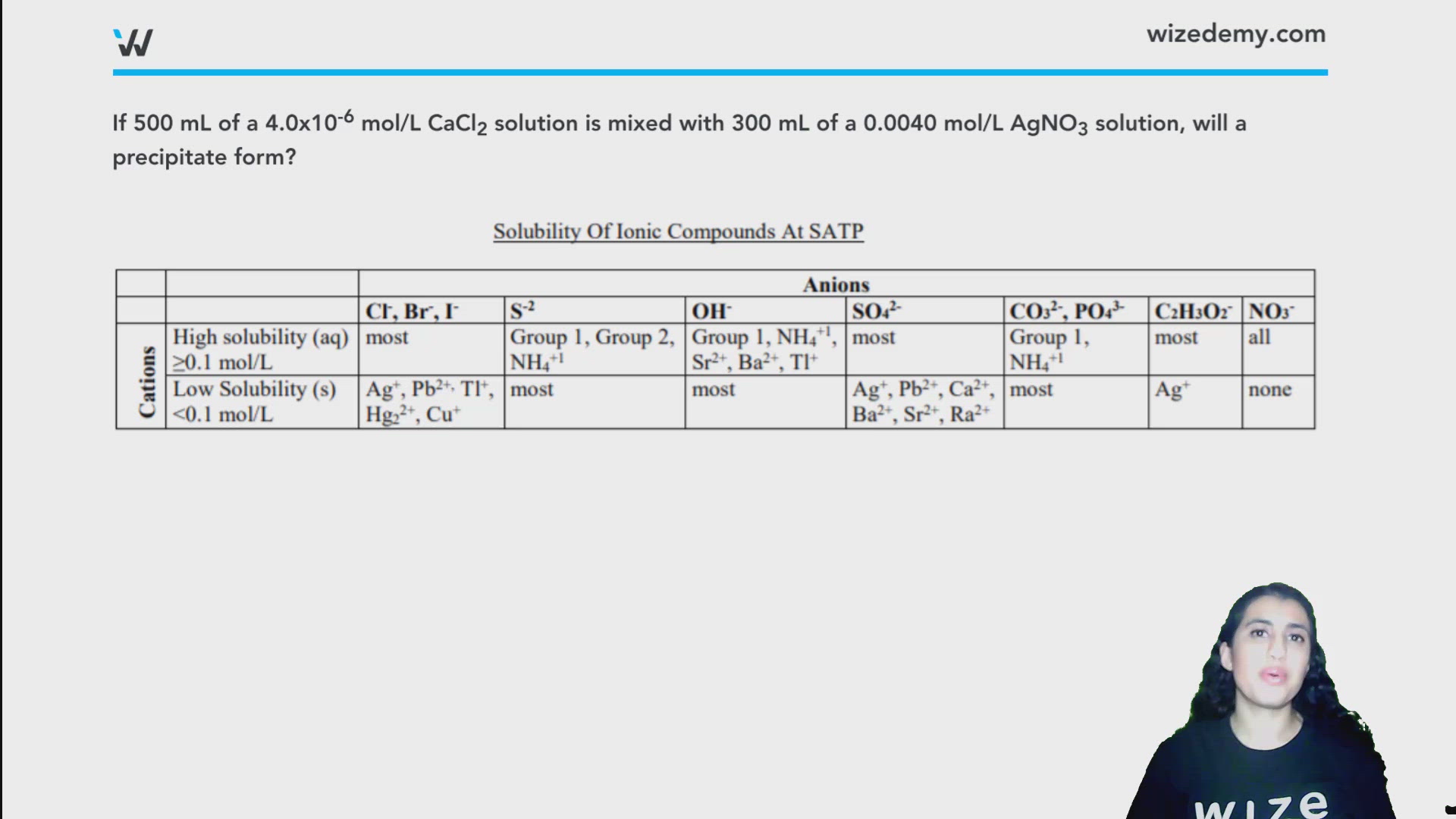
If 500 mL of a 4.0x10⁻⁶ mol/L CaCl2 solution is mixed with 300 mL of a 0.0040 mol/L AgNO3 solution, will a precipitate form? (Ksp(AgCl)=1.8x10⁻¹⁰)

Does a precipitate of PbBr2 form if 50.0 mL of 0.0100 M Pb(NO3)2 is mixed with 50.0 mL of 0.100 M NaBr?
(Ksp PbBr2 = 2.1 × 10⁻⁶)
Practice: Dissociation
What ions does Na2CO3 dissociate into in water?