Wize University Chemistry Textbook > Thermodynamics Part 2: (2nd Law-entropy, 3rd Law, Gibbs Free Energy, Spontaneity)
Gibbs Free Energy + Spontaneity
Popular Courses
MCAT
General Course
CHEM 1302A/B
Western University
General Chemistry
University Study Guides
AP Chemistry Exam Prep Course
AP Exam Prep
CHEM 1A03
McMaster University
CHEM 112
Queen's University
CHEM 203
University of Calgary
DAT
General Course
Chemistry
General Course
General Chemistry
University Study Guides
CHEM 1E03
McMaster University
Chemistry 12
British Columbia High School
CHM135H1
University of Toronto
CHEM 154
University of British Columbia
CHEM 102
University of Alberta
CHEM 123
University of British Columbia
CHEM*1050
University of Guelph
CHY 102
Toronto Metropolitan University
CHEM 120
McGill University
SC/CHEM 1001 3.00
York University

0:00 / 0:00
Gibbs Free Energy and Spontaneity
- It is not always convenient to calculate the entropy of the system and the surroundings to determine whether a process is spontaneous
- Gibbs showed that at constant T and p another state function, ΔG , of the system can predict whether a reaction is spontaneous or not.
- under constant T:
- under constant T and P:
- If ∆𝐺 > 0 the reaction isnon-spontaneous(spontaneousin the reverse direction)
- If ∆𝐺 < 0 the reaction isspontaneousand reversible/irreversibleirreversible
- Just like enthalpy and entropy Gibbs free energy for a reaction can be calculated
Note: we can use the same equation we saw for enthalpy of the reaction and entropy of the reaction. For Gibbs Free Energy just be aware that if the tables are given with values at 25C, this equation can only be used when reaction conditions are at 25C!
- Gibbs free energy is a state function which allows us to set up the following relation
- Also recall how for deltaH0f of aqueous ions, it was not possible to separate the cation and anion contributions
- deltaH0f=0 for H+
- we can do the same for entropy and Gibbs free energy: deltaS0=0 for H+ and deltaG0f=0 for H+
0:00 / 0:00
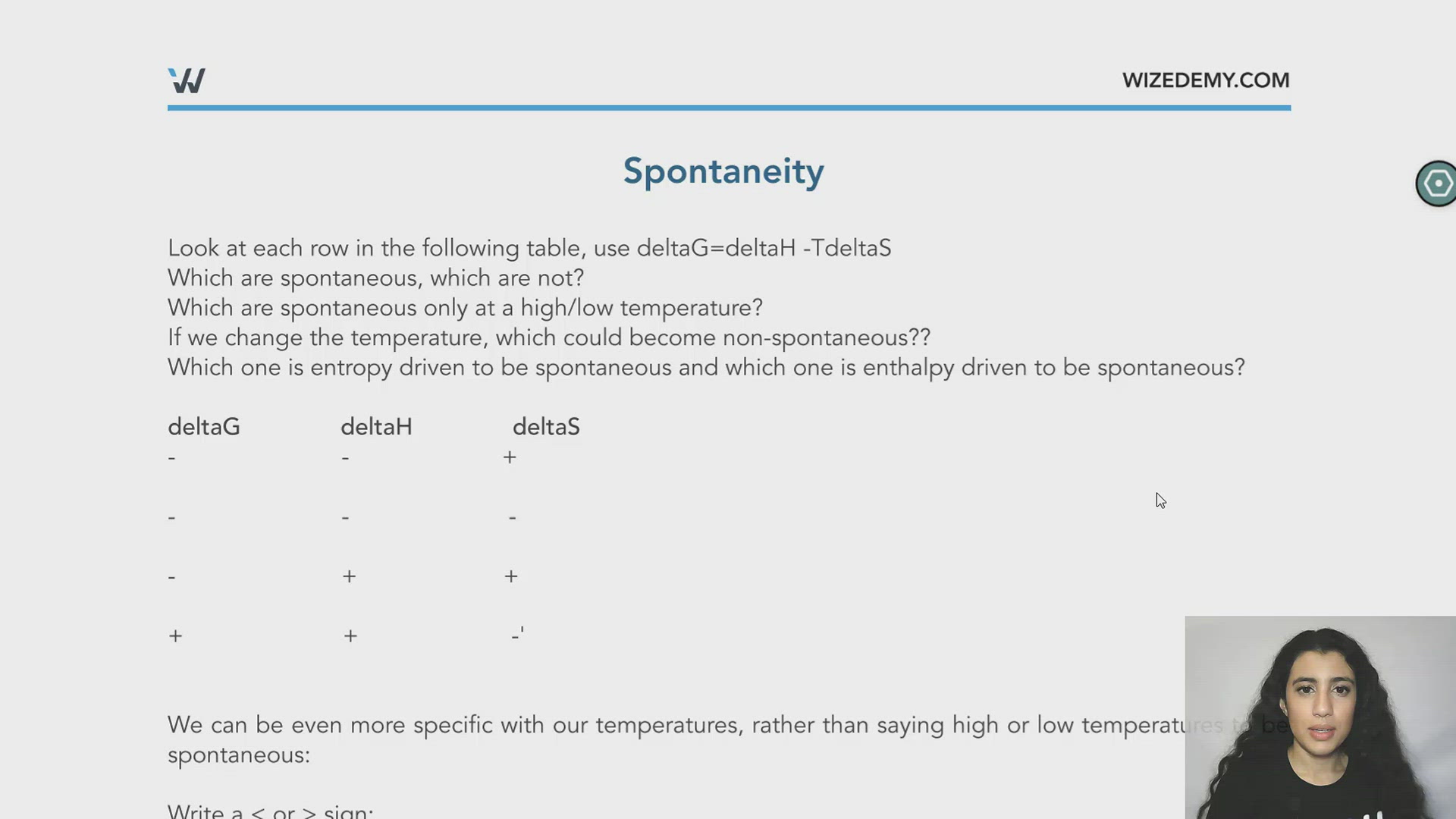
Spontaneity
Look at each row in the following table, use deltaG=deltaH -TdeltaS
Which are spontaneous, which are not?
Which are spontaneous only at a high/low temperature?
If we change the temperature, which could become non-spontaneous??
Which one is entropy driven to be spontaneous and which one is enthalpy driven to be spontaneous?
deltaG deltaH deltaS
- - +
- - -
- + +
+ + -'
We can be even more specific with our temperatures, rather than saying high or low temperatures to be spontaneous:
Write a < or > sign:
For Row 2: T
For Row 3: T
Now what if for row 2 we had placed the opposite sign?
What about for row 3 if we placed the opposite sign?
Using the following table, predict which of the following reactions would be spontaneous at 25°C:
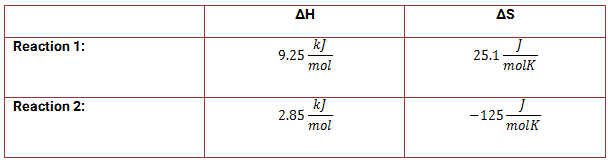
If either of the reactions is non-spontaneous, at what temperature might it become spontaneous?
Consider reaction 1:
deltaG = deltaH - T(deltaS)
=9250J/mol - 298K(25.1J/molK)
=1770.2J/mol
Since deltaG is positive, it is non-spontaneous.
The temerature would need to be a lot higher to result in a negative delta G (spontaneous reaction).
Specifically the temperature would have to be greater than deltaH/deltaS.
deltaH/deltaS=9250J/mol / 25.1J/molK
=368.5K
Therefore temp. would need to be higher than 368.5K for it to be spontaneous!
Want to check?
DeltaG= deltaH - TdeltaS
=9250J/mol - 369(25.1)
= - 11.9 aka the reaction is now spontaneous!!
Now consider reaction 2:
deltaG = deltaH - T(deltaS)
=2850J/mol - 298K(-125J/molK)
=2850 J/mol+ 37250J/mol
=40 100 J/mol
This reaction is also not spontaneous because the deltaG is a positive value.
For this reaction, since deltaH is positive and entropy is negative, both the deltaH part of the equation and the -T(deltaS) part of the equation end up positive no matter how you change the temperature in Kelvins. Therefore, temperature cannot be changed to make this reaction spontaneous and it will remain non-spontaneous!
0:00 / 0:00
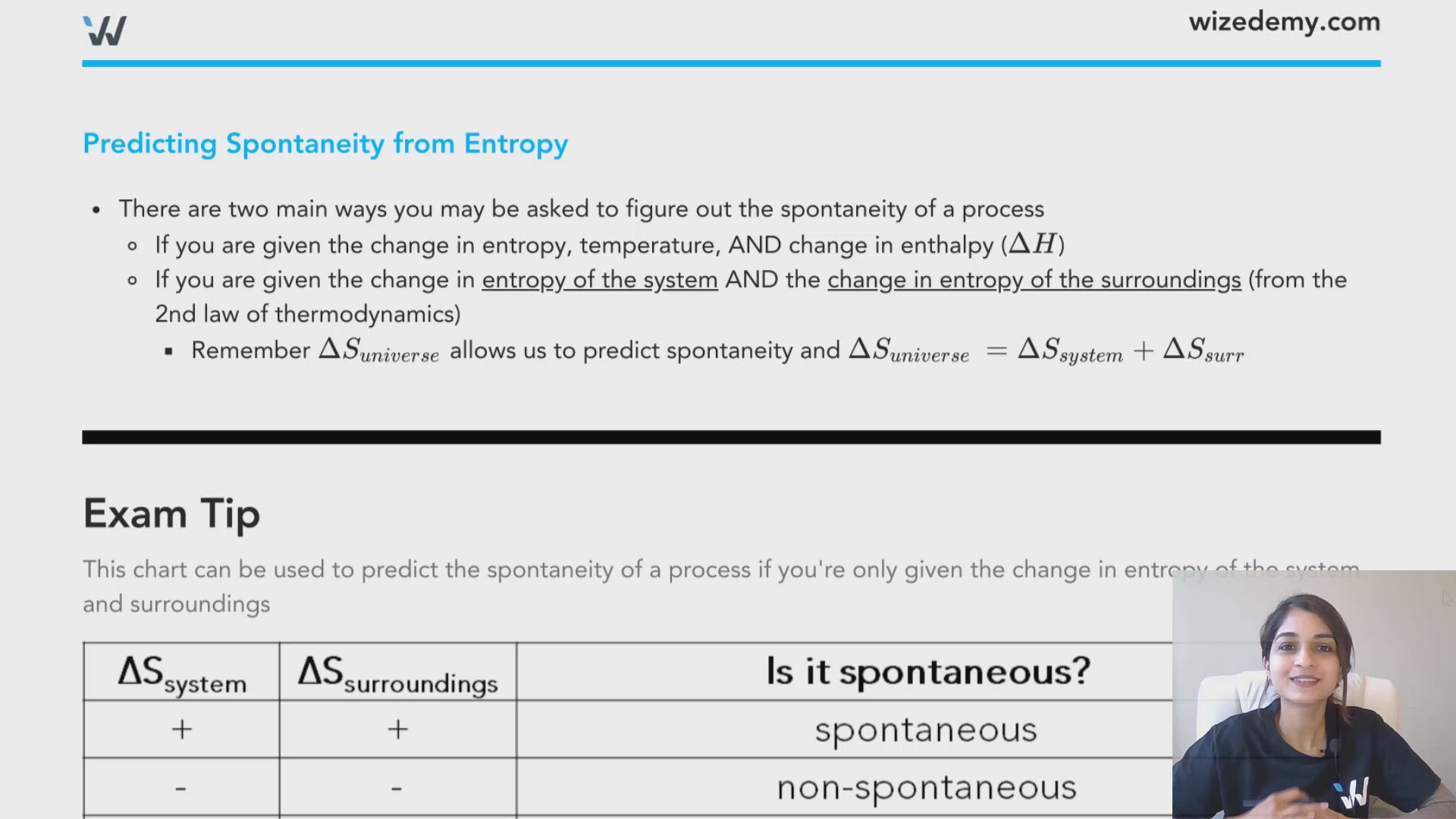
Predicting Spontaneity from Entropy
- There are two main ways you may be asked to figure out the spontaneity of a process
- If you are given the change in entropy, temperature, AND change in enthalpy ()
- If you are given the change in entropy of the system AND the change in entropy of the surroundings (from the 2nd law of thermodynamics)
- Remember allows us to predict spontaneity and
Exam Tip
This chart can be used to predict the spontaneity of a process if you're only given the change in entropy of the system and surroundings
