Wize University Chemistry Textbook > Thermodynamics Part 2: (2nd Law-entropy, 3rd Law, Gibbs Free Energy, Spontaneity)
Connecting Gibbs Free Energy and Equilibrium
Popular Courses
MCAT
General Course
CHEM 1302A/B
Western University
General Chemistry
University Study Guides
AP Chemistry Exam Prep Course
AP Exam Prep
CHEM 112
Queen's University
CHEM 203
University of Calgary
DAT
General Course
Chemistry
General Course
General Chemistry
University Study Guides
CHEM 1E03
McMaster University
CHM135H1
University of Toronto
CHEM 154
University of British Columbia
CHEM 102
University of Alberta
CHEM 123
University of British Columbia
CHEM*1050
University of Guelph
CHY 102
Toronto Metropolitan University
CHEM 120
McGill University
SC/CHEM 1001 3.00
York University
APSC 132
Queen's University
CHEM 112B
Queen's University

0:00 / 0:00
Chemical Equilibrium and ΔG
- In general the Gibbs free energy can be related to the reaction quotient by the following expression
Recall:
∆G < 0 for a spontaneous process
∆G = 0 at equilibrium
- If the reaction is at equilibrium then:
We can rearrange this equation to solve for K:
Wize Tip
We just covered 3 important equations to know for your exam!
1)

2) Is what we get when we let ∆G=0 in the above equation:
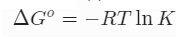
3) We get when we solve for K using equation 2:
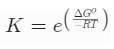
Note: the e in the above equation is a button on your calculator! We will look at some problems so you can get some practice getting familiar with that button!
Gibbs Free Energy and Chemical Reactions
Gibbs free energy is a sate function, so just like enthalpy we can use Gibbs free energies of formation to determine the change in Gibbs free energy for a reaction. This equation can only be used when the temperature is 298K!
van’t Hoff Equation
**memorize this equation as well!
0:00 / 0:00
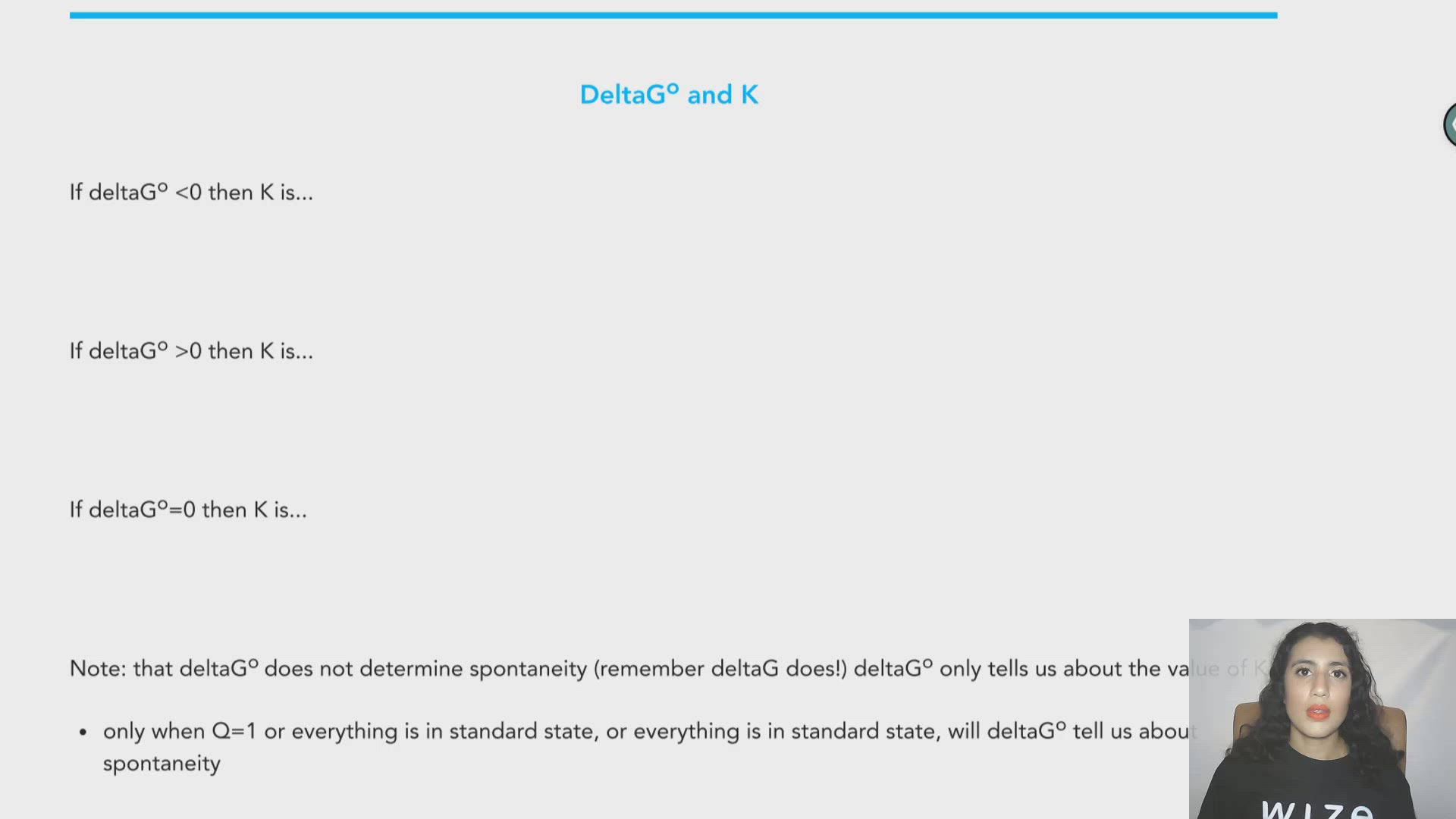
ΔGo and K
If ΔGo < 0 then K is...
K > 1
If ΔGo > 0 then K is...
0 < K < 1
If ΔGo = 0 then K is...
K = 1
Note: that ΔGo does not determine spontaneity (remember ΔG does!) ΔGo only tells us about the value of K
- Only when Q = 1 or everything is in standard state, or everything is in standard state, will ΔGo tell us about spontaneity.
Consider the following reaction at 25°C:
𝐹𝑒(𝑂𝐻)2(𝑠) ⇌ 𝐹𝑒2+(𝑎𝑞) + 2 𝑂𝐻−(𝑎𝑞)
Calculate ΔG° for the reaction. Ksp for Fe(OH)2 is 1.6 × 10⁻¹⁴.
The reaction we are asked to calculate ΔG0 for is the solubility of Fe(OH)2 in water ie, Ksp reaction. Therefore, we can use the relationship between K and ΔG0 to find the answer.
ΔrS° and ΔrH° are known to be –225.3 J K–1mol–1 and –32.8 kJ mol–1 respectively for the following reaction:
a. Is this reaction spontaneous under standard conditions at T = 298K and P = 1 atm?
b. Are reactants or products favoured in the above conditions?
c. At what temperature does the reaction favour the opposite?
a.
ΔG = ΔH - T(ΔS)
ΔG = -32,800 J/mol - (298K)(-225.3 J/Kmol)
ΔG = +34k J/mol
Since the value is positive, the reaction is not spontaneous.
b.
Since ΔGo is positive it means that reactants are favoured over the product under STANDARD conditions.
c.
A reaction transitions from reactants to products or vice versa when ΔGo = 0. In our case, ΔGo > 0 first so reactants are favoured. ΔGo = 0 is the middle point and when ΔGo < 0 products are favored.
Assuming ΔHo and ΔSo are temperature independent:
So any temperature below 145.6K would result in a negative value for ΔGo , where products are favored over reactants!
If you get confused with deciding if the temperature should be below or above 145.6 to get non-spontaneous, think of the signs:
We want ΔG to be negative, ΔH is negative and ΔS is negative:
ΔG = ΔH - T(ΔS)
(-G) = (-H) - T(-S)
Now the minus sign multiplied by the negative sign in front of ΔS will multiply to create a positive sign:
(-G) = (-H) + T(S)
Now we know that when T = 145.6K, ΔG = 0 because the negative H is cancelled out perfectly by +T(S)
If I increased the temperature, then -H + TS would make ΔG positive
If i decreased the temperature, then -H + TS would make ΔG negative
Another way to figure out if ΔG is negative at a temperature lower or higher than 145.6K is by plugging in other temperature values:
a) If we plug in a higher temperature than 145.6K (can pick any number let's do 160K)
ΔG = ΔH - T(ΔS)
ΔG = -32,800J/mol - (160)(-225.3)
ΔG = +3,248 J/mol
Now we know that we get a +ΔG when we use a HIGHER temperature.
b) So we must get a -ΔG when we use a LOWER temperature, but let's check:
We can pick any temperature lower than 145.6K to check this. Let's check 135K
ΔG = ΔH - TΔS
ΔG = -32,800 - (135)(-225)
ΔG = -2,425 J/mol
Now we are sure that we get a -ΔG when we use a LOWER temperature (in this example)
The equilibrium constant for the decomposition of N2O4(g) into NO2(g) has an equilibrium constant K = 660021 at 298K.
- Write the balanced chemical reaction for the decomposition of N2O4(g).
- What is ΔGo for the above reaction?
- It is known that ΔSo = +165 J mol-1 K -1 and ΔHo = +15.9 kJ mol-1 . Assuming ΔHo and ΔSo are temperature independent, calculate the equilibrium constant, K.
a.
b.
deltaG=deltaG0 + RTlnQ
At equilibrium, deltaG=0, deltaGo=-RTlnK
This equation can only be used in standard conditions:
c. Solve for K:
deltaGo = deltaHo - TdeltaSo
deltaGo = 15,900 J/mol - 298K(165 J/molK)
deltaGo = -33,270 J/mol
deltaG0=-RTlnK
lnK = deltaG0/-RT
elnK = edeltaG0/-RT
lne(K) = edeltaG0/-RT lne = 1
K = e13.428...
K = 679063
In British Columbia there has been fierce debate over whether we should increase or halt production of LNG liquefied natural gas (CH4). One alternative to liquefying CH4 (bp = -161.5 oC) is to convert it directly into methanol (CH3OH) which is a liquid at room temperature and pressure in the reaction shown below.

- Calculate ΔHo , ΔSo and ΔGo at 25oC for the conversion of natural gas to methanol. Is this process spontaneous?
- Calculate the equilibrium constant for this reaction at 25oC.
- What are three things you could do to favour the production of methanol?
- Under the following conditions is the reaction spontaneous? (see below)
a.
Since deltaGo is negative, it is spontaneous.
b.
c.
- Increase partial pressure of CH4 or O2
- Remove Methanol from the reaction as formed
- Cool the reaction down .
- Increase Total Pressure / Decrease Total Volume
d.
p(CH3OH)=1atm
Since deltaG <0 the reaction is spontaneous in the forward direction!

Mark Yourself Question
- Grab a piece of paper and try this problem yourself.
- When you're done, check the "I have answered this question" box below.
- View the solution and report whether you got it right or wrong.
Consider the following reaction
is measured to be at , what temperature would the reaction need to be run at to get an equilibrium constant of ?