Popular Courses
MCAT
General Course
DAT
General Course
CHEM 121
Simon Fraser University
CHEM 205
University of British Columbia
CHEM 130
University of British Columbia
CHEM 1481
Texas A & M University
CHEM 1012
Dalhousie University
CHM 2045
University of Florida
CHEM 1001
Carleton University
CHEM 1P91
Brock University
CHMA11H3
University of Toronto
CHEM 1110
University of Manitoba
CHEM 1300
University of Manitoba
CHEM 151
University of Arizona
CHM 1045
Florida State University
CHEM 124
California Polytechnic State University-San Luis Obispo
NE 121
University of Waterloo
CHEM 161
Rutgers University
CHEM 1002
Carleton University
CHM220H1
University of Toronto

0:00 / 0:00
Infrared Spectroscopy

Infrared (IR) Spectroscopy measures the interaction of IR light with different functional groups found (in particular: carbonyl groups, alkanes/alkenes/alkynes, alcohols and amines) within your sample.
The energy of the IR light is varied to see where the sample absorbs light energy:

IR Spectroscopy
Since we measure absorptions characteristic to certain bonds, IR spectroscopy is a great way to determine which functional groups are present in a molecule.
Wize Concept
We will just focus on memorizing a few functional groups from this table. If you see a more complicated problem on your exam, your prof will provide you with a table similar to the one shown below (usually found on a formula sheet).
Important functional groups to know:
- OH
- C=O

General Trends in IR Peaks
Hybridization affects bond strength! Stronger bonds have vibrate at higher frequencies (they have higher wavenumbers).
Vibrations of bonds involving heavier atoms have lower vibrational frequencies (they have lower wavenumbers).
- We often use a unit called wavenumber () to represent the energy of vibrational absorbances
- IR spectroscopy generally covers the 500-4000 range.

0:00 / 0:00
Example: IR Spectra
The IR spectrum for cyclohexanone is given below. Which functional groups can you identify from this data? How?

There are sp3 C-H bonds which we can see for the peak(s) around 2900cm-1.
There is a C=O which we can see by the peak at 1700 cm-1

0:00 / 0:00
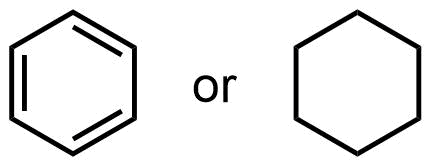
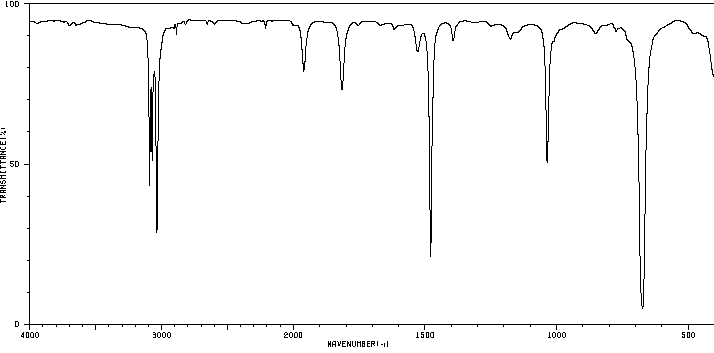
Which molecule does the IR spectra belong to?

0:00 / 0:00
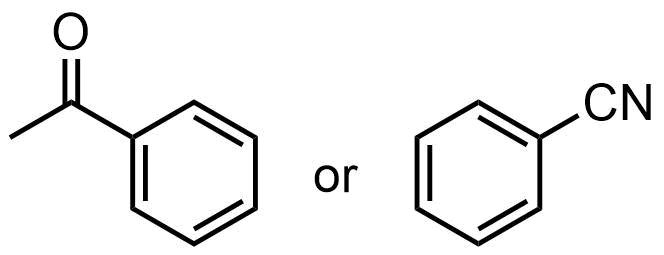
Which molecule does the IR spectra belong to?

Practice: IR Spectra
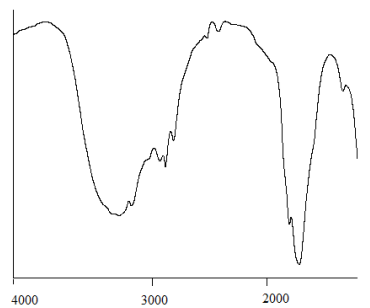
Based on the IR spectrum below, what is the most likely empirical formula for this molecule?

Practice: IR Spectra
Identify all the functional groups in the following IR Spectrum:

Practice: IR Spectroscopy
The "Brazilian blowout" hair treatment, now renamed the "keratin smoothing" treatment after bad press, contains the chemical methylene glycol. This treatment was found to release a toxic chemical called formaldehyde due to a reversible reaction between methylene glycol and water. The reaction is detailed below.


Mark Yourself Question
- Grab a piece of paper and try this problem yourself.
- When you're done, check the "I have answered this question" box below.
- View the solution and report whether you got it right or wrong.
Which molecule does the IR spectra belong to?
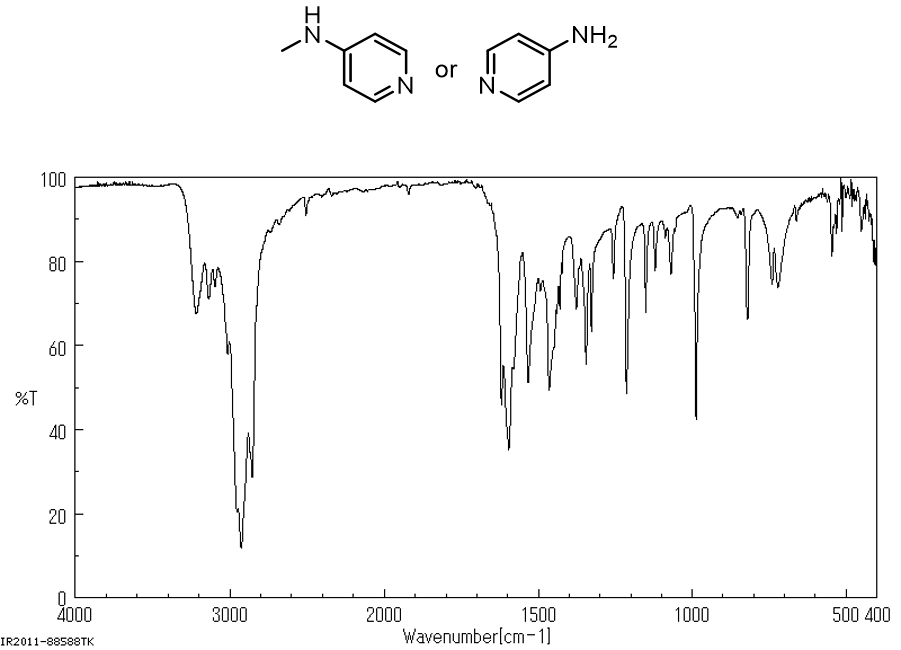
Mark Yourself Question
- Grab a piece of paper and try this problem yourself.
- When you're done, check the "I have answered this question" box below.
- View the solution and report whether you got it right or wrong.
Which molecule does the IR spectra belong to?

IR Spectra Cheatsheet
O-H vs C-H vs COOH
OH is broad and to the left of 3000 cm-1
C-H is the sharp band just right of 3000 cm-1

COOH is much more broad than an O-H and overlaps all of the C-H stretch,
We can also see the C=O stretch at ~1800 cm-1 . This is a key feature of all carbonyl compounds.
Do not mistake this for C=C which are small and subtle (and easier to identify using NMR anyway)