Popular Courses
MCAT
General Course
DAT
General Course
CHEM 121
Simon Fraser University
CHEM 205
University of British Columbia
CHEM 130
University of British Columbia
CHEM 1481
Texas A & M University
CHEM 1012
Dalhousie University
CHEM 1001
Carleton University
CHM 2045
University of Florida
CHEM 1P91
Brock University
CHMA11H3
University of Toronto
CHEM 1110
University of Manitoba
CHEM 1300
University of Manitoba
CHEM 151
University of Arizona
CHM 1045
Florida State University
CHEM 124
California Polytechnic State University-San Luis Obispo
NE 121
University of Waterloo
CHEM 161
Rutgers University
CHM220H1
University of Toronto
CHM220H1
University of Toronto
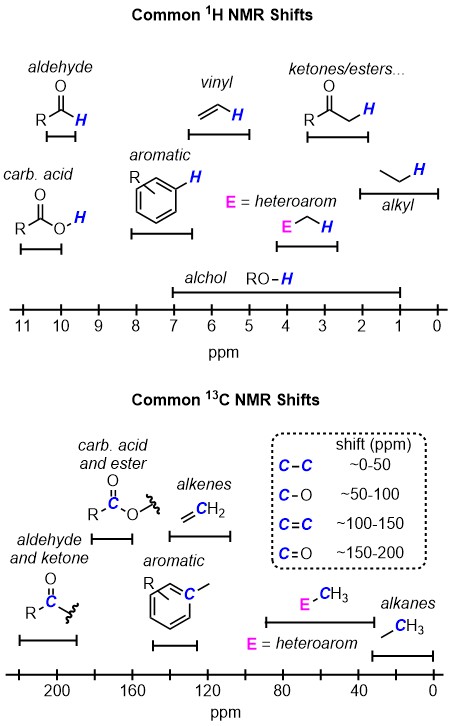
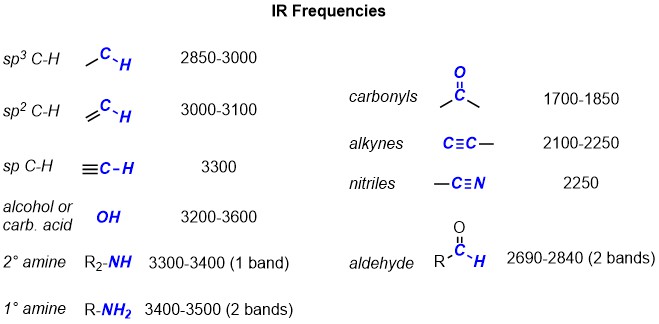
Spectroscopy Overview
1) Determine molecular weight from mass spectrum
- get this from looking for the M+ fragment (has the heaviest mass)
2) Determine # of unique Hs from H1-NMR spectrum
- get this for the overall # of peaks
3) Determine the # of unique Cs from the C13-NMR spectrum (if it shows splitting as well you will be able to see how many Hs are attached to each of those Cs
- overall # of peaks=# of unique Cs
- if there is coupling, for a unique C, the # of small peaks for that C -1=the number of Hs directly bound to those Cs
4) Examine each spectrum for obvious elements:
- Examine IR spectrum for presence or absence of carbonyl groups (C=O), hydroxyl groups, NH groups, etc
- shows functional groups
- examine mass spectrum for typical fragments like ArCH3- (where Ar=aromatic/benzene ring), CH3CO-, CH3-, etc
- examine UV-VIS spectrum for evidence of conjugation, aromatic rings, etc