Wize University Chemistry Textbook > Structure Elucidation (IR Spectroscopy, NMR, Mass Spectrometry)
UV-Vis, Fluorescence, and Phosphorescence
Popular Courses
MCAT
General Course
DAT
General Course
CHEM 121
Simon Fraser University
CHEM 205
University of British Columbia
CHEM 130
University of British Columbia
CHEM 1481
Texas A & M University
CHEM 1012
Dalhousie University
CHM 2045
University of Florida
CHEM 1001
Carleton University
CHEM 1P91
Brock University
CHMA11H3
University of Toronto
CHEM 1110
University of Manitoba
CHEM 1300
University of Manitoba
CHEM 151
University of Arizona
CHM 1045
Florida State University
CHEM 124
California Polytechnic State University-San Luis Obispo
NE 121
University of Waterloo
CHEM 161
Rutgers University
CHM220H1
University of Toronto
CHEM 1002
Carleton University

0:00 / 0:00
Visible Region of the Electromagnetic Spectrum
- Bonus: Electromagnetic radiation is classified based on its wavelength:

Increasing wavelength
(left)
Increasing Energy
(right)
Increasing Frequency
(right)
- Note the order of waves from lowest energy to highest energy (ex. UV rays have higher energy than the visible region)
- Also note the order of colours: R.O.Y.G.B.I.V. (from longest wavelength to shortest or lowest energy to highest!)
Wize Tip
On the left side, we have things like our household appliances, but on the right we have dangerous waves. A memory tip is to think of GAMMA like GRANDMA, and grandmas are short (:P), so gamma rays have the shortest wavelength!
Recall: Last class we talked about gamma radiation and they had high penetration and high energy. That info matches with the EM spectrum!

Also if given a question about absorbing colours, know that when one colour is absorbed, you will see the colour that is opposite to it on the colour wheel.
- For example, if red is absorbed, you will seegreen.
- If we see violet,yellowmust have been absorbed.
0:00 / 0:00
UV-vis Theory
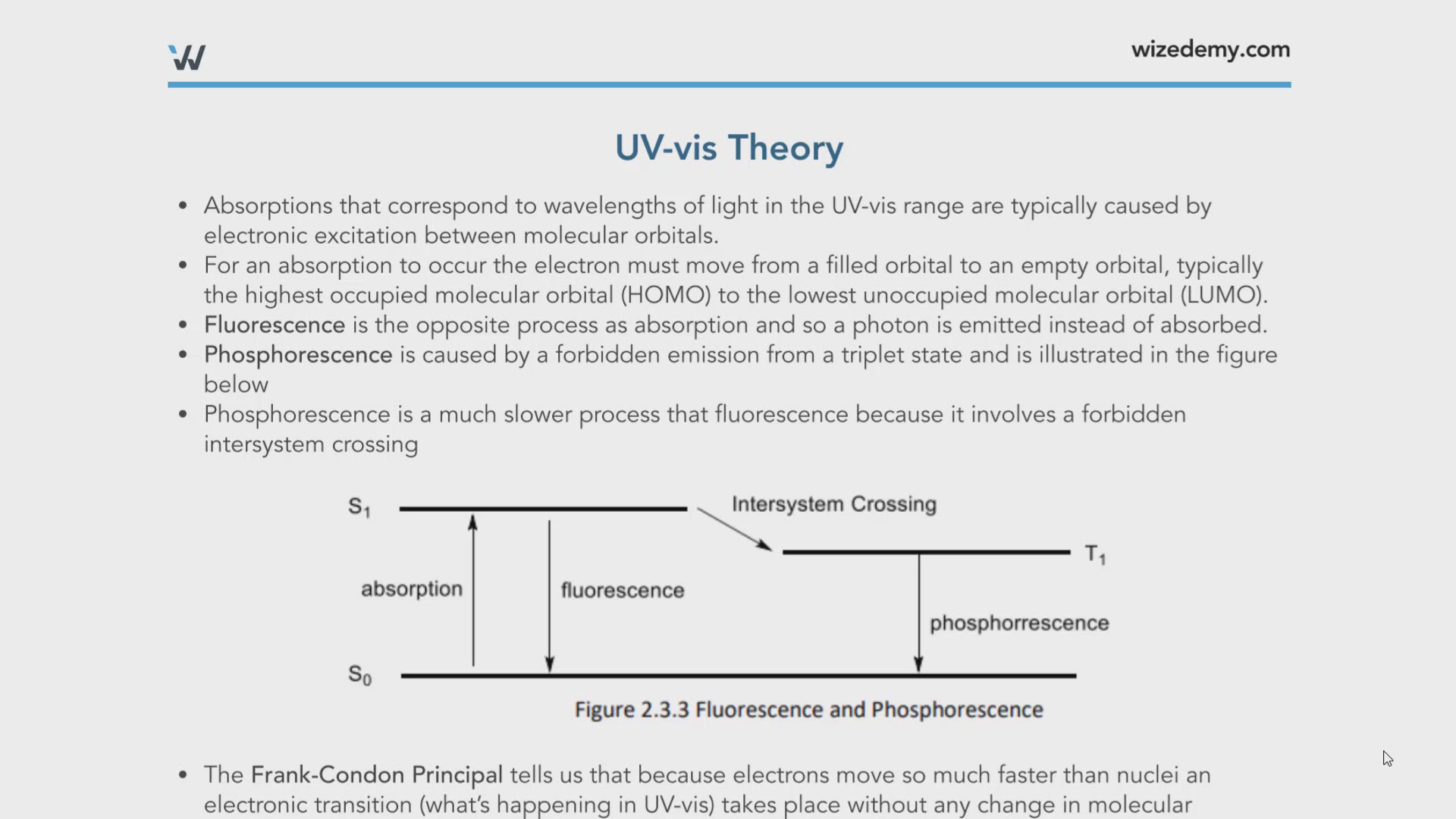
- Absorptions that correspond to wavelengths of light in the UV-vis range are typically caused by electronic excitation between molecular orbitals.
- For an absorption to occur the electron must move from a filled orbital to an empty orbital, typically the highest occupied molecular orbital (HOMO) to the lowest unoccupied molecular orbital (LUMO).
- Fluorescence is the opposite process as absorption and so a photon is emitted instead of absorbed.
- Phosphorescence is caused by a forbidden emission from a triplet state and is illustrated in the figure below
- Phosphorescence is a much slower process that fluorescence because it involves a forbidden intersystem crossing

- The Frank-Condon Principal tells us that because electrons move so much faster than nuclei an electronic transition (what’s happening in UV-vis) takes place without any change in molecular geometry.
- Because molecules can relax rapidly, fluorescence will occur from the ground vibrational level. As we can see in figure 2.3.4 this results in the absorption energy being greater than the emission energy. This difference is called the stokes shift (red line=fluorescence)

What Does it Tell Us For Molecule Identification?
- Honestly, not much. Although this information is often provided along with 1H, 13C NMR spectra and IR absorption spectra, it is never necessary to identify the molecule and is often misleading.
- Compounds which have a UV-vis absorption band typically have conjugated pi systems like benzene rings and double bonds. A table is given on your formula sheet...use it if you are explicitly asked to explain the UV-vis spectrum
- E (extinction coefficient) tells us about the strength of the absorption at that peak
- larger E=stronger absorption

- more conjugated double bonds present=lower energy of the transition=longer wavelength of absorption

Mark Yourself Question
- Grab a piece of paper and try this problem yourself.
- When you're done, check the "I have answered this question" box below.
- View the solution and report whether you got it right or wrong.
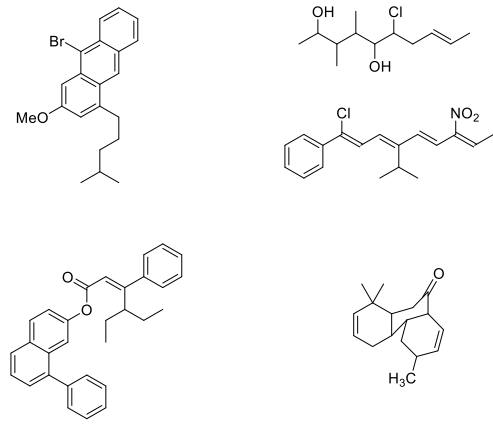
Circle the compounds below which you predict would give an absorption in the UV-vis region. And circle the chromophore.