Popular Courses
CHEM 121
Simon Fraser University
CHEM 205
University of British Columbia
CHEM 130
University of British Columbia
CHEM 1481
Texas A & M University
CHEM 1012
Dalhousie University
CHM 2045
University of Florida
CHEM 1001
Carleton University
CHEM 1P91
Brock University
CHMA11H3
University of Toronto
CHEM 1110
University of Manitoba
CHEM 1300
University of Manitoba
CHEM 151
University of Arizona
CHM 1045
Florida State University
CHEM 124
California Polytechnic State University-San Luis Obispo
NE 121
University of Waterloo
CHEM 161
Rutgers University
CHM220H1
University of Toronto
CHM220H1
University of Toronto
CHEM 1002
Carleton University
CHEM 102
University of Illinois at Urbana - Champaign
0:00 / 0:00
Carbon (13C) NMR
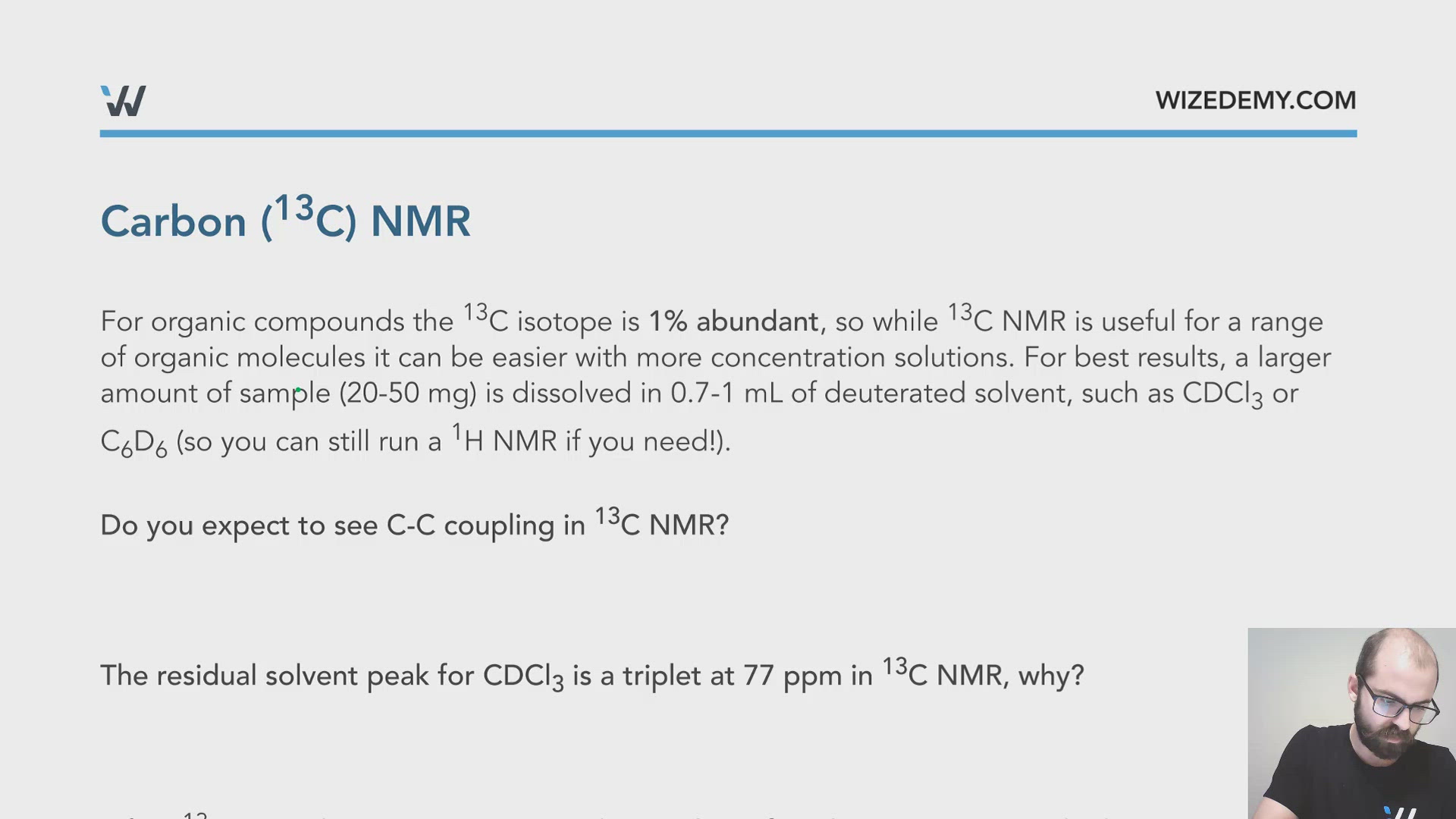
For organic compounds the 13C isotope is 1% abundant, so while 13C NMR is useful for a range of organic molecules it can be easier with more concentration solutions. For best results, a larger amount of sample (20-50 mg) is dissolved in 0.7-1 mL of deuterated solvent, such as CDCl3 or C6D6 (so you can still run a 1H NMR if you need!).
Do you expect to see C-C coupling in 13C NMR?
The residual solvent peak for CDCl3 is a triplet at 77 ppm in 13C NMR, why?
Often 13C NMR data is just given as a the number of peaks (e.g. compound X has 6 signals in its 13C NMR spectrum). Each unique carbon environment will produce a different signal. With that in mind, how many signals are expected in the 13C NMR for the following compounds?

Common 13C NMR Shifts

0:00 / 0:00

0:00 / 0:00


Mark Yourself Question
- Grab a piece of paper and try this problem yourself.
- When you're done, check the "I have answered this question" box below.
- View the solution and report whether you got it right or wrong.
Mark Yourself Question
- Grab a piece of paper and try this problem yourself.
- When you're done, check the "I have answered this question" box below.
- View the solution and report whether you got it right or wrong.

Mark Yourself Question
- Grab a piece of paper and try this problem yourself.
- When you're done, check the "I have answered this question" box below.
- View the solution and report whether you got it right or wrong.