Wize University Macroeconomics Textbook > Unemployment Fluctuations and the NAIRU
Employment and Unemployment
Popular Courses
ECON 203
Concordia University
Macroeconomics
University Study Guides
Macroeconomics
General Course
ECON 102
University of British Columbia
ECON*1100
University of Guelph
Macroeconomics
University Study Guides
ECON 102
University of Alberta
ECO102H1
University of Toronto
ECO 1102
University of Ottawa
ECON 209
McGill University
ECON 1BB3
McMaster University
ECON 112
Queen's University
AP/ECON 1010 3.00
York University
ECON 295
McGill University
ECON 110
Queen's University
ECON 105
Simon Fraser University
ECON 1102
Dalhousie University
ECON 1002
Carleton University
ECON 1BA3
McMaster University
ECON 330
McGill University

0:00 / 0:00
Employment
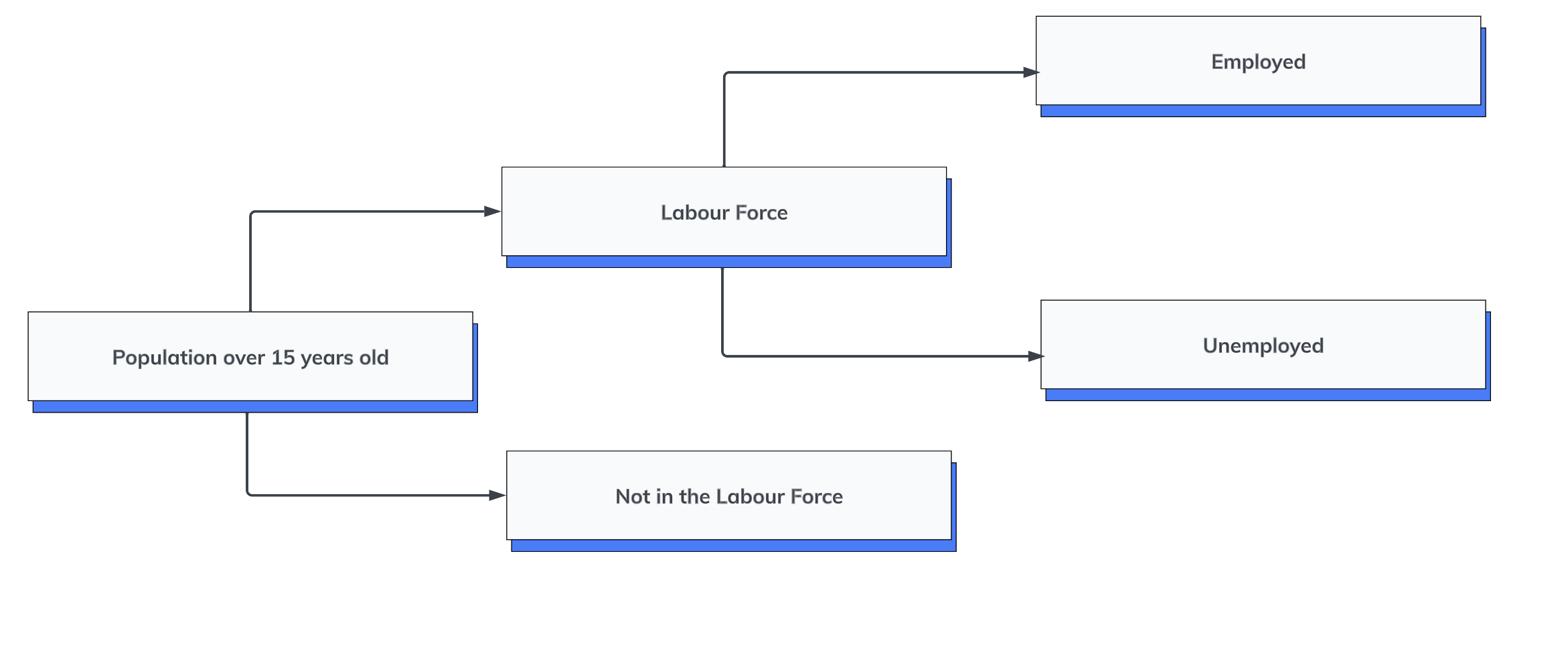
- Employed: any adult (aged 15 or above) that has a job.
- Unemployed: any adult (aged 15 or above) that does not have a job but is actively looking for one.
- Labour force = employed + unemployed
- Unemployment rate: the percentage of the labour force that is unemployed.

Flows in the Labour Market
Flow: Individuals moving between employment, unemployment and not in the labour force.
Average duration of unemployment spell
- Measures the average number of months an individual spends being unemployed.
- Ratio of the stock of unemployment (Us) and the monthly outflow from unemployment (Uo)
- Stock of Unemployment (Us): This represents the total number of people who are unemployed at a specific point in time. It's like a snapshot of the current unemployed population.
- Monthly Outflow from Unemployment (Uo): This refers to the number of people moving out of unemployment and into employment or leaving the labor force during a particular month.

Practice Questions: Employment and Unemployment
1. Suppose that next year 300 000 existing jobs in the economy are eliminated through layoffs and plant closures, and 400 000 new jobs are created through expansions and the creation of new firms. The amount of unemployment will rise over that year if
A) more than 300 000 people drop out of the labour force.
B) more than 100 000 people drop out of the labour force.
C) less than 100 000 people drop out of the labour force.
D) less than 100 000 people join the labour force.
E) more than 100 000 people join the labour force.
2. Suppose in a given month the flow out of unemployment equals 300 000 per month, and the flow into unemployment equals 330 000 per month. The rate of unemployment has
A) increased by 30 000.
B) decreased by 30 000.
C) increased by 10%.
D) decreased by 10%.
E) Not enough information to determine.
3. Suppose we know the following information about the labour market. Over a one-month period:
-total number of previously unemployed workers that found jobs = 150 000
-total number of previously employed workers that became unemployed = 150 000
During this month the gross flow into unemployment was ________ and the net flow into unemployment was ________.
A) 150 000; zero
B) 150 000; 150 000
C) zero; 150 000
D) zero; zero
E) 300 000; 150 000

4. What is the unemployment rate on March 1?
A) 19.3%
B) 5.6%
C) 6.0%
D) 8.7%
E) 8.0%
5. Something unusual happened in this country's labour force between January 1 and February 1. What was it?
A) The unemployment rate declined, even though the stock of unemployment remained stable.
B) The labour force grew by one million workers, which represents over 3 percent of the country's total population.
C) The unemployment rate declined because workers left the labour force.
D) The number of workers employed rose, even though workers left the labour force.
E) One million workers (net) left their jobs and also left the labour force.