Wize University Macroeconomics Textbook > Unemployment Fluctuations and the NAIRU
Unemployment Fluctuations
Popular Courses
ECON 203
Concordia University
Macroeconomics
University Study Guides
Macroeconomics
General Course
ECON 102
University of British Columbia
ECON*1100
University of Guelph
Macroeconomics
University Study Guides
ECON 102
University of Alberta
ECO102H1
University of Toronto
ECO 1102
University of Ottawa
ECON 209
McGill University
ECON 1BB3
McMaster University
ECON 112
Queen's University
AP/ECON 1010 3.00
York University
ECON 295
McGill University
ECON 110
Queen's University
ECON 105
Simon Fraser University
ECON 1102
Dalhousie University
ECON 1002
Carleton University
ECON 1BA3
McMaster University
ECON 330
McGill University
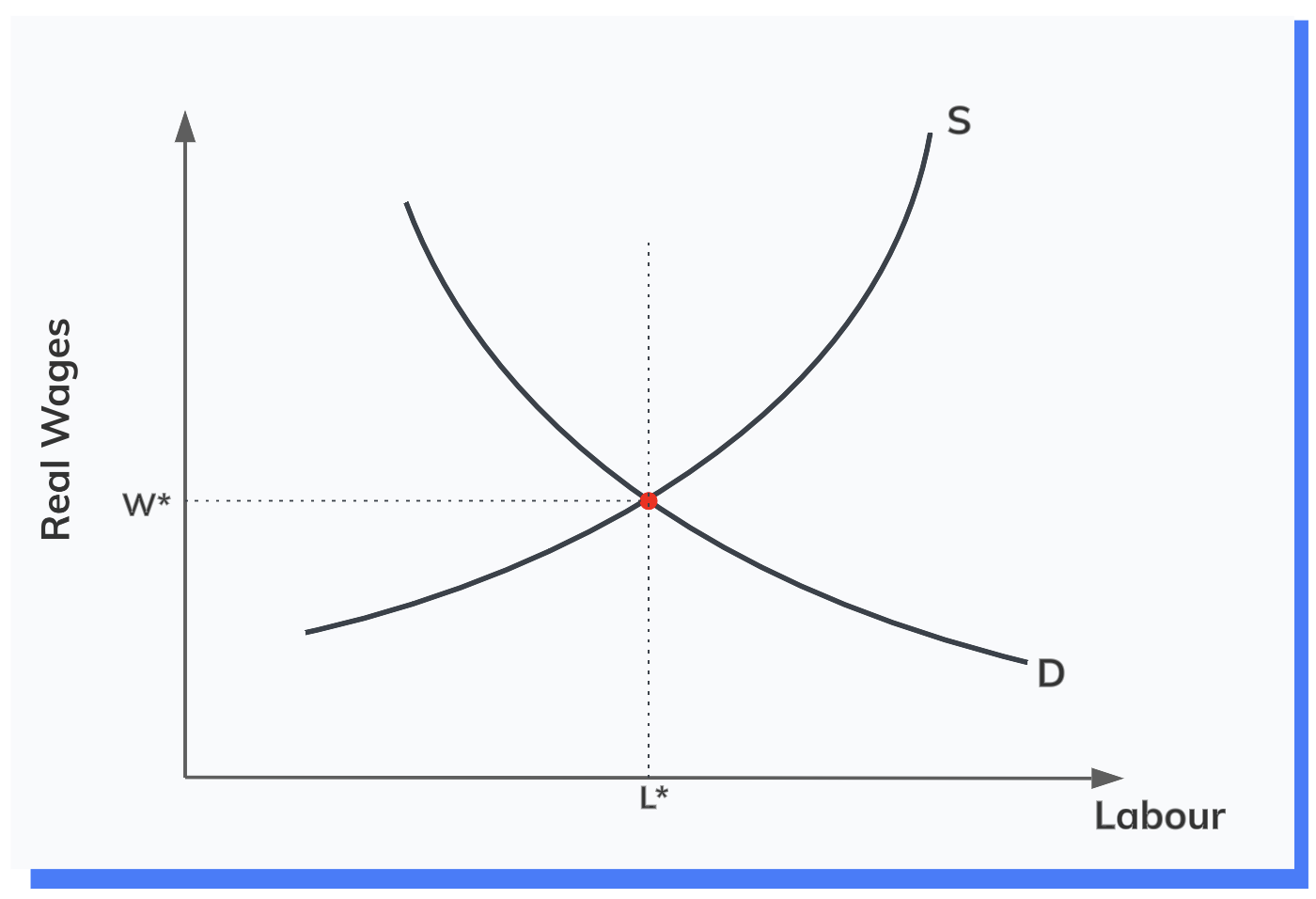
Market Clearing Theory
- Real wages adjust quickly to supply or demand shocks.
- Wages are perfectly flexible
- This implies that wages can adjust instantly and without any obstacles in response to changes in market conditions.
- Labour market clears quickly.
- Real GDP returns to potential GDP quickly.
- Unemployment rate is always equal to NAIRU
- There is no involuntary unemployment
- Unemployment is only caused by frictional or structural reasons and is voluntary.
Wize Concept
Involuntary unemployment: A person is willing to accept a job at the going wage but cannot find one due to market conditions.
Changes in Supply and Demand
- Demand for labour changes when technological changes affect the marginal product of labour.
- Supply for labour changes when individuals’ willingness to work changes.
Non-Market Clearing Theories
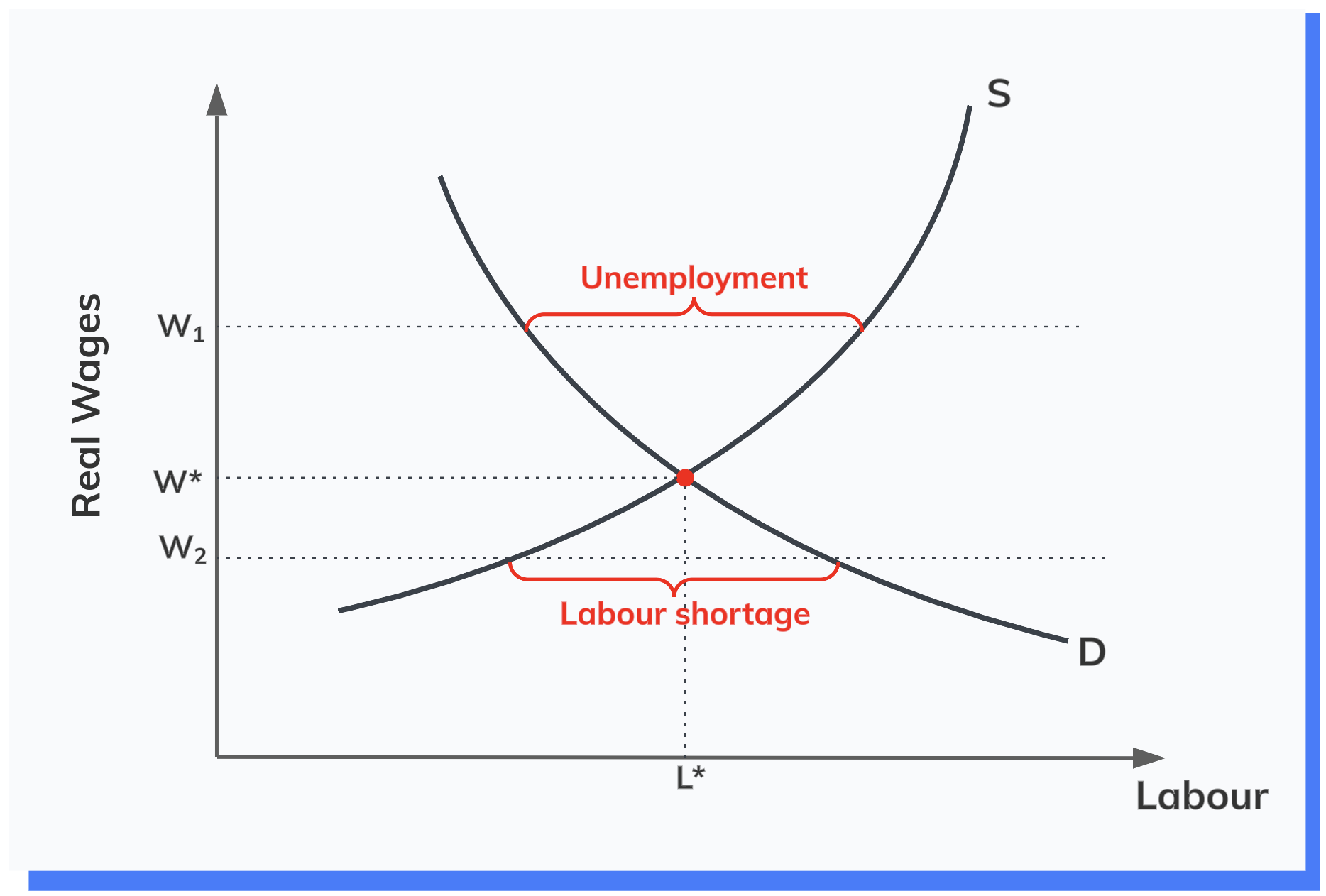
- Real wages adjust slowly to supply or demand shocks.
- Wages are sticky
- Labour market does not clear quickly.
- Unemployment can be involuntary (recessions)
- This is called cyclical unemployment
- Happens when going wage is above the market-clearing (equilibrium wage).
Changes to Supply and Demand
- When labour demand > labour supply: labour shortage
- When labour demand < labour supply: unemployment
Reducing Unemployment
Reducing Cyclical Unemployment
- Expansionary Monetary and fiscal policies
- Increase government spending
- Decrease taxes
- Decrease interest rate
- Increase the money supply
Reducing Frictional Unemployment
- Decrease benefits of unemployment insurance program.
- Create a national job bank to show available jobs across the country.
Reducing Structural Unemployment
- Programs to retrain and relocate individuals.
Practice Questions: Unemployment Fluctuations
1. Which of the following describes what economists sometimes call "voluntary unemployment"?
A) A job is available but the worker has not yet found it.
B) The level of real GDP is at or above the economy's potential output.
C) A person is willing to accept a job at the going wage rate but cannot find one.
D) A worker enters the job market for the first time.
E) A worker is not willing to accept an available job at the going wage rate.
2. Market-clearing theories of the labour market suggest that fluctuations in employment and wages can be caused by the supply side of the market through changes in the
A) price level.
B) level of net exports in the economy.
C) marginal efficiency of investment.
D) willingness of firms to hire workers.
E) willingness of workers to supply their labour.
The labour market in the diagram below begins in equilibrium with a real wage of $10 and quantity employed of 1000.
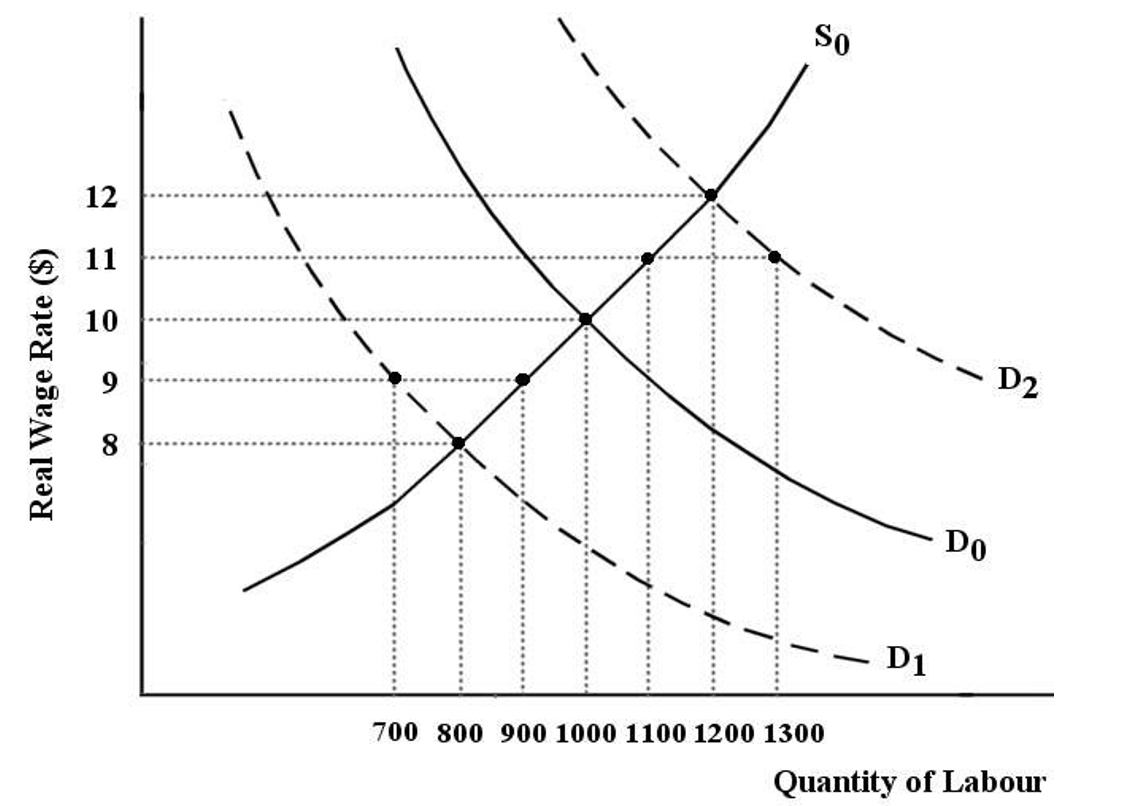
3. Given the labour supply and labour demand curves, D0 and S0, which of the following statements is true in the market-clearing theory of unemployment?
A) At any wage above $10, there is an excess demand for labour, and the wage will be driven down.
B) At any wage above $10, there is an excess supply of labour, and the wage will be driven down.
C) At any wage above $10, there is persistent, involuntary unemployment.
D) At any wage below $10, there is an excess supply of labour, and the wage will be driven up.
E) At any wage below $10, there is an excess demand for labour, and the wage will be driven down.
4. The economy begins with D0 and S0. Suppose there is a negative shock to the economy, which shifts the demand for labour curve to D1. In the market-clearing theory of unemployment,
A) wages would be sticky and would adjust downward to, perhaps $9, causing involuntary unemployment of 200 workers.
B) the wage rate would fall to $8, employment would fall to 800, causing involuntary unemployment of 200 workers.
C) wages would be sticky and would adjust downward to, perhaps $9, causing involuntary unemployment of 300 workers.
D) the wage rate would fall to $8, employment would fall to 800 and there would be no involuntary unemployment.
E) all markets would clear, causing the demand for labour curve to shift back to D0 and the wage rate and employment levels would return to their original levels.
5. The economy begins with D0 and S0. Suppose there is a negative shock to the economy, which shifts the demand for labour curve to D1. An outcome consistent with non-market-clearing theories of unemployment is
A) the wage rate would fall to $8, employment would fall to 800, causing involuntary unemployment of 200 workers.
B) wages would be sticky and would adjust downward to, perhaps $9, causing involuntary unemployment of 300 workers at that wage.
C) the wage rate would fall to $8, employment would fall to 800 and there would be no unemployment.
D) wages would be sticky and would adjust downward to, perhaps $9, causing involuntary unemployment of 200 workers at that wage.
E) all markets would clear, causing the demand for labour curve to shift back to D0 and the wage rate and employment levels would return to their original levels
6. In non-market-clearing theories of the labour market, an important explanation for the existence of involuntary unemployment is that labour markets exhibit
A) an elastic labour demand curve.
B) perfectly flexible wages.
C) rigid or sticky wages.
D) unshifting labour demand.
E) unshifting labour supply.